International
ADVANCED AND APPLIED SCIENCES
EISSN: 2313-3724, Print ISSN: 2313-626X
Frequency: 12


Volume 13, Issue 2 (February 2026), Pages: 178-185

----------------------------------------------
Original Research Paper
Obstacles to the adaptation of curriculum objectives and content for students with learning disabilities in Saudi Arabia
Author(s):
Affiliation(s):
Department of Special Education, College of Education, Imam Mohammad Ibn Saud Islamic University (IMSIU), Riyadh, Saudi Arabia
Full text

* Corresponding Author.
 Corresponding author's ORCID profile: https://orcid.org/0000-0002-5886-7200
Digital Object Identifier (DOI)
https://doi.org/10.21833/ijaas.2026.02.018
Abstract
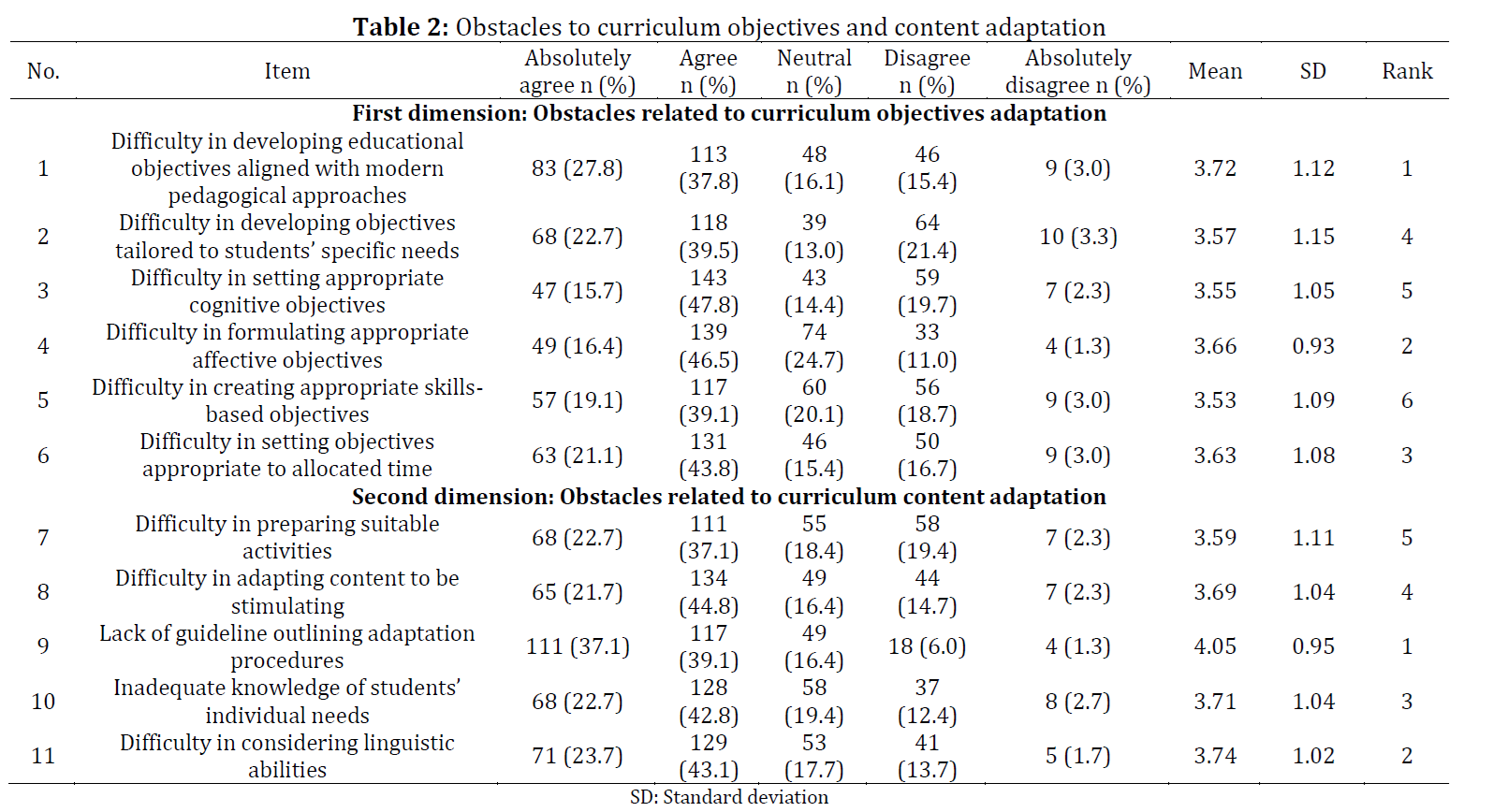
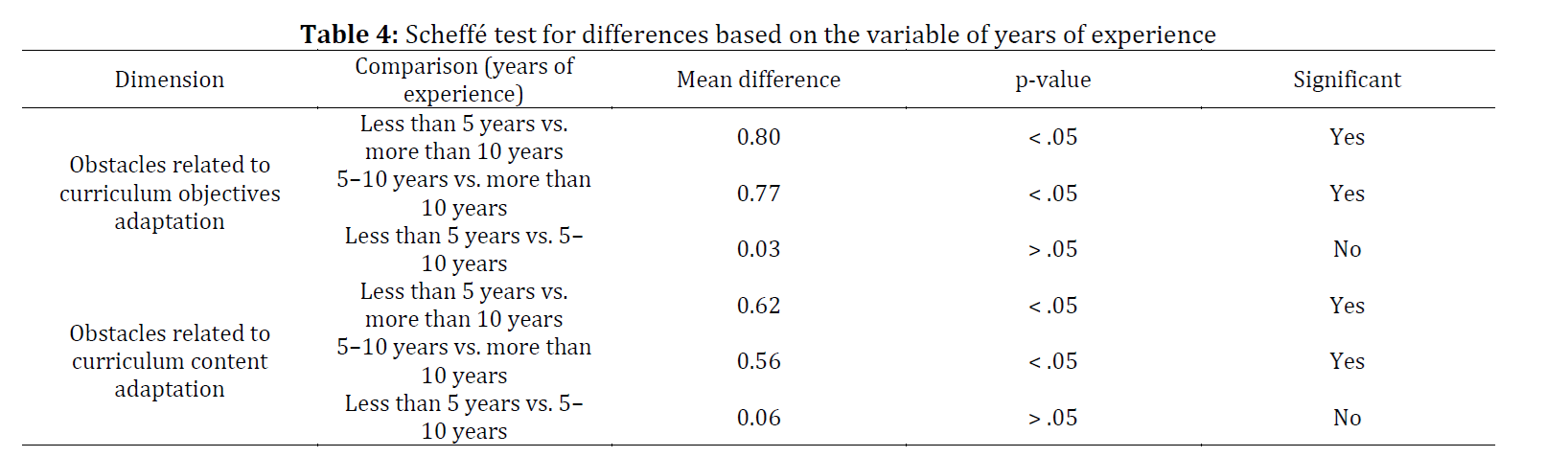
Curriculum adaptation of objectives and content plays an important role in improving the academic performance of students with learning disabilities and in achieving specific educational outcomes. Therefore, this study aims to examine the obstacles to adapting curriculum objectives and content from teachers’ perspectives. It also investigates whether there are significant differences in teachers’ views of these obstacles according to their years of experience, academic degree, and gender. The study adopts a descriptive survey method. A structured questionnaire was developed to collect data from a sample of 299 teachers working in public schools that offer learning disability programs in Riyadh, Saudi Arabia. The participants were selected using simple random sampling. The results indicate that teachers face several major obstacles in adapting curriculum objectives and content for students with learning disabilities. These obstacles were rated at a high level, with a mean score of 3.61 for curriculum objectives and 3.75 for curriculum content. The findings also show statistically significant differences in teachers’ responses based on years of experience, in favor of teachers with fewer years of experience. However, no statistically significant differences were found based on academic degree or gender.
© 2026 The Authors. Published by IASE.
This is an
Keywords
Adaptation, Objectives, Content, Curriculum, Learning disabilities
Article history
Received 19 September 2025, Received in revised form 3 February 2026, Accepted 16 February 2026
Acknowledgment
The authors would like to express their sincere gratitude to the teachers who generously shared their time and experiences to participate in this study.
Compliance with ethical standards
Ethical considerations:
Ethical approval was obtained from the Ethics Committee at Imam Mohammad Ibn Saud Islamic University (Approval No. 638623681656319867). Participation was voluntary, and informed consent was obtained from all participants. Confidentiality and anonymity were ensured.
Conflict of interest: The author(s) declared no potential conflicts of interest with respect to the research, authorship, and/or publication of this article.Citation:
Eltantawy MM, Alsudairy NA, and Aljihani SH (2026). Obstacles to the adaptation of curriculum objectives and content for students with learning disabilities in Saudi Arabia. International Journal of Advanced and Applied Sciences, 13(2): 178-185
Figures
No Figure
Tables
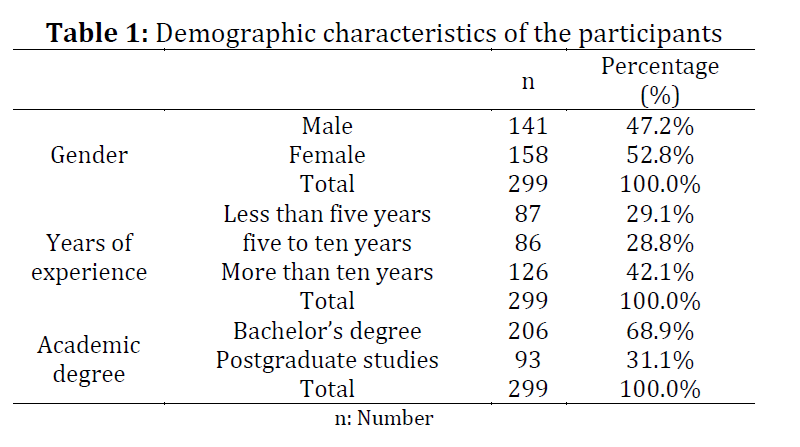
Table 1 Table 2 Table 3 Table 4 Table 5 Table 6



----------------------------------------------
References (19)
Ahmad NA and May YS (2018). Challenges in preparing teachers for inclusive education and its impact to students with learning disabilities. International Journal of Academic Research in Progressive Education & Development, 7(3): 569–581. https://doi.org/10.6007/IJARPED/v7-i3/4575 [Google Scholar]
Al-Busaidi S and Tuzlukova V (2018). Teachers’ perceptions of practices and challenges of innovating for the inclusion of special needs university English language learners in Oman. Journal of Educational and Psychological Studies, 12(4): 659-671. https://doi.org/10.53543/jeps.vol12iss4pp659-671 [Google Scholar]
Alhassan ARK and Abosi CO (2017). Teachers' pedagogical competence in adapting curricula for children with learning difficulties (LD) in primary schools in Ghana. Journal of the American Academy of Special Education Professionals, 12(2): 41-61. https://doi.org/10.64546/jaasep.336 [Google Scholar]
Alkhawaldeh MA and Khasawneh MAS (2022). Problems faced by English language teachers in teaching students with learning disabilities. Science and Education, 3(5): 677-687. [Google Scholar]
Collins SE, Clifasefi SL, Stanton J et al. (2018). Community-based participatory research (CBPR): Towards equitable involvement of community in psychology research. American Psychologist, 73(7): 884–898. https://doi.org/10.1037/amp0000167 [Google Scholar] PMid:29355352 PMCid:PMC6054913
Cortiella C and Horowitz SH (2014). The state of learning disabilities: Facts, trends and emerging issues. Third Edition, National Center for Learning Disabilities, New York, USA. [Google Scholar]
Deunk MI, Smale-Jacobse AE, de Boer H, Doolaard S, and Bosker RJ (2018). Effective differentiation practices: A systematic review and meta-analysis of studies on the cognitive effects of differentiation practices in primary education. Educational Research Review, 24: 31-54. https://doi.org/10.1016/j.edurev.2018.02.002 [Google Scholar]
Florian L (2015). Inclusive pedagogy: A transformative approach to individual differences but can it help reduce educational inequalities? Scottish Educational Review, 47(1): 5-14. https://doi.org/10.1163/27730840-04701003 [Google Scholar]
Florian L and Black-Hawkins K (2011). Exploring inclusive pedagogy. British Educational Research Journal, 37(5): 813-828. https://doi.org/10.1080/01411926.2010.501096 [Google Scholar]
Genovesi E, Jakobsson C, Nugent L, Hanlon C, and Hoekstra RA (2022). Stakeholder experiences, attitudes and perspectives on inclusive education for children with developmental disabilities in sub-Saharan Africa: A systematic review of qualitative studies. Autism, 26(7): 1606-1625. https://doi.org/10.1177/13623613221096208 [Google Scholar] PMid:35635316 PMCid:PMC9483198
Gibbs K (2023). Voices in practice: Challenges to implementing differentiated instruction by teachers and school leaders in an Australian mainstream secondary school. The Australian Educational Researcher, 50: 1217-1232. https://doi.org/10.1007/s13384-022-00551-2 [Google Scholar]
Gilson CB and Biggs EE (2024). Perspectives of special education teachers and paraprofessionals on working together in general education settings. International Journal of Inclusive Education, 28(14): 3341-3356. https://doi.org/10.1080/13603116.2023.2216206 [Google Scholar]
Guskey TR (2002). Professional development and teacher change. Teachers and Teaching, 8(3): 381-391. https://doi.org/10.1080/135406002100000512 [Google Scholar]
Mpofu J and Sefotho MM (2024). Challenges of competency-based curriculum in teaching learners with learning disabilities. African Journal of Disability, 13: 1268. https://doi.org/10.4102/ajod.v13i0.1268 [Google Scholar] PMid:38628957 PMCid:PMC11019064
Nilsen S (2017). Special education and general education–coordinated or separated? A study of curriculum planning for pupils with special educational needs. International Journal of Inclusive Education, 21(2): 205-217. https://doi.org/10.1080/13603116.2016.1193564 [Google Scholar]
Petersen A (2016). Perspectives of special education teachers on general education curriculum access: Preliminary results. Research and Practice for Persons with Severe Disabilities, 41(1): 19-35. https://doi.org/10.1177/1540796915604835 [Google Scholar]
Strnadová I, Danker J, Dowse L, and Tso M (2024). Supporting students with disability to improve academic, social and emotional, and self-determination and life-skills outcomes: Umbrella review of evidence-based practices. International Journal of Inclusive Education, 28(14): 3606-3622. https://doi.org/10.1080/13603116.2023.2221239 [Google Scholar]
Suprayogi MN, Valcke M, and Godwin R (2017). Teachers and their implementation of differentiated instruction in the classroom. Teaching and Teacher Education, 67: 291-301. https://doi.org/10.1016/j.tate.2017.06.020 [Google Scholar]
- UNESCO (2017). A guide for ensuring inclusion and equity in education. The United Nations Educational, Scientific and Cultural Organization, Paris, France. [Google Scholar]