International
ADVANCED AND APPLIED SCIENCES
EISSN: 2313-3724, Print ISSN: 2313-626X
Frequency: 12


Volume 13, Issue 3 (March 2026), Pages: 244-249

----------------------------------------------
Original Research Paper
Corporate governance compliance and disclosure: Insights from Pakistani listed firms
Author(s):
Affiliation(s):
1Effat College of Business, Effat University, Jeddah, Saudi Arabia
2Department of Management Sciences, COMSATS University Islamabad, Wah Campus, Wah Cantt, Pakistan
Full text

* Corresponding Author.
 Corresponding author's ORCID profile: https://orcid.org/0000-0003-0731-9260
Digital Object Identifier (DOI)
https://doi.org/10.21833/ijaas.2026.03.025
Abstract
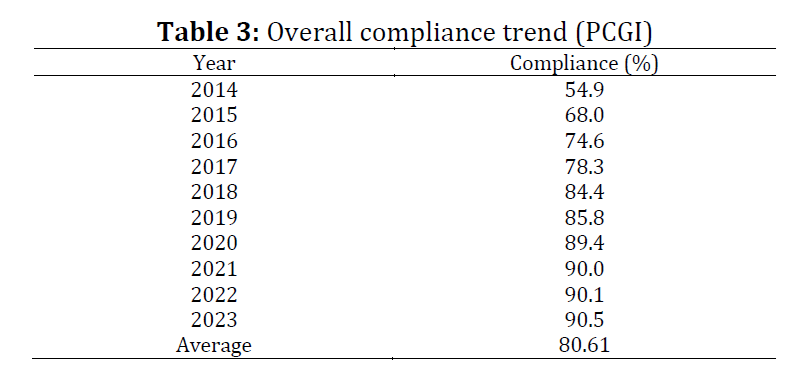
The objective of this study is to examine the impact of corporate governance compliance and disclosure on achieving a sustainable corporate reporting system in a developing country. Specifically, the study evaluates the level of corporate governance disclosure and compliance with the Pakistani Corporate Governance (CG) Code of 2013. A sample of 150 Pakistani firms was selected, and data were collected from their annual reports covering the period from 2014 to 2023. The analysis of the data shows several important findings. Over the ten-year period, Pakistani firms demonstrate a positive trend in corporate governance compliance and disclosure. The level of corporate governance improved after the revision of the CG Code in 2013, which contributed to more sustainable corporate governance practices and reporting. The findings suggest that stronger enforcement and monitoring of the 2013 Pakistani Corporate Governance Code could further improve transparency and sustainability in corporate reporting. Policymakers and regulators may use these results to design targeted reforms that maintain and strengthen the increasing trend of compliance among listed firms. Overall, the study provides empirical evidence of a decade-long improvement in corporate governance compliance and disclosure among Pakistani firms following the 2013 code revision, highlighting the important role of regulatory reforms in promoting sustainable corporate governance practices and improving reporting quality in emerging markets.
© 2026 The Authors. Published by IASE.
This is an
Keywords
Corporate governance compliance, Corporate governance disclosure, Sustainable corporate reporting, Corporate governance code, Emerging markets
Article history
Received 12 August 2025, Received in revised form 7 March 2026, Accepted 22 March 2026
Acknowledgment
The author acknowledges the support of Effat University, Jeddah, for providing the time, facilities, and academic environment necessary to complete this research. I also extend my appreciation to COMSATS University Islamabad, Wah Campus, for their valuable resources and institutional cooperation that contributed to the successful development of this work.
Compliance with ethical standards
Conflict of interest: The author(s) declared no potential conflicts of interest with respect to the research, authorship, and/or publication of this article.Citation:
Khan MY (2026). Corporate governance compliance and disclosure: Insights from Pakistani listed firms. International Journal of Advanced and Applied Sciences, 13(3): 244-249
Figures
No Figure
Tables
----------------------------------------------
References (31)
Adelopo I (2011). Voluntary disclosure practices amongst listed companies in Nigeria. Advances in Accounting, 27(2): 338-345. https://doi.org/10.1016/j.adiac.2011.08.009 [Google Scholar]
Aguilera RV and Cuervo‐Cazurra A (2009). Codes of good governance. Corporate Governance: An International Review, 17(3): 376-387. https://doi.org/10.1111/j.1467-8683.2009.00737.x [Google Scholar]
Albu CN and Girbina MM (2015). Compliance with corporate governance codes in emerging economies. How do Romanian listed companies “comply-or-explain”? Corporate Governance, 15(1): 85-107. https://doi.org/10.1108/CG-07-2013-0095 [Google Scholar]
Allegrini M and Greco G (2013). Corporate boards, audit committees and voluntary disclosure: Evidence from Italian listed companies. Journal of Management & Governance, 17: 187-216. https://doi.org/10.1007/s10997-011-9168-3 [Google Scholar]
Al-Malkawi HAN, Pillai R, and Bhatti MI (2014). Corporate governance practices in emerging markets: The case of GCC countries. Economic Modelling, 38: 133-141. https://doi.org/10.1016/j.econmod.2013.12.019 [Google Scholar]
Eisenberg T, Sundgren S, and Wells MT (1998). Larger board size and decreasing firm value in small firms. Journal of Financial Economics, 48(1): 35-54. https://doi.org/10.1016/S0304-405X(98)00003-8 [Google Scholar]
Haniffa R and Hudaib M (2006). Corporate governance structure and performance of Malaysian listed companies. Journal of Business Finance & Accounting, 33(7‐8): 1034-1062. https://doi.org/10.1111/j.1468-5957.2006.00594.x [Google Scholar]
Hegazy MA and Hegazy K (2010). Corporate governance in the UK: Audit committees and disclosure arrangements - A web-based analysis. Journal of Business Studies Quarterly, 1(2): 32-55. https://doi.org/10.2139/ssrn.1597893 [Google Scholar]
Hooghiemstra R (2012). What determines the informativeness of firms' explanations for deviations from the Dutch corporate governance code? Accounting and Business Research, 42(1): 1-27. https://doi.org/10.1080/00014788.2011.600630 [Google Scholar]
Hussainey K and Al‐Najjar B (2012). Understanding the determinants of RiskMetrics/ISS Ratings of the quality of UK companies' corporate governance practice. Canadian Journal of Administrative Sciences / Revue Canadienne des Sciences de l'Administration, 29(4): 366-377. https://doi.org/10.1002/cjas.1227 [Google Scholar]
Javed AY and Iqbal R (2007). Relationship between corporate governance indicators and firm value: A case study of Karachi stock exchange. Working Papers 2007:14, Pakistan Institute of Development Economics, Islamabad, Pakistan. [Google Scholar]
Javid AY and Iqbal R (2008). Ownership concentration, corporate governance and firm performance: Evidence from Pakistan. The Pakistan Development Review, 47(4): 643-659. https://doi.org/10.30541/v47i4IIpp.643-659 [Google Scholar]
Javid AY and Iqbal R (2010). Corporate governance in Pakistan: Corporate valuation, ownership and financing. Working Papers 2010: 57, Pakistan Institute of Development Economics, Islamabad, Pakistan. [Google Scholar]
Judge WQ (2011). What level of analysis is most salient for a global theory of corporate governance? Corporate Governance: An International Review, 19(2): 97-98. https://doi.org/10.1111/j.1467-8683.2010.00841.x [Google Scholar]
Khan A, Bhatti R, and Khan A (2016a). E-books usage by agricultural, engineering and social science students in selected universities of Pakistan: An empirical assessment. The Electronic Library, 34(6): 958-973. https://doi.org/10.1108/EL-08-2015-0163 [Google Scholar]
Khan M, Serafeim G, and Yoon A (2016b). Corporate sustainability: First evidence on materiality. The Accounting Review, 91(6): 1697-1724. https://doi.org/10.2308/accr-51383 [Google Scholar]
Khan MY (2016). Corporate governance and cost of capital: Evidence from Pakistani listed firms. Ph.D. Dissertation, University of Glasgow, Glasgow, Scotland. [Google Scholar]
Khan MY (2025). Corporate governance and financial reporting transparency: Evidence from an emerging market. In: Hamdan RK (Ed.), Integrating big data and IoT for enhanced decision-making systems in business. Studies in Big Data, 177: 631-640. Springer, Cham, Switzerland. https://doi.org/10.1007/978-3-031-97609-4_53 [Google Scholar]
Khan MY, Javeed A, Cuong LK, and Pham H (2020). Corporate governance and cost of capital: Evidence from emerging market. Risks, 8(4): 104. https://doi.org/10.3390/risks8040104 [Google Scholar]
Krambia‐Kapardis M and Psaros J (2006). The implementation of corporate governance principles in an emerging economy: A critique of the situation in Cyprus. Corporate Governance: An International Review, 14(2): 126-139. https://doi.org/10.1111/j.1467-8683.2006.00492.x [Google Scholar]
Ntim CG and Soobaroyen T (2013). Corporate governance and performance in socially responsible corporations: New empirical insights from a neo‐institutional framework. Corporate Governance: An International Review, 21(5): 468-494. https://doi.org/10.1111/corg.12026 [Google Scholar]
Ntim CG, Opong KK, and Danbolt J (2012). The relative value relevance of shareholder versus stakeholder corporate governance disclosure policy reforms in South Africa. Corporate Governance: An International Review, 20(1): 84-105. https://doi.org/10.1111/j.1467-8683.2011.00891.x [Google Scholar]
Pass C (2006). The revised combined code and corporate governance: An empirical survey of 50 large UK companies. Managerial Law, 48(5): 467-478. https://doi.org/10.1108/03090550610715963 [Google Scholar]
Salterio SE, Conrod JE, and Schmidt RN (2013). Canadian evidence of adherence to “comply or explain” corporate governance codes: An international comparison. Accounting Perspectives, 12(1): 23-51. https://doi.org/10.1111/1911-3838.12006 [Google Scholar]
Samaha K, Dahawy K, Hussainey K, and Stapleton P (2012). The extent of corporate governance disclosure and its determinants in a developing market: The case of Egypt. Advances in Accounting, 28(1): 168-178. https://doi.org/10.1016/j.adiac.2011.12.001 [Google Scholar]
Schiehll E, Terra PRS, and Victor FG (2013). Determinants of voluntary executive stock option disclosure in Brazil. Journal of Management & Governance, 17: 331-361. https://doi.org/10.1007/s10997-011-9179-0 [Google Scholar]
Shleifer A and Vishny RW (1997). A survey of corporate governance. The Journal of Finance, 52(2): 737-783. https://doi.org/10.1111/j.1540-6261.1997.tb04820.x [Google Scholar]
Solomon J (2007). Corporate governance and accountability. John Wiley and Sons, Hoboken, USA. [Google Scholar]
Tariq YB and Abbas Z (2013). Compliance and multidimensional firm performance: Evaluating the efficacy of rule-based code of corporate governance. Economic Modelling, 35: 565-575. https://doi.org/10.1016/j.econmod.2013.08.015 [Google Scholar]
Tsamenyi M, Enninful‐Adu E, and Onumah J (2007). Disclosure and corporate governance in developing countries: Evidence from Ghana. Managerial Auditing Journal, 22(3): 319-334. https://doi.org/10.1108/02686900710733170 [Google Scholar]
- Uma S and Roger B (2003). Research methods for business: A skill building approach. 4th Edition, John Wiley and Sons, Hoboken, USA. [Google Scholar]