International
ADVANCED AND APPLIED SCIENCES
EISSN: 2313-3724, Print ISSN: 2313-626X
Frequency: 12


Volume 13, Issue 3 (March 2026), Pages: 190-197

----------------------------------------------
Original Research Paper
Conceptual framework for speech audiometry materials in the Saudi Arabic dialect
Author(s):
Affiliation(s):
Department of Rehabilitation Health Sciences, College of Applied Medical Sciences, King Saud University, Riyadh, Saudi Arabia
Full text

* Corresponding Author.
 Corresponding author's ORCID profile: https://orcid.org/0009-0007-6082-7527
Digital Object Identifier (DOI)
https://doi.org/10.21833/ijaas.2026.03.019
Abstract
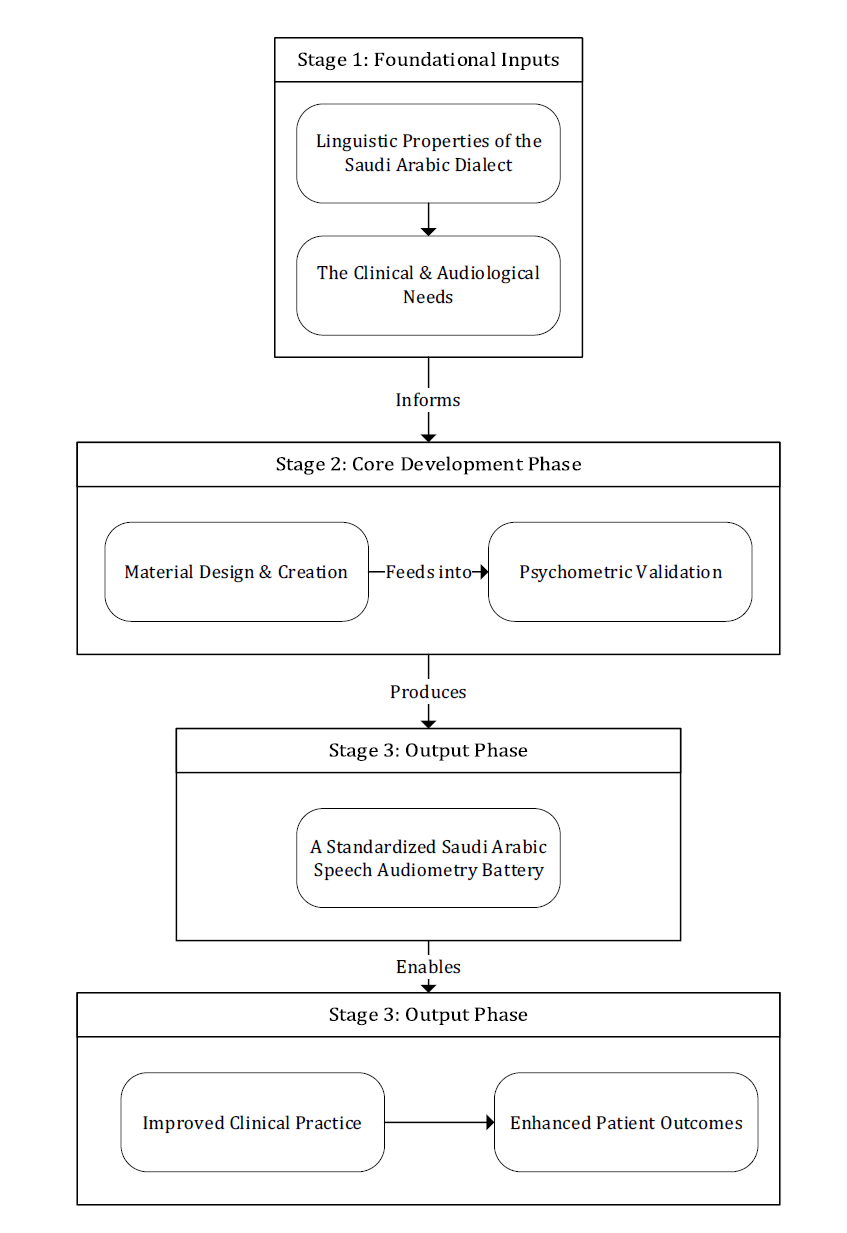
Speech audiometry plays an important role in comprehensive hearing assessment; however, standardized materials designed for the Saudi Arabic dialect are currently unavailable. This study proposes a conceptual framework to guide the development of culturally and linguistically appropriate speech audiometry materials. A systematic literature review covering the period from 2004 to 2025 was conducted following PRISMA guidelines, and Design Science Research principles were applied to structure the framework. The proposed framework consists of four stages: (1) foundational linguistic and clinical analysis, (2) development and validation of core materials, (3) production of standardized assessment tools, and (4) implementation for clinical application and outcomes. The framework addresses key gaps in audiological practice in Saudi Arabia by providing a structured and evidence-based approach to developing ecologically valid assessment tools. It offers a systematic process that moves from identifying the problem to developing practical solutions, with the goal of improving diagnostic accuracy, rehabilitation effectiveness, and patient outcomes within the diverse linguistic context of Saudi Arabia.
© 2026 The Authors. Published by IASE.
This is an
Keywords
Speech audiometry, Saudi Arabic dialect, Hearing assessment, Audiology materials development, Clinical audiology
Article history
Received 4 November 2025, Received in revised form 10 March 2026, Accepted 13 March 2026
Acknowledgment
No Acknowledgment.
Compliance with ethical standards
Conflict of interest: The author(s) declared no potential conflicts of interest with respect to the research, authorship, and/or publication of this article.Citation:
Alkhamees AH (2026). Conceptual framework for speech audiometry materials in the Saudi Arabic dialect. International Journal of Advanced and Applied Sciences, 13(3): 190-197
Figures
Tables
----------------------------------------------
References (21)
Abdulkader D (2024). Characterizing speech sound productions in Saudi Arabic and English bilingual children: Culturally informed and sensitive instrumental methods. Ph.D. Dissertation, University of Cincinnati, Cincinnati, USA. [Google Scholar]
Al Matar W (2021). Speech audiometry: Arabic word recognition test for adults. Ph.D. Dissertation, Kent State University, Kent, USA. [Google Scholar]
Alanazi AA (2017). Audiology and speech-language pathology practice in Saudi Arabia. International Journal of Health Sciences, 11(5): 43-55. [Google Scholar]
Alanazi AA (2024). Tinnitus prevalence, associated characteristics, and treatment patterns among adults in Saudi Arabia. Audiology Research, 14(5): 760-777. https://doi.org/10.3390/audiolres14050064 [Google Scholar] PMid:39311217 PMCid:PMC11417728
Alanazi AA, ALHarbi MF, AlMutairi AM, AlRashied MA, and Abed R (2024a). Awareness of audiology and speech-language pathology services among healthcare professionals in Saudi Arabia. South African Journal of Communication Disorders, 71(1): a1043. https://doi.org/10.4102/sajcd.v71i1.1043 [Google Scholar] PMid:38949430 PMCid:PMC11219645
Alanazi AA, Almutairi RA, Alsuhaibani KS, Alruwaily Y, Alqudiey HA, Alabbas MA, and Alanazi SR (2024b). Exploration of preschool hearing screening at primary healthcare centers in Riyadh, Saudi Arabia: A cross-sectional study. Journal of Otology, 19(4): 214-219. https://doi.org/10.1016/j.joto.2024.10.001 [Google Scholar] PMid:39776543 PMCid:PMC11701338
Alfakir R, Hammady M, Afghah T, Abd Al-Ghaffar M, and Youssif M (2025). Translation, cultural adaptation, and validation of the HEAR-COMMAND Tool–Arabic: A self-rated ICF-based questionnaire for assessing hearing, communication, and conversation disability in Arabic-speaking populations. The Egyptian Journal of Otolaryngology, 41(1): 101-112. https://doi.org/10.1186/s43163-025-00832-4 [Google Scholar]
Alharbi FA and Ahmed MR (2015). Evaluation of hearing among kindergarten children in Jazan (Kingdom of Saudi Arabia). Interventional Medicine and Applied Science, 7(3): 91-94. https://doi.org/10.1556/1646.7.2015.3.1 [Google Scholar] PMid:26527196 PMCid:PMC4609019
Alkahtani RA (2020). Assessment of sensorineural hearing loss in children in the Kingdom of Saudi Arabia. Ph.D. Dissertation, University of Southampton, Southampton, UK. [Google Scholar]
Alkhamees A, Bryan K, and Mahon M (2016). Development of an auditory rehabilitation training programme for hearing impaired adults in Saudi Arabia. Journal of Health Science, 4(6): 304–317. https://doi.org/10.17265/2328-7136/2016.06.004 [Google Scholar]
Alothman NI and Alanazi AA (2024). School-based hearing screening of first-grade students in Saudi Arabia: A pilot study. South African Journal of Communication Disorders, 71(1): a1063. https://doi.org/10.4102/sajcd.v71i1.1063 [Google Scholar] PMid:39625087 PMCid:PMC11622043
Alsebai SZ (2024). Assessment of speech recognition and quality of effusion in Arabic children. Ph.D. Dissertation, University of Southampton, Southampton, UK. [Google Scholar]
Alshamrani R, Altheeb F, Almasaoud H, Alghamdi A, Latif R, Rafique N, and Sulaiman AA (2022). The effect of various patterns of personal listening devices on hearing among university students in Saudi Arabia. Acta Informatica Medica, 30(3): 225-229. https://doi.org/10.5455/aim.2022.30.225-229 [Google Scholar] PMid:36311152 PMCid:PMC9560056
Hevner AR, March ST, Park J, and Ram S (2004). Design science in information systems research. MIS Quarterly, 28(1): 75-105. https://doi.org/10.2307/25148625 [Google Scholar]
Honu-Mensah CM (2015). Development and evaluation of psychometrically equivalent trisyllabic words for speech audiometry in Fante. Ph.D. Dissertation, University of Ghana, Accra, Ghana. [Google Scholar]
Hull M (2016). Medical language proficiency: A discussion of interprofessional language competencies and potential for patient risk. International Journal of Nursing Studies, 54: 158-172. https://doi.org/10.1016/j.ijnurstu.2015.02.015 [Google Scholar] PMid:25863658
Parmar B and Rajasingam S (2023). Adult speech testing in the UK. ENT & Audiology News, 32(2): 32-34. [Google Scholar]
Parmar BJ, Rajasingam SL, Bizley JK, and Vickers DA (2022). Factors affecting the use of speech testing in adult audiology. American Journal of Audiology, 31(3): 528-540. https://doi.org/10.1044/2022_AJA-21-00233 [Google Scholar] PMid:35737980 PMCid:PMC7613483
Rayes HHH (2021). The development and evaluation of the hearing intervention battery in Arabic (HIBA) for auditory perception in children with cochlear implants. Ph.D. Dissertation, University College London, London, UK. [Google Scholar]
Sarkis-Onofre R, Catalá-López F, Aromataris E, and Lockwood C (2021). How to properly use the PRISMA statement. Systematic Reviews, 10: 117. https://doi.org/10.1186/s13643-021-01671-z [Google Scholar] PMid:33875004 PMCid:PMC8056687
- Yousef M, Mesallam T, Abdelsamad Y, Alkhamiss S, Alotaibi T, Alsanosi S, and Alsanosi A (2024). Development and cultural adaptation of the Saudi pediatric speech intelligibility test. Saudi Medical Journal, 45(11): 1260-1264. https://doi.org/10.15537/smj.2024.45.11.20240539 [Google Scholar] PMid:39510566 PMCid:PMC11549608