International
ADVANCED AND APPLIED SCIENCES
EISSN: 2313-3724, Print ISSN: 2313-626X
Frequency: 12


Volume 13, Issue 3 (March 2026), Pages: 174-179

----------------------------------------------
Original Research Paper
Improving Grade 9 students’ mathematics achievement in similarity through game-based learning
Author(s):
Affiliation(s):
1Faculty of Education, Mahasarakham University, Kham Riang, Thailand
2Department of Mathematics, Triam Udomsuksa Pattanakan Roiet, Roi Et, Thailand
Full text

* Corresponding Author.
 Corresponding author's ORCID profile: https://orcid.org/0000-0001-6182-7333
Digital Object Identifier (DOI)
https://doi.org/10.21833/ijaas.2026.03.017
Abstract
The purpose of this study was to develop game-based learning lesson plans on the concept of similarity for Grade 9 mathematics, evaluate students’ learning achievement before and after instruction, and examine their satisfaction with this approach. The study employed a quasi-experimental one-group pretest–posttest design. The participants consisted of 11 Grade 9 students from Triam Udomsuksa Pattanakan Roi Et School. The research instruments included nine game-based lesson plans, an achievement test, and a satisfaction questionnaire. Data were analyzed using the Wilcoxon Signed Ranks Test, along with percentage, mean, and standard deviation. The results indicated that students’ posttest scores were significantly higher than their pretest scores at the 0.05 significance level. In addition, the students’ overall satisfaction with the game-based learning approach was at the highest level. This study contributes empirical evidence supporting the effectiveness of game-based learning as a pedagogical approach for improving both academic achievement and student engagement in secondary mathematics.
© 2026 The Authors. Published by IASE.
This is an
Keywords
Game-based learning, Mathematics education, Similarity concept, Learning achievement, Student satisfaction
Article history
Received 30 October 2025, Received in revised form 10 March 2026, Accepted 12 March 2026
Acknowledgment
The study was supported by Mahasarakham University, Thailand.
Compliance with ethical standards
Ethical considerations:
This study adhered to ethical standards for research involving human participants. As the participants were minors, informed consent was obtained from both the students and their parents or legal guardians prior to participation. Participation was entirely voluntary, and students were informed of their right to withdraw from the study at any time without penalty. All data were collected and reported anonymously to ensure participants’ privacy and confidentiality.
Conflict of interest: The author(s) declared no potential conflicts of interest with respect to the research, authorship, and/or publication of this article.Citation:
Soontharin P, Boonsa J, and Poonputta A (2026). Improving Grade 9 students’ mathematics achievement in similarity through game-based learning. International Journal of Advanced and Applied Sciences, 13(3): 174-179
Figures
No Fifure
Tables
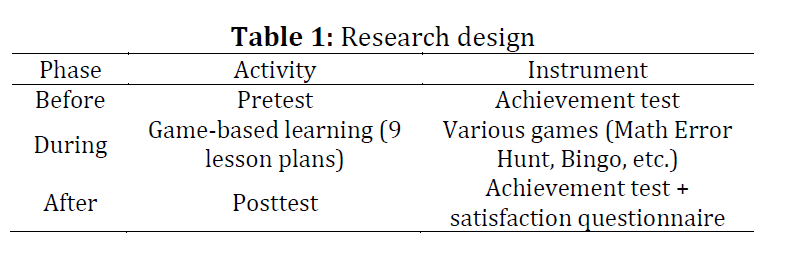
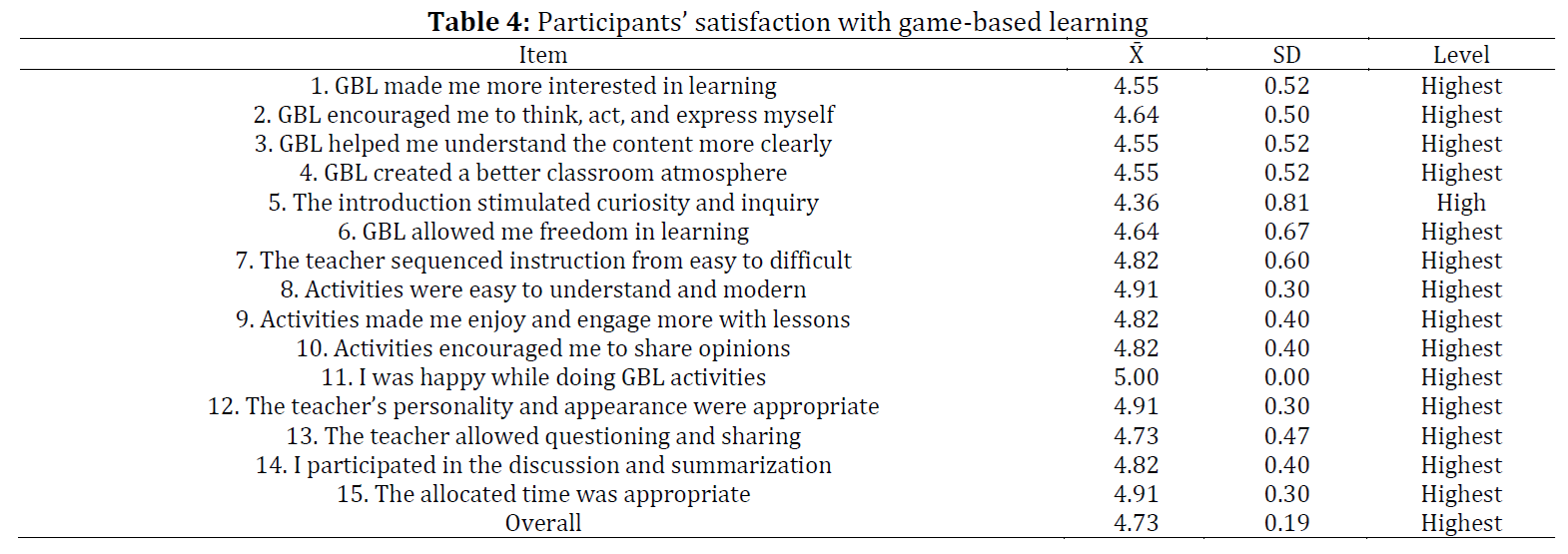
Table 1 Table 2 Table 3 Table 4


----------------------------------------------
References (26)
Adams E (2014). Fundamentals of game design. Pearson Education, London, UK. [Google Scholar]
Akman E and Çakır R (2023). The effect of educational virtual reality game on primary school students’ achievement and engagement in mathematics. Interactive Learning Environments, 31(3): 1467-1484. https://doi.org/10.1080/10494820.2020.1841800 [Google Scholar]
Alt D (2023). Assessing the benefits of gamification in mathematics for student gameful experience and gaming motivation. Computers & Education, 200: 104806. https://doi.org/10.1016/j.compedu.2023.104806 [Google Scholar]
Chen CC and Tu HY (2021). The effect of digital game-based learning on learning motivation and performance under social cognitive theory and entrepreneurial thinking. Frontiers in Psychology, 12: 750711. https://doi.org/10.3389/fpsyg.2021.750711 [Google Scholar] PMid:34975642 PMCid:PMC8716945
Csikszentmihalyi M (1990). Flow: The psychology of optimal experience. Harper and Row, New York, USA. [Google Scholar]
Deci EL and Ryan RM (1985). Conceptualizations of intrinsic motivation and self-determination. In: Deci EL and Ryan RM (Eds.), Intrinsic motivation and self-determination in human behavior: 11-40. Springer, Boston, USA. https://doi.org/10.1007/978-1-4899-2271-7_2 [Google Scholar]
Farber M (2015). Gamify your classroom: A field guide to game-based learning. Peter Lang, New York, USA. https://doi.org/10.3726/978-1-4539-1459-5 [Google Scholar]
Greenwald S and Thomley J (2024). Mathematical similarity. EBSCO Information Services, Ipswich, USA. Available online at: https://www.ebsco.com/research-starters/physics/mathematical-similarity
Grigoriadou VJ, Coutelieris FA, and Theologou K (2021). History of the concept of similarity in natural sciences. Conatus - Journal of Philosophy, 6(1): 101-123. https://doi.org/10.12681/cjp.22955 [Google Scholar]
Gupta P and Goyal P (2022). Is game-based pedagogy just a fad? A self-determination theory approach to gamification in higher education. International Journal of Educational Management, 36(3): 341-356. https://doi.org/10.1108/IJEM-04-2021-0126 [Google Scholar]
Hellerstedt A and Mozelius P (2019). Game-based learning: A long history. In the Irish Conference on Game-based Learning, Cork, Ireland: 1-4. [Google Scholar]
Herbst P, Fujita T, Halverscheid S, and Weiss M (2017). The learning and teaching of geometry in secondary schools: A modeling perspective. 1st Edition, Routledge, London, UK. https://doi.org/10.4324/9781315267593 [Google Scholar]
Hu Z (2024). Game-based learning: Alternative approaches to teaching and learning strategies in health sciences education. Educational Process: International Journal, 13(2): 90-104. https://doi.org/10.22521/edupij.2024.132.6 [Google Scholar]
Hui HB and Mahmud MS (2023). Influence of game-based learning in mathematics education on the students' cognitive and affective domain: A systematic review. Frontiers in Psychology, 14: 1105806. https://doi.org/10.3389/fpsyg.2023.1105806 [Google Scholar] PMid:37057144 PMCid:PMC10086333
Hussein MH, Ow SH, Elaish MM, and Jensen EO (2022). Digital game-based learning in K-12 mathematics education: A systematic literature review. Education and Information Technologies, 27: 2859-2891. https://doi.org/10.1007/s10639-021-10721-x [Google Scholar]
İlhan A (2021). The impact of game-based, modeling, and collaborative learning methods on the achievements, motivations, and visual mathematical literacy perceptions. SAGE Open, 11(1). https://doi.org/10.1177/21582440211003567 [Google Scholar]
Johnson EK and Salter A (2022). Playful pedagogy in the pandemic: Pivoting to game-based learning. 1st Edition, Routledge, London, UK. https://doi.org/10.4324/9781003281696 [Google Scholar]
Jones K (2002). Issues in the teaching and learning of geometry. In Haggarty L (Ed.), Aspects of teaching secondary mathematics: Perspectives on practice: 121–139. 1st Edition, Routledge, London, UK. [Google Scholar]
Juman ZAMS, Mathavan M, Ambegedara AS, and Udagedara IG (2022). Difficulties in learning geometry component in mathematics and active-based learning methods to overcome the difficulties. Shanlax International Journal of Education, 10(2): 41-58. https://doi.org/10.34293/education.v10i2.4299 [Google Scholar]
Rosenthal R (1991). Meta-analytic procedures for social research. SAGE Publications, Thousand Oaks, USA. https://doi.org/10.4135/9781412984997 [Google Scholar]
Su C and Hsaio KC (2015). Developing and evaluating gamifying learning system by using flow-based model. Eurasia Journal of Mathematics, Science and Technology Education, 11(6): 1283-1306. https://doi.org/10.12973/eurasia.2015.1386a [Google Scholar]
Tiengyoo K, Sotaro S, and Thaithae S (2024). Exploring factors influencing 21st century mathematics in Thai secondary schools: A study in Lopburi Province. Pedagogical Research, 9(3): em0217. https://doi.org/10.29333/pr/14731 [Google Scholar] PMid:26435059
Ting GLC, Eng TH, Li LS, and Idris HBM (2023). A comparison study between active and passive students in intensive mathematics I course. Open Journal of Social Sciences, 11(5): 105-117. https://doi.org/10.4236/jss.2023.115009 [Google Scholar]
Vankúš P (2021). Influence of game-based learning in mathematics education on students’ affective domain: A systematic review. Mathematics, 9(9): 986. https://doi.org/10.3390/math9090986 [Google Scholar]
Vygotsky LS (1978). Mind in society: The development of higher psychological processes. Harvard University Press, Cambridge, USA. [Google Scholar]
- Whitney DR and Sabers DL (1970). Improving essay examination III: Use of item analysis. Technical Bulletin No. 11, University Evaluation and Examination Service, Iowa City, USA. [Google Scholar]