
International
ADVANCED AND APPLIED SCIENCES
EISSN: 2313-3724, Print ISSN: 2313-626X
Frequency: 12


Volume 13, Issue 3 (March 2026), Pages: 86-94

----------------------------------------------
Original Research Paper
Integrating AI, IoT, and blockchain into enterprise architecture: A model of readiness, integration capability, and value creation
Author(s):
Affiliation(s):
Management Information Systems, University of Jeddah, Jeddah, Saudi Arabia
Full text

* Corresponding Author.
 Corresponding author's ORCID profile: https://orcid.org/0009-0004-0025-6492
Digital Object Identifier (DOI)
https://doi.org/10.21833/ijaas.2026.03.009
Abstract
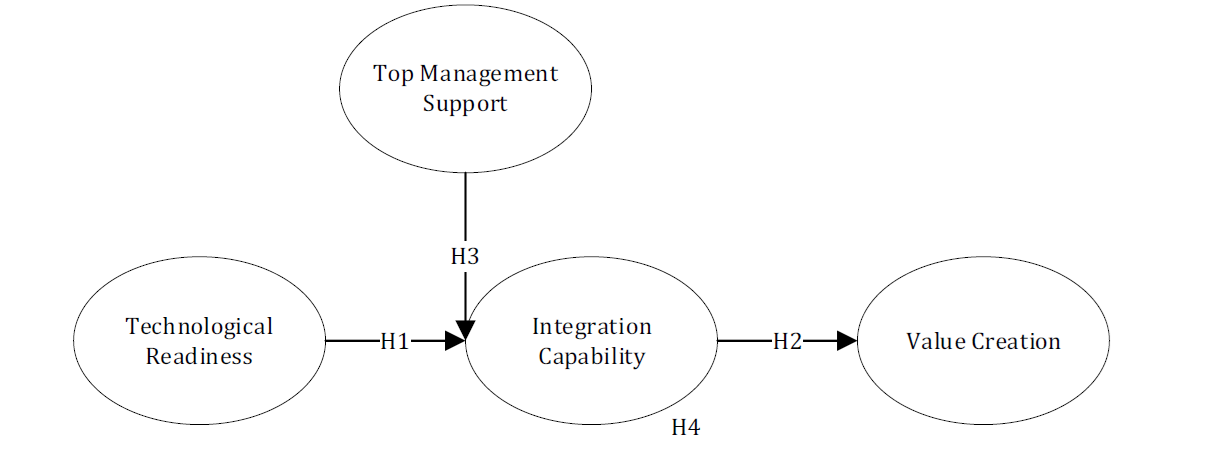
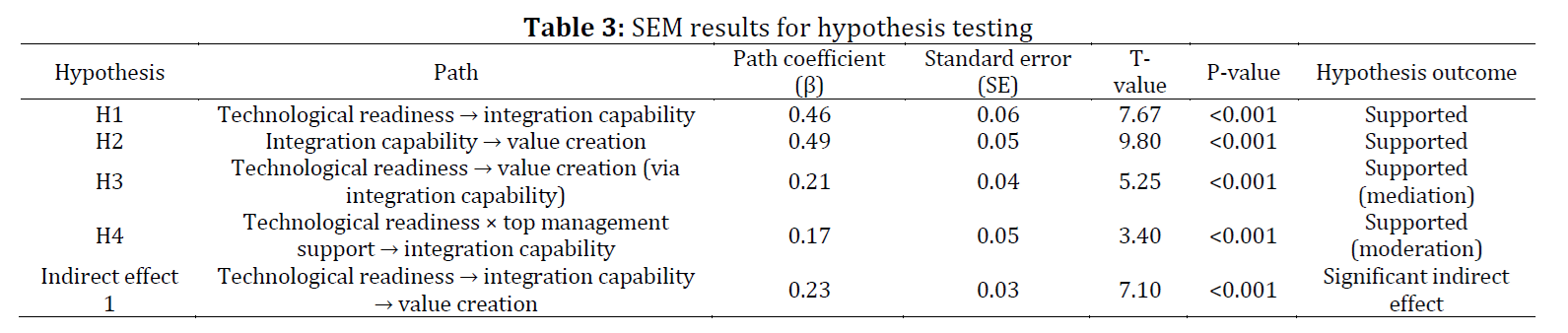
The rapid convergence of Artificial Intelligence (AI), the Internet of Things (IoT), and Blockchain is transforming enterprise architecture (EA) and changing how organizations create value. However, there is limited empirical research explaining how technological readiness and managerial conditions help firms effectively integrate these technologies within EA frameworks. Based on the Technology–Organization–Environment (TOE) framework, the Resource-Based View (RBV), and Dynamic Capabilities Theory, this study develops and tests a model that links technological readiness, integration capability, top management support, and value creation. A quantitative cross-sectional survey was conducted, and data were collected from IT and enterprise architecture professionals across different industries. Structural equation modeling (SEM) was used to test the proposed relationships. The results show that technological readiness significantly improves integration capability, which then increases organizational value through greater efficiency, innovation, and agility. In addition, top management support moderates the relationship between technological readiness and integration capability, strengthening the positive effect of technological readiness. This study contributes to the literature on digital transformation and enterprise architecture by providing a simple and empirically validated framework for integrating emerging technologies into enterprise systems. The findings also offer practical guidance for managers to prioritize technological readiness and leadership support in order to maximize value from new technologies.
© 2026 The Authors. Published by IASE.
This is an
Keywords
Artificial intelligence integration, Enterprise architecture, Technological readiness, Integration capability, Organizational value creation
Article history
Received 10 October 2025, Received in revised form 4 March 2026, Accepted 8 March 2026
Acknowledgment
No Acknowledgment.
Compliance with ethical standards
Ethical considerations:
The data for this study were collected using a questionnaire administered to voluntary participants. Respondents were informed about the purpose of the study, and participation was entirely voluntary. Anonymity and confidentiality of the responses were assured, and no personally identifiable information was collected.
Conflict of interest: The author(s) declared no potential conflicts of interest with respect to the research, authorship, and/or publication of this article.Citation:
ALGhamdi SA (2026). Integrating AI, IoT, and blockchain into enterprise architecture: A model of readiness, integration capability, and value creation. International Journal of Advanced and Applied Sciences, 13(3): 86-94
Figures
Tables
----------------------------------------------
References (26)
Aisaiti G, Liang L, Liu L, Xie J, and Zhang T (2021). How social enterprises gain cognitive legitimacy in the post-pandemic period? Social welfare logic and digital transformation. Industrial Management & Data Systems, 121(12): 2697-2721. https://doi.org/10.1108/IMDS-01-2021-0065 [Google Scholar]
Bharadwaj AS (2000). A resource-based perspective on information technology capability and firm performance: An empirical investigation. MIS Quarterly, 24(1): 169–196. https://doi.org/10.2307/3250983 [Google Scholar]
Bradley RV, Pratt RM, Byrd TA, Outlay CN, and Wynn DE Jr (2012). Enterprise architecture, IT effectiveness and the mediating role of IT alignment in US hospitals. Information Systems Journal, 22(2): 97-127. https://doi.org/10.1111/j.1365-2575.2011.00379.x [Google Scholar]
Byrd TA and Turner DE (2001). An exploratory examination of the relationship between flexible IT infrastructure and competitive advantage. Information & Management, 39(1): 41-52. https://doi.org/10.1016/S0378-7206(01)00078-7 [Google Scholar]
Chatterjee D, Grewal R, and Sambamurthy V (2002). Shaping up for e-commerce: Institutional enablers of the organizational assimilation of web technologies. MIS Quarterly, 26(2): 65-89. https://doi.org/10.2307/4132321 [Google Scholar]
Ding X, Sheng Z, Appolloni A, Shahzad M, and Han S (2024). Digital transformation, ESG practice, and total factor productivity. Business Strategy and the Environment, 33(5): 4547-4561. https://doi.org/10.1002/bse.3718 [Google Scholar]
Fornell C and Larcker DF (1981). Evaluating structural equation models with unobservable variables and measurement error. Journal of Marketing Research, 18(1): 39-50. https://doi.org/10.1177/002224378101800104 [Google Scholar]
Hair JF, Black WC, Babin BJ, and Anderson RE (2010). Multivariate data analysis. 7th Edition, Pearson Prentice Hall, Upper Saddle River, USA. [Google Scholar]
Henseler J, Ringle CM, and Sarstedt M (2015). A new criterion for assessing discriminant validity in variance-based structural equation modeling. Journal of the Academy of Marketing Science, 43: 115-135. https://doi.org/10.1007/s11747-014-0403-8 [Google Scholar]
Hu LT and Bentler PM (1999). Cutoff criteria for fit indexes in covariance structure analysis: Conventional criteria versus new alternatives. Structural Equation Modeling: A Multidisciplinary Journal, 6(1): 1-55. https://doi.org/10.1080/10705519909540118 [Google Scholar]
Ifinedo P (2011). Internet/e‐business technologies acceptance in Canada's SMEs: An exploratory investigation. Internet Research, 21(3): 255-281. https://doi.org/10.1108/10662241111139309 [Google Scholar]
Jarvenpaa SL and Ives B (1991). Executive involvement and participation in the management of information technology. MIS Quarterly, 15(2): 205-227. https://doi.org/10.2307/249382 [Google Scholar]
Melville N, Kraemer K, and Gurbaxani V (2004). Information technology and organizational performance: An integrative model of IT business value. MIS Quarterly, 28(2): 283–322. https://doi.org/10.2307/25148636 [Google Scholar]
Parasuraman A (2000). Technology readiness index (TRI): A multiple-item scale to measure readiness to embrace new technologies. Journal of Service Research, 2(4): 307-320. https://doi.org/10.1177/109467050024001 [Google Scholar]
Pavlou PA and El Sawy OA (2010). The “third hand”: IT-enabled competitive advantage in turbulence through improvisational capabilities. Information Systems Research, 21(3): 443-471. https://doi.org/10.1287/isre.1100.0280 [Google Scholar]
Preacher KJ and Hayes AF (2008). Asymptotic and resampling strategies for assessing and comparing indirect effects in multiple mediator models. Behavior Research Methods, 40: 879-891. https://doi.org/10.3758/BRM.40.3.879 [Google Scholar] PMid:18697684
Premkumar G and Roberts M (1999). Adoption of new information technologies in rural small businesses. Omega, 27(4): 467-484. https://doi.org/10.1016/S0305-0483(98)00071-1 [Google Scholar]
Rai A, Patnayakuni R, and Seth N (2006). Firm performance impacts of digitally enabled supply chain integration capabilities. MIS Quarterly, 30(2): 225–246. https://doi.org/10.2307/25148729 [Google Scholar]
Ross JW, Weill P, and Robertson D (2006). Enterprise architecture as strategy: Creating a foundation for business execution. Harvard Business Press, Brighton, USA. [Google Scholar]
Sun Z, Zhao L, Mehrotra A, Salam MA, and Yaqub MZ (2025). Digital transformation and corporate green innovation: An affordance theory perspective. Business Strategy and the Environment, 34(1): 433-449. https://doi.org/10.1002/bse.3991 [Google Scholar]
Tallon PP (2008). Inside the adaptive enterprise: An information technology capabilities perspective on business process agility. Information Technology and Management, 9: 21-36. https://doi.org/10.1007/s10799-007-0024-8 [Google Scholar]
Teece DJ, Pisano G, and Shuen A (1997). Dynamic capabilities and strategic management. Strategic Management Journal, 18(7): 509-533. https://doi.org/10.1002/(SICI)1097-0266(199708)18:7<509::AID-SMJ882>3.0.CO;2-Z [Google Scholar]
Tornatzky LG, Fleischer M, and Chakrabarti AK (1990). The processes of technological innovation. Lexington Books, Lanham, USA. [Google Scholar]
Weill P and Ross JW (2004). IT governance: How top performers manage IT decision rights for superior results. Harvard Business Press, Brighton, USA. [Google Scholar]
Zhu C, Li N, and Ma J (2024). Impact of CEO overconfidence on enterprise digital transformation: Moderating effect based on digital finance. Finance Research Letters, 59: 104688. https://doi.org/10.1016/j.frl.2023.104688 [Google Scholar]
- Zhu K, Kraemer KL, and Xu S (2006). The process of innovation assimilation by firms in different countries: A technology diffusion perspective on e-business. Management Science, 52(10): 1557-1576. https://doi.org/10.1287/mnsc.1050.0487 [Google Scholar]