
International
ADVANCED AND APPLIED SCIENCES
EISSN: 2313-3724, Print ISSN: 2313-626X
Frequency: 12


Volume 13, Issue 3 (March 2026), Pages: 74-85

----------------------------------------------
Original Research Paper
CNN–LSTM-based EEG epileptic seizure detection: A hardware–software co-design approach
Author(s):
Affiliation(s):
1School of Information and Communications Engineering, Xi’an Jiaotong University, Xi’an, China
2Department of Computer Engineering, National University of Technology, Islamabad, Pakistan
Full text

* Corresponding Author.
 Corresponding author's ORCID profile: https://orcid.org/0009-0005-2460-5797
Digital Object Identifier (DOI)
https://doi.org/10.21833/ijaas.2026.03.008
Abstract
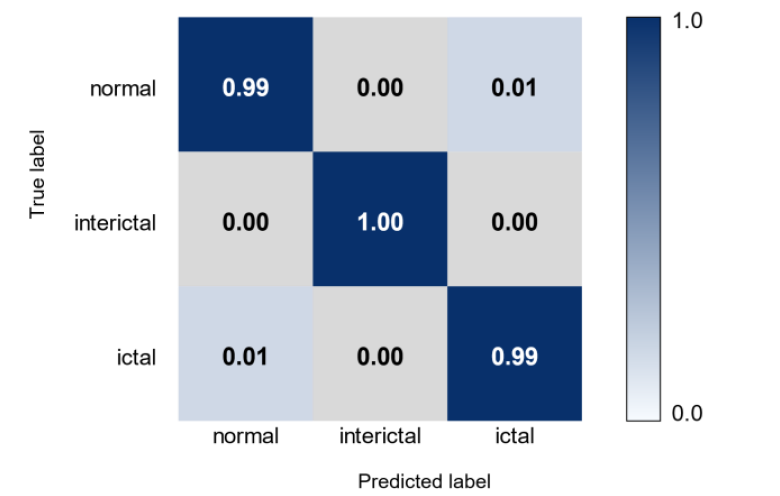
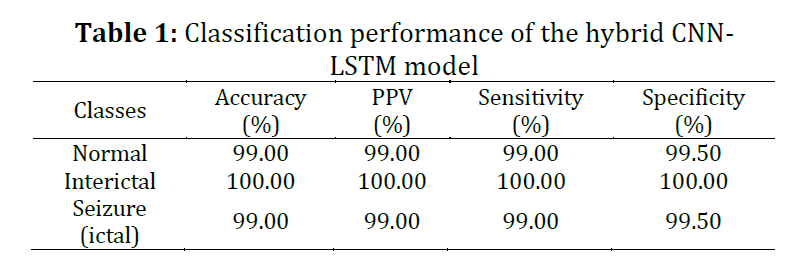
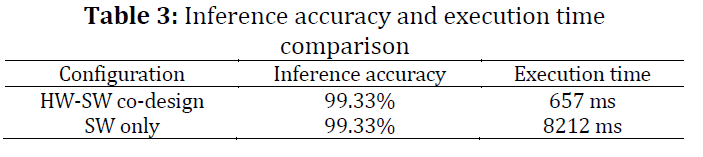
Epileptic seizure detection from electroencephalogram (EEG) signals is important for early clinical intervention in patients with neurological disorders. This study presents a hardware–software co-design implementation of a hybrid Convolutional Neural Network–Long Short-Term Memory (CNN–LSTM) model for automatic EEG classification on the Xilinx Zynq-7000 System-on-Chip (SoC) platform. In the proposed architecture, the CNN layers, which extract spatial features, are executed on the ARM Cortex-A9 processors, while the LSTM and fully connected layers are implemented in the FPGA fabric to enable real-time inference. The model was trained and tested on the Bonn University EEG dataset for three-class classification: normal, interictal, and seizure (ictal) states. The proposed system achieves a classification accuracy of 99.33% with an inference latency of 0.657 seconds per EEG segment. Hardware-oriented optimizations, including fixed-point quantization and efficient approximations of activation functions, reduce power consumption and increase processing speed. Compared with a full software implementation, the proposed co-design provides a 12.5× reduction in execution time. These results demonstrate that deep learning–based seizure detection can be effectively deployed on resource-limited embedded platforms for real-time medical applications.
© 2026 The Authors. Published by IASE.
This is an
Keywords
EEG, FPGA, Epileptic seizure detection, CNN-LSTM, Zynq SoC
Article history
Received 4 August 2025, Received in revised form 16 February 2026, Accepted 5 March 2026
Acknowledgment
No Acknowledgment.
Compliance with ethical standards
Ethical considerations:
This study uses the publicly available Bonn University EEG dataset. All data are anonymized and were collected in prior studies with appropriate ethical approval. No new experiments involving human participants or animals were conducted in this research. Therefore, ethical approval and informed consent were not required for this study.
Conflict of interest: The author(s) declared no potential conflicts of interest with respect to the research, authorship, and/or publication of this article.Citation:
Akhtar N, Buzdar AR, and Fan J (2026). CNN–LSTM-based EEG epileptic seizure detection: A hardware–software co-design approach. International Journal of Advanced and Applied Sciences, 13(3): 74-85
Figures
Fig. 1
Fig. 2
Fig. 3
Fig. 4
Fig. 5
Fig. 6
Fig. 7
Fig. 8
Tables
Table 1 Table 2 Table 3 Table 4

----------------------------------------------
References (36)
Ahmad I, Liu Z, Li L, Ullah I, Aboyeji ST, Wang X, Samuel OW, Li G, Tao Y, Chen Y, and Chen S (2024). Robust epileptic seizure detection based on biomedical signals using an advanced multi-view deep feature learning approach. IEEE Journal of Biomedical and Health Informatics, 28(10): 5742-5754. https://doi.org/10.1109/JBHI.2024.3396130 [Google Scholar] PMid:38696293
Alam MS, Hasan M, Farooq O, and Hasan M (2024a). Field programmable gate array‐based energy‐efficient and fast epileptic seizure detection using support vector machine and quadratic discriminant analysis classifier. Engineering Reports, 6(8): e12812. https://doi.org/10.1002/eng2.12812 [Google Scholar]
Alam MS, Khan U, Hasan M, and Farooq O (2024b). Energy efficient FPGA implementation of an epileptic seizure detection system using a QDA classifier. Expert Systems with Applications, 249: 123755. https://doi.org/10.1016/j.eswa.2024.123755 [Google Scholar]
Beeraka SM, Kumar A, Sameer M, Ghosh S, and Gupta B (2022). Accuracy enhancement of epileptic seizure detection: A deep learning approach with hardware realization of STFT. Circuits, Systems, and Signal Processing, 41: 461-484. https://doi.org/10.1007/s00034-021-01789-4 [Google Scholar]
Buzdar AR, Latif A, Sun L, and Buzdar A (2016). FPGA prototype implementation of digital hearing aid from software to complete hardware design. International Journal of Advanced Computer Science and Applications, 7(1): 645-654. https://doi.org/10.14569/IJACSA.2016.070188 [Google Scholar]
Buzdar AR, Sun L, Azhar MW, Khan MI, and Rao K (2017a). Area and energy efficient viterbi accelerator for embedded processor datapaths. International Journal of Advanced Computer Science and Applications, 8(3): 402-407. https://doi.org/10.14569/IJACSA.2017.080355 [Google Scholar]
Buzdar AR, Sun L, Rao K, Azhar MW, and Khan MI (2017b). Cyclic redundancy checking (CRC) accelerator for embedded processor datapaths. International Journal of Advanced Computer Science and Applications, 8(2): 321-325. https://doi.org/10.14569/IJACSA.2017.080242 [Google Scholar]
Cao X, Zheng S, Zhang J, Chen W, and Du G (2025). A hybrid CNN-Bi-LSTM model with feature fusion for accurate epilepsy seizure detection. BMC Medical Informatics and Decision Making, 25: 6. https://doi.org/10.1186/s12911-024-02845-0 [Google Scholar] PMid:39762881 PMCid:PMC11706039
Chaturvedi A (2023). Harnessing machine learning and deep learning for improved epileptic seizure detection: A review. In the Proceedings of the 5th International Conference on Information Management & Machine Intelligence, ACM, Jaipur, India: 1-9. https://doi.org/10.1145/3647444.3647944 [Google Scholar]
Dabbaghian A and Kassiri H (2025). Energy-efficient automated seizure detection in wearable/implantable BCIs: Motivations, methods, and example implementation. In the 2025 IEEE 55th International Symposium on Multiple-Valued Logic, IEEE Computer Society, Montreal, Canada: 57-62. https://doi.org/10.1109/ISMVL64713.2025.00020 [Google Scholar]
Dash DP, Kolekar M, Chakraborty C, and Khosravi MR (2024). Review of machine and deep learning techniques in epileptic seizure detection using physiological signals and sentiment analysis. ACM Transactions on Asian and Low-Resource Language Information Processing, 23(1): 1-29. https://doi.org/10.1145/3552512 [Google Scholar]
Ein Shoka AA, Dessouky MM, El-Sayed A, and Hemdan EED (2023). EEG seizure detection: concepts, techniques, challenges, and future trends. Multimedia Tools and Applications, 82: 42021-42051. https://doi.org/10.1007/s11042-023-15052-2 [Google Scholar] PMid:37362745 PMCid:PMC10071471
Feng L, Li Z, and Wang Y (2017). VLSI design of SVM-based seizure detection system with on-chip learning capability. IEEE Transactions on Biomedical Circuits and Systems, 12(1): 171-181. https://doi.org/10.1109/TBCAS.2017.2762721 [Google Scholar] PMid:29377805
Goel A (2025). Epilepsy seizure detection based on EEG signals using machine learning. In 2025 International Conference on Intelligent and Innovative Technologies in Computing, Electrical and Electronics, IEEE, Bengaluru, India: 1-9. https://doi.org/10.1109/IITCEE64140.2025.10915478 [Google Scholar]
Indira Priyadarshini B and Reddy DK (2023). Adaptive octopus deep transfer learning based epileptic seizure classification on field programmable gate arrays. Evolving Systems, 14: 479-499. https://doi.org/10.1007/s12530-022-09474-w [Google Scholar]
Jaffino G, Jose JP, Raman R, Venkatesan RS, and Aarthi VPMB (2023). FPGA-based system for real-time epileptic seizure detection using KNN classifier. In the 2023 Second International Conference on Electrical, Electronics, Information and Communication Technologies, IEEE, Trichirappalli, India: 1-5. https://doi.org/10.1109/ICEEICT56924.2023.10157075 [Google Scholar]
Jose JP, Sundaram M, and Jaffino G (2020). FPGA implementation of epileptic seizure detection using ELM classifier. In the 2020 Sixth International Conference on Bio Signals, Images, and Instrumentation, IEEE, Chennai, India: 1-5. https://doi.org/10.1109/ICBSII49132.2020.9167598 [Google Scholar] PMid:33655238 PMCid:PMC7903891
Khan MI and da Silva B (2024). Harnessing FPGA technology for energy-efficient wearable medical devices. Electronics, 13(20): 4094. https://doi.org/10.3390/electronics13204094 [Google Scholar]
Meddah K, Zairi H, Bessekri B, Cherrih H, and Kedir-Talha M (2020). FPGA implementation of epileptic seizure detection based on DWT, PCA and support vector machine. In the 2020 Second International Conference on Embedded and Distributed Systems, IEEE, Oran, Algeria: 141-146. https://doi.org/10.1109/EDiS49545.2020.9296466 [Google Scholar]
Mulla ZA, Reddy S, Lakshmi VV, and Maturi SC (2022). Epileptic seizure detection system using single hidden layer extreme learning machine (ELM). In the 2022 9th International Conference on Computing for Sustainable Global Development, IEEE, New Delhi, India: 298-302. https://doi.org/10.23919/INDIACom54597.2022.9763268 [Google Scholar]
Muneeb A and Kassiri H (2024). Customized development and hardware optimization of a fully-spiking SNN for EEG-based seizure detection. In the 2024 IEEE Biomedical Circuits and Systems Conference, IEEE, Xi'an, China: 1-5. https://doi.org/10.1109/BioCAS61083.2024.10798216 [Google Scholar]
Pandey SK, Janghel RR, Mishra PK, and Ahirwal MK (2023). Automated epilepsy seizure detection from EEG signal based on hybrid CNN and LSTM model. Signal, Image and Video Processing, 17: 1113-1122. https://doi.org/10.1007/s11760-022-02318-9 [Google Scholar]
Rafiammal SS, Jamal DN, and Mohideen SK (2020). Reconfigurable hardware design for automatic epilepsy seizure detection using EEG signals. Engineering, Technology and Applied Science Research, 10(3): 5803-5807. https://doi.org/10.48084/etasr.3419 [Google Scholar]
Razi KF and Schmid A (2021). Two-stage hardware-friendly epileptic seizure detection method with a dynamic feature selection. In the 2021 43rd Annual International Conference of the IEEE Engineering in Medicine & Biology Society (EMBC), IEEE, Mexico City, Mexico: 156-159. https://doi.org/10.1109/EMBC46164.2021.9630486 [Google Scholar] PMid:34891261
Rizal A, Hadiyoso S, and Ramdani AZ (2022). FPGA-based implementation for real-time epileptic EEG classification using Hjorth descriptor and KNN. Electronics, 11(19): 3026. https://doi.org/10.3390/electronics11193026 [Google Scholar]
Rout SK, Sahani M, Dora C, Biswal PK, and Biswal B (2022). An efficient epileptic seizure classification system using empirical wavelet transform and multi-fuse reduced deep convolutional neural network with digital implementation. Biomedical Signal Processing and Control, 72: 103281. https://doi.org/10.1016/j.bspc.2021.103281 [Google Scholar]
Sadangi RK, Patra B, Gandhi TK, Sutar BC, Maity NP, and Maity R (2024). Improved EEG-based epileptic seizure classification using fusion of machine learning model with statistical feature integration. In the 2024 International Conference on Communication, Control, and Intelligent Systems, IEEE, Mathura, India: 1-4. https://doi.org/10.1109/CCIS63231.2024.10931966 [Google Scholar]
Sahani M, Rout SK, and Dash PK (2021). FPGA implementation of epileptic seizure detection using semi supervised reduced deep convolutional neural network. Applied Soft Computing, 110: 107639. https://doi.org/10.1016/j.asoc.2021.107639 [Google Scholar]
Saini SK and Chandel G (2024). Implementation of the frequency domain feature extraction technique for machine learning-based seizure detection. In the 2024 First International Conference for Women in Computing, IEEE, Pune, India: 1-6. https://doi.org/10.1109/InCoWoCo64194.2024.10863338 [Google Scholar]
Sajja A and Rooban S (2024). FPGA implementation of automatic seizure detection in EEG signals using machine learning algorithm. Discover Applied Sciences, 6: 383. https://doi.org/10.1007/s42452-024-06060-4 [Google Scholar]
Sarić R, Beganović N, Jokić D, and Čustović E (2022). Towards efficient implementation of MLP-ANN classifier on the FPGA-based embedded system. IFAC-PapersOnLine, 55(4): 207-212. https://doi.org/10.1016/j.ifacol.2022.06.034 [Google Scholar]
Sarić R, Jokić D, Beganović N, Pokvić LG, and Badnjević A (2020). FPGA-based real-time epileptic seizure classification using artificial neural network. Biomedical Signal Processing and Control, 62: 102106. https://doi.org/10.1016/j.bspc.2020.102106 [Google Scholar]
Shanmugam S and Dharmar S (2025). FFNN architecture implementation on FPGA for seizure detection using EEG signals. Applied Soft Computing, 181: 113533. https://doi.org/10.1016/j.asoc.2025.113533 [Google Scholar]
Tatum WO, Rubboli G, Kaplan PW et al. (2018). Clinical utility of EEG in diagnosing and monitoring epilepsy in adults. Clinical Neurophysiology, 129(5): 1056-1082. https://doi.org/10.1016/j.clinph.2018.01.019 [Google Scholar] PMid:29483017
WHO (2019). Epilepsy: A public health imperative. World Health Organization, Geneva, Switzerland. [Google Scholar]
- Zairi H, Meddah K, Cherrih H, Bessekri B, and Talha MK (2022). FPGA-based neural network system for epileptic seizure detection. In the 2022 2nd International Conference on Advanced Electrical Engineering, IEEE, Constantine, Algeria: 1-6. https://doi.org/10.1109/ICAEE53772.2022.9962009 [Google Scholar]