International
ADVANCED AND APPLIED SCIENCES
EISSN: 2313-3724, Print ISSN: 2313-626X
Frequency: 12


Volume 13, Issue 3 (March 2026), Pages: 41-51

----------------------------------------------
Original Research Paper
Virtual presence and enjoyment as mediators between interaction quality and continuance intention in China’s smart museums
Author(s):
Affiliation(s):
1Faculty of Creative Technology and Heritage, Universiti Malaysia Kelantan, Kota Bharu, Malaysia
2Global Entrepreneurship Research and Innovation Center, Universiti Malaysia Kelantan, Kota Bharu, Malaysia
3Art College, Harbin Cambridge College, Harbin, China
4Chengdu Academy of Fine Arts, Sichuan Conservatory of Music, Ziyang, China
5School of Fashion Design, Jiangxi Institute of Fashion Technology, Nanchang, China
Full text

* Corresponding Author.
 Corresponding author's ORCID profile: https://orcid.org/0000-0003-3725-7443
Digital Object Identifier (DOI)
https://doi.org/10.21833/ijaas.2026.03.005
Abstract
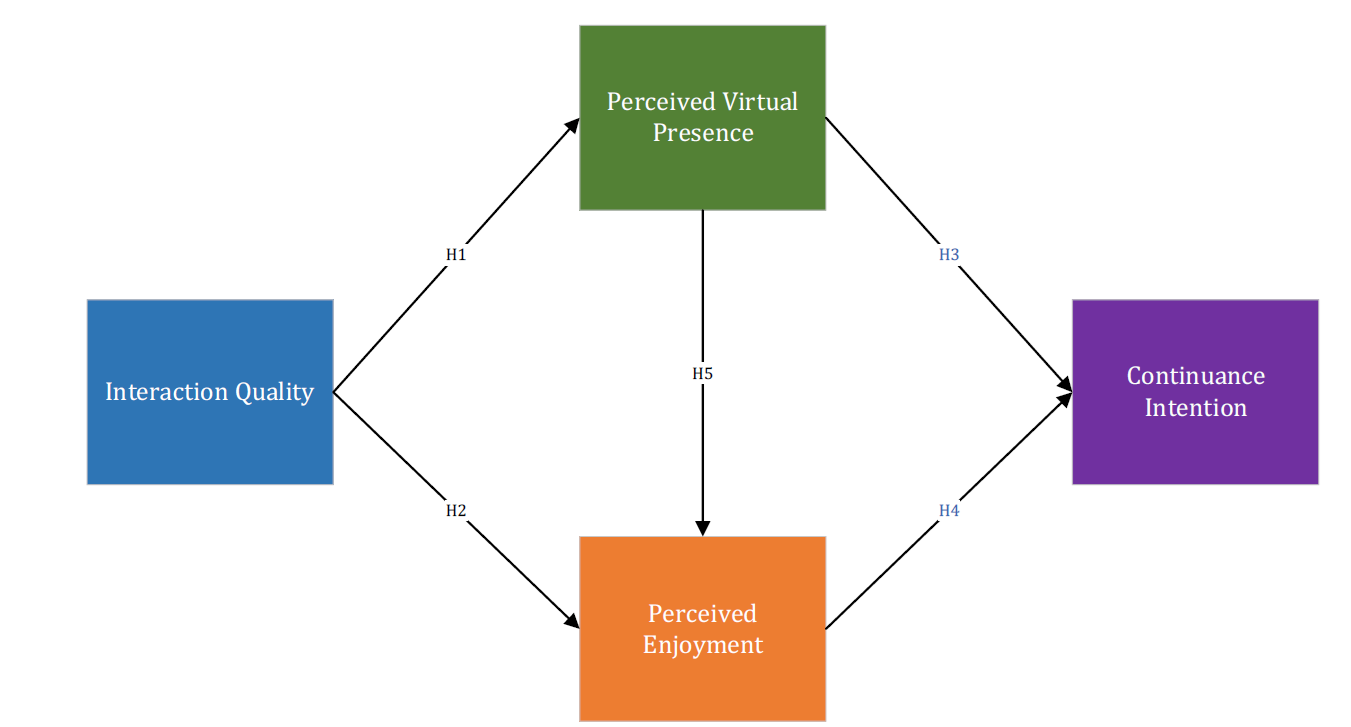
This study examined how perceived virtual presence and perceived enjoyment mediate the relationship between interaction quality and continuance intention in China’s smart museums. Based on the Technology Acceptance Model (TAM), the study proposed an extended framework that includes experiential factors to explain sustained user engagement with digital cultural technologies. Data were collected through a quantitative survey of 464 museum visitors and analyzed using partial least squares structural equation modeling (PLS-SEM). The findings show that interaction quality has a significant positive effect on both perceived virtual presence and perceived enjoyment. These two factors, in turn, positively influence continuance intention. Among the mediators, perceived enjoyment had the strongest effect, while perceived virtual presence contributed to continuance intention both directly and indirectly. The model explained 53.9% of the variance in continuance intention, highlighting the joint role of technological and psychological factors in post-adoption behavior. This study extends the TAM in immersive cultural contexts and provides practical insights for designing smart museum technologies that encourage long-term visitor engagement.
© 2026 The Authors. Published by IASE.
This is an
Keywords
Smart museums, Interaction quality, Virtual presence, Perceived enjoyment, Continuance intention
Article history
Received 7 July 2025, Received in revised form 12 January 2026, Accepted 2 March 2026
Acknowledgment
No Acknowledgment.
Compliance with ethical standards
Ethical considerations:
Participation was entirely voluntary, and informed consent was obtained from all respondents prior to data collection. Anonymity and confidentiality were assured, and no identifying personal information was collected.
Conflict of interest: The author(s) declared no potential conflicts of interest with respect to the research, authorship, and/or publication of this article.Citation:
Xu L, Khidzir NZB, Radzuan AWB, Nannan G, Heng Y, and Yueming Y (2026). Virtual presence and enjoyment as mediators between interaction quality and continuance intention in China’s smart museums. International Journal of Advanced and Applied Sciences, 13(3): 41-51
Figures
Tables
Table 1 Table 2 Table 3 Table 4 Table 5


----------------------------------------------
References (37)
Akdim K, Casaló LV, and Flavián C (2022). The role of utilitarian and hedonic aspects in the continuance intention to use social mobile apps. Journal of Retailing and Consumer Services, 66: 102888. https://doi.org/10.1016/j.jretconser.2021.102888 [Google Scholar]
Al-Geitany S, Aljuhmani HY, Emeagwali OL, and Nasr E (2023). Consumer behavior in the post-COVID-19 era: The impact of perceived interactivity on behavioral intention in the context of virtual conferences. Sustainability, 15(11): 8600. https://doi.org/10.3390/su15118600 [Google Scholar]
Andres HP (2002). A comparison of face‐to‐face and virtual software development teams. Team Performance Management: An International Journal, 8(1-2): 39-48. https://doi.org/10.1108/13527590210425077 [Google Scholar]
Balducci F, Buono P, Desolda G, Impedovo D, and Piccinno A (2020). Improving smart interactive experiences in cultural heritage through pattern recognition techniques. Pattern Recognition Letters, 131: 142-149. https://doi.org/10.1016/j.patrec.2019.12.011 [Google Scholar]
Barreda-Ángeles M and Hartmann T (2022). Psychological benefits of using social virtual reality platforms during the COVID-19 pandemic: The role of social and spatial presence. Computers in Human Behavior, 127: 107047. https://doi.org/10.1016/j.chb.2021.107047 [Google Scholar] PMid:34629723 PMCid:PMC8489850
Chen SC, Yen DC, and Hwang MI (2012). Factors influencing the continuance intention to the usage of Web 2.0: An empirical study. Computers in Human Behavior, 28(3): 933-941. https://doi.org/10.1016/j.chb.2011.12.014 [Google Scholar]
Gao M and Huang L (2024). The mediating role of perceived enjoyment and attitude consistency in omni-channel retailing. Asia Pacific Journal of Marketing and Logistics, 36(3): 599-621. https://doi.org/10.1108/APJML-01-2023-0079 [Google Scholar]
Guo Y, Lu S, Shen M, Huang W, Yi X, and Zhang J (2024). Differences in heritage tourism experience between VR and AR: A comparative experimental study based on presence and authenticity. ACM Journal on Computing and Cultural Heritage, 17(2): 30. https://doi.org/10.1145/3648001 [Google Scholar]
Hammady R, Ma M, and Temple N (2016). Augmented reality and gamification in heritage museums. In: Marsh T, Ma M, Oliveira M, Baalsrud Hauge J, and Göbel S (Eds.), Serious games. JCSG 2016. Lecture notes in computer science, 9894: 181–187. Springer, Cham, Switzerland. https://doi.org/10.1007/978-3-319-45841-0_17 [Google Scholar]
Hasan AAT, Sumon SM, Islam MT, and Hossain MS (2021). Factors influencing online shopping intentions: The mediating role of perceived enjoyment. Turkish Journal of Marketing, 6(3): 239-253. https://doi.org/10.30685/tujom.v6i3.132 [Google Scholar]
Hooi R and Cho H (2017). Virtual world continuance intention. Telematics and Informatics, 34(8): 1454-1464. https://doi.org/10.1016/j.tele.2017.06.009 [Google Scholar]
Huang CM, Liao JY, Lin TY, Hsu HP, Charles Lee TC, and Guo JL (2021). Effects of user experiences on continuance intention of using immersive three‐dimensional virtual reality among institutionalized older adults. Journal of Advanced Nursing, 77(9): 3784-3796. https://doi.org/10.1111/jan.14895 [Google Scholar] PMid:34051116
Hung SY, Chen CC, Hung HM, and Ho WW (2013). Critical factors predicting the acceptance of digital museums: User and system perspectives. Journal of Electronic Commerce Research, 14(3): 231-243. [Google Scholar]
Jung T, tom Dieck MC, Lee H, and Chung N (2016). Effects of virtual reality and augmented reality on visitor experiences in museum. In: Inversini A and Schegg R (Eds.), Information and communication technologies in tourism 2016: 621–635. Springer, Cham, Switzerland. https://doi.org/10.1007/978-3-319-28231-2_45 [Google Scholar] PMCid:PMC4907848
Kabir ZS and Kang K (2024a). How user-platform interactions influence continuance intention in augmented reality mobile platforms. In: Ahram T and Karwowski W (Eds.), Human factors in design, engineering, and computing. AHFE (2024) International Conference. AHFE International, USA. https://doi.org/10.54941/ahfe1005640 [Google Scholar]
Kabir ZS and Kang K (2024b). The impact of augmented reality through user-platform interactions towards continuance intention with the effect of user generation. Information, 15(12): 758. https://doi.org/10.3390/info15120758 [Google Scholar]
Khalil S, Kallmuenzer A, and Kraus S (2024). Visiting museums via augmented reality: An experience fast-tracking the digital transformation of the tourism industry. European Journal of Innovation Management, 27(6): 2084-2100. https://doi.org/10.1108/EJIM-09-2022-0479 [Google Scholar]
Kim HS and Choi B (2025). The power of customer-to-customer self-service technology in enhancing customer-to-customer interactions. European Journal of Marketing, 59(1): 157-181. https://doi.org/10.1108/EJM-06-2023-0504 [Google Scholar]
Li J, Tu XF, Nie JW, Ye J, and Lv C (2024). Visitors’ acceptance of wearable AR technology in museums. SAGE Open, 14(4). https://doi.org/10.1177/21582440241303507 [Google Scholar]
López-Martínez A, Carrera Á, and Iglesias CA (2020). Empowering museum experiences applying gamification techniques based on linked data and smart objects. Applied Sciences, 10(16): 5419. https://doi.org/10.3390/app10165419 [Google Scholar]
Munnukka J, Talvitie-Lamberg K, and Maity D (2022). Anthropomorphism and social presence in human–virtual service assistant interactions: The role of dialog length and attitudes. Computers in Human Behavior, 135: 107343. https://doi.org/10.1016/j.chb.2022.107343 [Google Scholar]
Pereira R and Tam C (2021). Impact of enjoyment on the usage continuance intention of video-on-demand services. Information & Management, 58(7): 103501. https://doi.org/10.1016/j.im.2021.103501 [Google Scholar]
Resnick B, Galik E, Paudel A, McPherson R, Van Haitsma K, Boltz M, Ellis J, Eshraghi K, Behrens L, Zhu S, and Breman RB (2021). Reliability and validity testing of the quantified quality of interaction scale (QUIS). Journal of Nursing Measurement, 29(2): E95-E109. https://doi.org/10.1891/JNM-D-19-00101 [Google Scholar] PMid:33863846 PMCid:PMC8324536
Seol S, Lee H, Yu J, and Zo H (2016). Continuance usage of corporate SNS pages: A communicative ecology perspective. Information & Management, 53(6): 740-751. https://doi.org/10.1016/j.im.2016.02.010 [Google Scholar]
Serravalle F, Ferraris A, Vrontis D, Thrassou A, and Christofi M (2019). Augmented reality in the tourism industry: A multi-stakeholder analysis of museums. Tourism Management Perspectives, 32: 100549. https://doi.org/10.1016/j.tmp.2019.07.002 [Google Scholar]
Shi M, Deng L, Zhang M, and Long Y (2025). How telepresence and perceived enjoyment mediate the relationship between interaction quality and continuance intention: Evidence from China Zisha-ware digital museum. PLOS ONE, 20(1): e0317784. https://doi.org/10.1371/journal.pone.0317784 [Google Scholar] PMid:39841733 PMCid:PMC11753657
Shi M, Wang Q, and Long Y (2023). Exploring the key drivers of user continuance intention to use digital museums: Evidence from China’s Sanxingdui museum. IEEE Access, 11: 81511-81526. https://doi.org/10.1109/ACCESS.2023.3297501 [Google Scholar]
Shiau WL and Luo MM (2013). Continuance intention of blog users: The impact of perceived enjoyment, habit, user involvement and blogging time. Behaviour & Information Technology, 32(6): 570-583. https://doi.org/10.1080/0144929X.2012.671851 [Google Scholar]
Sun HM, Li SP, Zhu YQ, and Hsiao B (2015). The effect of user's perceived presence and promotion focus on usability for interacting in virtual environments. Applied Ergonomics, 50: 126-132. https://doi.org/10.1016/j.apergo.2015.03.006 [Google Scholar] PMid:25959326
Todorova-Ekmekci M (2021). Using innovative technologies, digital media and site tools for presentation and sustainable preservation of cultural heritage. In the 5th International Symposium on Multidisciplinary Studies and Innovative Technologies, IEEE, Ankara, Turkey: 135-140. https://doi.org/10.1109/ISMSIT52890.2021.9604569 [Google Scholar]
van Brakel V, Barreda-Ángeles M, and Hartmann T (2023). Feelings of presence and perceived social support in social virtual reality platforms. Computers in Human Behavior, 139: 107523. https://doi.org/10.1016/j.chb.2022.107523 [Google Scholar]
van Schaik P and Ling J (2011). An integrated model of interaction experience for information retrieval in a web-based encyclopaedia. Interacting with Computers, 23(1): 18-32. https://doi.org/10.1016/j.intcom.2010.07.002 [Google Scholar]
Venkatesh V, Thong JY, and Xu X (2012). Consumer acceptance and use of information technology: Extending the unified theory of acceptance and use of technology. MIS Quarterly, 36(1): 157-178. https://doi.org/10.2307/41410412 [Google Scholar]
Wang S, Duan Y, Yang X, Cao C, and Pan S (2023). ‘Smart Museum’ in China: From technology labs to sustainable knowledgescapes. Digital Scholarship in the Humanities, 38(3): 1340-1358. https://doi.org/10.1093/llc/fqac097 [Google Scholar]
Yang S and Zhang W (2022). Presence and flow in the context of virtual reality storytelling: What influences enjoyment in virtual environments? Cyberpsychology, Behavior, and Social Networking, 25(2): 101-109. https://doi.org/10.1089/cyber.2021.0037 [Google Scholar] PMid:34962138
YiFei L and Othman MK (2024). Investigating the behavioural intentions of museum visitors towards VR: A systematic literature review. Computers in Human Behavior, 155: 108167. https://doi.org/10.1016/j.chb.2024.108167 [Google Scholar]
- Zollo L, Rialti R, Marrucci A, and Ciappei C (2022). How do museums foster loyalty in tech-savvy visitors? The role of social media and digital experience. Current Issues in Tourism, 25(18): 2991-3008. https://doi.org/10.1080/13683500.2021.1896487 [Google Scholar]