International
ADVANCED AND APPLIED SCIENCES
EISSN: 2313-3724, Print ISSN: 2313-626X
Frequency: 12


Volume 13, Issue 3 (March 2026), Pages: 33-40

----------------------------------------------
Original Research Paper
A sustainable marine tourism model integrating the blue economy and local wisdom for poverty alleviation on Banyak Island
Author(s):
Affiliation(s):
1Accounting Study Program, Faculty of Economics and Business, Universitas Medan Area, Medan, Sumatra Utara, Indonesia
2Management Study Program, Faculty of Economics and Business, Universitas Medan Area, Medan, Sumatra Utara, Indonesia
3Master of Management Program, Universitas Medan Area, Medan, Sumatra Utara, Indonesia
4Master of Agribusiness Program, Universitas Medan Area, Medan, Sumatra Utara, Indonesia
5Department of Management, Universitas Samudra, Langsa, Aceh, Indonesia
Full text

* Corresponding Author.
 Corresponding author's ORCID profile: https://orcid.org/0000-0003-2937-9723
Digital Object Identifier (DOI)
https://doi.org/10.21833/ijaas.2026.03.004
Abstract
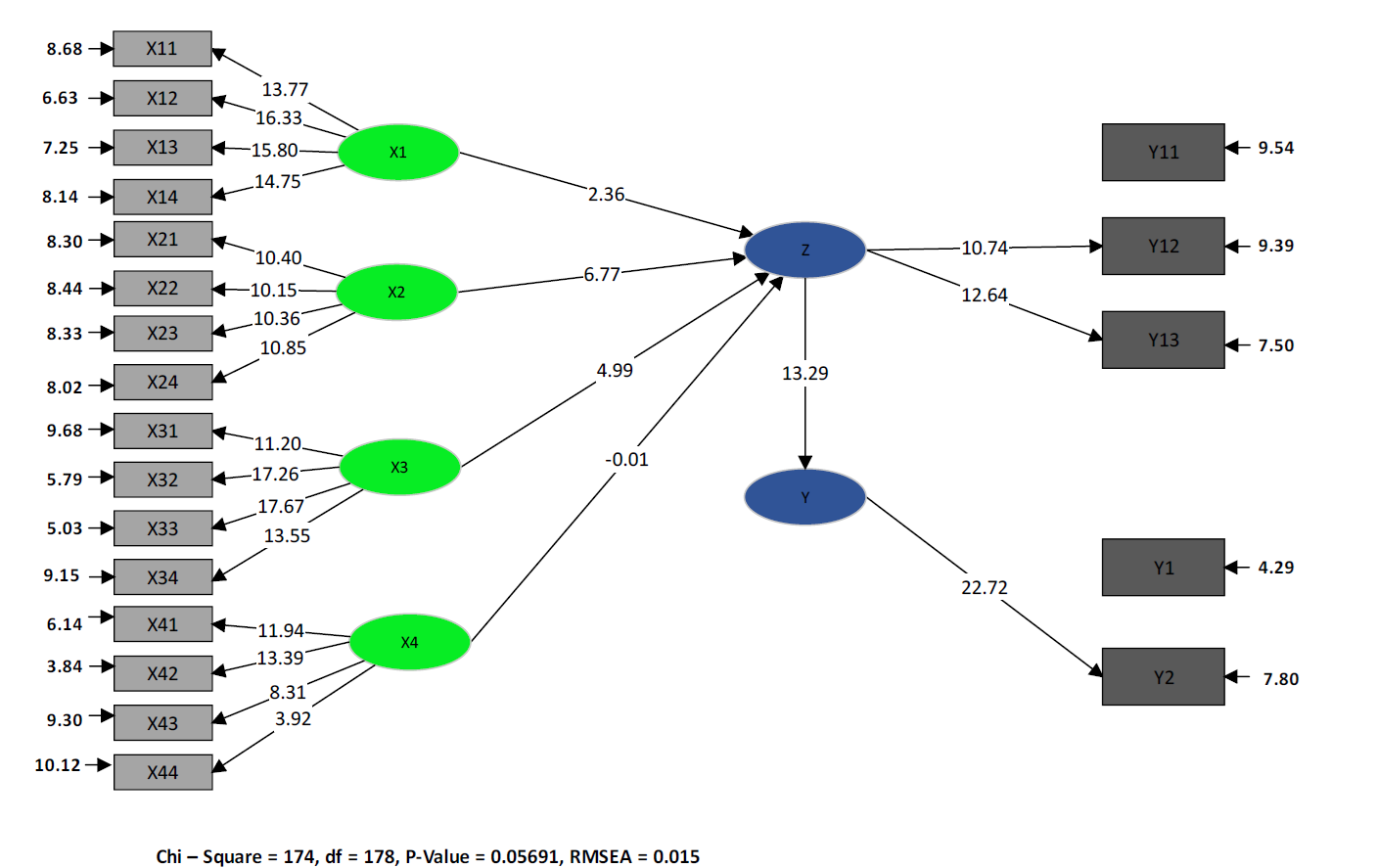
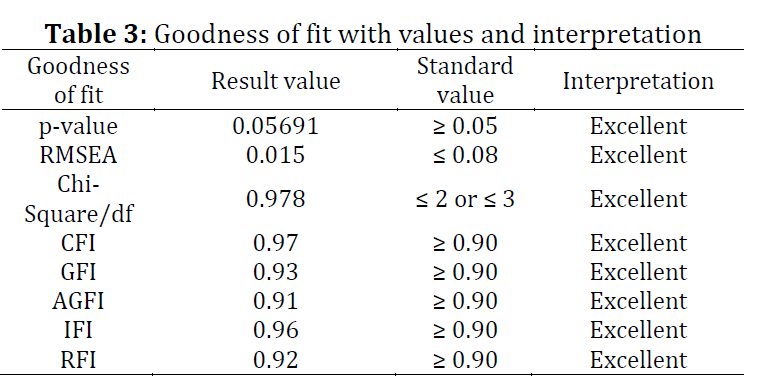
Banyak Island in Aceh Singkil Regency has strong potential for marine tourism, yet the region continues to face poverty and limited socio-economic development. This study aims to develop a sustainable marine tourism model based on the blue economy and local wisdom as a strategy for poverty reduction in coastal communities. A quantitative explanatory approach was applied using Structural Equation Modeling (SEM) with LISREL, analyzing Blue Economy Potential, Local Wisdom, Training and Capacity Building, Sustainable Marine Tourism, and Coastal Community Welfare. Data were collected from 176 active fishers selected through purposive sampling. The results indicate a good model fit (p-value = 0.05691; RMSEA = 0.015; CFI, GFI, and IFI ≥ 0.90). Local wisdom shows the strongest influence on the tourism model, followed by training and capacity building and blue economy potential, while the sustainable marine tourism model has a significant positive effect on community welfare. These findings suggest that integrating blue economy principles, local cultural values, and community capacity building can promote inclusive and sustainable marine tourism and effectively reduce poverty in coastal areas.
© 2026 The Authors. Published by IASE.
This is an
Keywords
Blue economy, Local wisdom, Marine tourism, Coastal welfare, Poverty reduction
Article history
Received 11 August 2025, Received in revised form 21 January 2026, Accepted 1 March 2026
Acknowledgment
The authors would like to express their deepest gratitude to the Ministry of Education, Science, and Technology of the Republic of Indonesia (Kemdiktisaintek) through the Direktorat Penelitian dan Pengabdian kepada Masyarakat (DPPM) for the funding support and trust given through the Regular Fundamental Research Scheme (PFR) grant. This support is very meaningful for the Universitas Medan Area research team in completing the research and publishing the research results in the form of scientific articles. Hopefully, the results of this research can provide a real contribution to the development of science and sustainable development, especially in the field of marine tourism and coastal community empowerment.
Compliance with ethical standards
Ethical considerations:
The study was conducted in accordance with ethical standards for research involving human participants. All respondents were informed about the research objectives and the voluntary nature of participation, and informed consent was obtained prior to completing the questionnaire. Participant anonymity and confidentiality were ensured, and the collected data were used solely for academic research purposes.
Conflict of interest: The author(s) declared no potential conflicts of interest with respect to the research, authorship, and/or publication of this article.Citation:
Tambunan SB, Wijaya M, Amelia WR, Lubis A, Effendi I, and Rosalina D (2026). A sustainable marine tourism model integrating the blue economy and local wisdom for poverty alleviation on Banyak Island. International Journal of Advanced and Applied Sciences, 13(3): 33-40
Figures
Tables

----------------------------------------------
References (25)
Andriany L, Lubis T, Amalia, Abus AF, and Delima (2022). Shaping ethnobotanical tourism on the coastal landscape through Halobanese oral traditions at Banyak Island. IOP Conference Series: Earth and Environmental Science, 1115: 012103. https://doi.org/10.1088/1755-1315/1115/1/012103 [Google Scholar]
Arismayanti NK (2021). Community local wisdom and efforts to create quality marine tourism. Webology, 18(2): 243-260. https://doi.org/10.14704/WEB/V18I2/WEB18319 [Google Scholar]
Banarsyadhimi URA, Dargusch P, and Kurniawan F (2022). Assessing the impact of marine tourism and protection on cultural ecosystem services using integrated approach: A case study of Gili Matra Islands. International Journal of Environmental Research and Public Health, 19(19): 12078. https://doi.org/10.3390/ijerph191912078 [Google Scholar] PMid:36231380 PMCid:PMC9564878
Bramwell B and Lane B (2011). Critical research on the governance of tourism and sustainability. Journal of Sustainable Tourism, 19(4-5): 411-421. https://doi.org/10.1080/09669582.2011.580586 [Google Scholar]
Byrne BM (1998). Structural equation modeling with LISREL, PRELIS, and SIMPLIS: Basic concepts, applications, and programming. 1st Edition, Psychology Press, New York, USA. https://doi.org/10.4324/9780203774762 [Google Scholar]
Choudhary P, Subhash GV, Khade M, Savant S, Musale A, Kumar GRK, Chelliah MS, and Dasgupta S (2021). Empowering blue economy: From underrated ecosystem to sustainable industry. Journal of Environmental Management, 291: 112697. https://doi.org/10.1016/j.jenvman.2021.112697 [Google Scholar] PMid:33934021
Cohen PJ, Allison EH, Andrew NL et al. (2019). Securing a just space for small-scale fisheries in the blue economy. Frontiers in Marine Science, 6: 171. https://doi.org/10.3389/fmars.2019.00171 [Google Scholar]
Farmery AK, Allison EH, Andrew NL, Troell M, Voyer M, Campbell B, Eriksson H, Fabinyi M, Song AM, and Steenbergen D (2021). Blind spots in visions of a “blue economy” could undermine the ocean's contribution to eliminating hunger and malnutrition. One Earth, 4(1): 28-38. https://doi.org/10.1016/j.oneear.2020.12.002 [Google Scholar]
Febriamansyah R (2025). The creative economy development strategy on marine tourism: A systematic literature review and future agenda. Tourism in Marine Environments, 20(1): 51-67. https://doi.org/10.3727/216901925X17367756790656 [Google Scholar]
Garcia O and Cater C (2022). Life below water; challenges for tourism partnerships in achieving ocean literacy. Journal of Sustainable Tourism, 30(10): 2428-2447. https://doi.org/10.1080/09669582.2020.1850747 [Google Scholar]
Goldberg J and Bryant M (2012). Country ownership and capacity building: the next buzzwords in health systems strengthening or a truly new approach to development? BMC Public Health, 12: 531. https://doi.org/10.1186/1471-2458-12-531 [Google Scholar] PMid:22818046 PMCid:PMC3461461
Islam MM and Shamsuddoha MD (2018). Coastal and marine conservation strategy for Bangladesh in the context of achieving blue growth and sustainable development goals (SDGs). Environmental Science & Policy, 87: 45-54. https://doi.org/10.1016/j.envsci.2018.05.014 [Google Scholar]
Kurniawan F, Adrianto L, Bengen DG, and Prasetyo LB (2016). Vulnerability assessment of small islands to tourism: The case of the Marine Tourism Park of the Gili Matra Islands, Indonesia. Global Ecology and Conservation, 6: 308-326. https://doi.org/10.1016/j.gecco.2016.04.001 [Google Scholar] PMCid:PMC10361309
Maingi SW (2019). Sustainable tourism certification, local governance and management in dealing with overtourism in East Africa. Worldwide Hospitality and Tourism Themes, 11(5): 532-551. https://doi.org/10.1108/WHATT-06-2019-0034 [Google Scholar]
Molenaar PCM (2019). Review of multivariate analysis with LISREL. Structural Equation Modeling: A Multidisciplinary Journal, 26(2): 324–327. https://doi.org/10.1080/10705511.2019.1566002 [Google Scholar]
Okafor-Yarwood I, Kadagi NI, Miranda NA, Uku J, Elegbede IO, and Adewumi IJ (2020). The blue economy–cultural livelihood–ecosystem conservation triangle: The African experience. Frontiers in Marine Science, 7: 586. https://doi.org/10.3389/fmars.2020.00586 [Google Scholar]
Okazaki E (2008). A community-based tourism model: Its conception and use. Journal of Sustainable Tourism, 16(5): 511-529. https://doi.org/10.1080/09669580802159594 [Google Scholar]
Ovchynnykova O, Martinkienė J, and Navickas V (2024). Enhancing global sustainability: The role of the blue economy in preserving natural capital. Challenges in Sustainability, 12(1): 65-79. https://doi.org/10.56578/cis120105 [Google Scholar]
Phelan A, Ruhanen L, and Mair J (2020). Ecosystem services approach for community-based ecotourism: Towards an equitable and sustainable blue economy. Journal of Sustainable Tourism, 28(10): 1665-1685. https://doi.org/10.1080/09669582.2020.1747475 [Google Scholar]
Pratiknjo MH, Mambo R, and Sandiah N (2023). Exploring and developing local wisdom in relation to marine conservation in the Bunaken National Marine Park. Journal of Humanities, Social Sciences and Business, 3(1): 31-50. https://doi.org/10.55047/jhssb.v3i1.798 [Google Scholar]
Sangpikul A (2018). The effects of travel experience dimensions on tourist satisfaction and destination loyalty: The case of an island destination. International Journal of Culture, Tourism and Hospitality Research, 12(1): 106-123. https://doi.org/10.1108/IJCTHR-06-2017-0067 [Google Scholar]
Siregar NSS, Prayudi A, Vita NI, Sari WP, and Rosalina D (2025). Developing Tangkahan Tourism Village in Indonesia by strengthening social media literacy for SME. WSEAS Transactions on Environment and Development, 21: 655-666. https://doi.org/10.37394/232015.2025.21.54 [Google Scholar]
Suryawan IWK, Gunawan VD, and Lee CH (2025). The role of local adaptive capacity in marine ecotourism scenarios. Tourism Management, 107: 105039. https://doi.org/10.1016/j.tourman.2024.105039 [Google Scholar]
Touwe S (2020). Local wisdom values of maritime community in preserving marine resources in Indonesia. Journal of Maritime Studies and National Integration, 4(2): 84-94. https://doi.org/10.14710/jmsni.v4i2.4812 [Google Scholar]
- Yadav N, Sahu NC, Sahoo D, and Yadav DK (2018). Analysis of barriers to sustainable tourism management in a protected area: A case from India. Benchmarking: An International Journal, 25(6): 1956-1976. https://doi.org/10.1108/BIJ-09-2016-0149 [Google Scholar]