
International
ADVANCED AND APPLIED SCIENCES
EISSN: 2313-3724, Print ISSN: 2313-626X
Frequency: 12


Volume 13, Issue 2 (February 2026), Pages: 196-202

----------------------------------------------
Original Research Paper
Innovation and technology in sustainable agriculture: Understanding farmers’ drivers and barriers to adoption
Author(s):
Affiliation(s):
College of Management and Business Technology, Nueva Ecija University of Science and Technology, Cabanatuan City, Nueva Ecija, Philippines
Full text

* Corresponding Author.
 Corresponding author's ORCID profile: https://orcid.org/0009-0001-8482-3746
Digital Object Identifier (DOI)
https://doi.org/10.21833/ijaas.2026.02.020
Abstract
This study examines farmers’ perceptions and understanding of adopting innovative and technology-based agricultural practices for sustainability. It identifies the main drivers and barriers influencing farmers’ decisions to adopt technology, with the aim of encouraging farm-level research and promoting agricultural development. The study included 114 respondents and used a descriptive correlational research design. The findings show that farmers have a high level of understanding and positive attitudes toward technological innovation in agriculture. Key drivers of adoption include economic considerations, sociocultural factors, institutional support, and technological aspects. However, several major challenges limit adoption, including insufficient financial resources to purchase machinery, limited access to bank loans, and inadequate farm inputs such as land, quality seeds, mechanization, fertilizers, and pesticides. The results also indicate that years of farming experience are significantly related to economic factors. In addition, the type of agricultural mechanization and tools is significantly associated with technological aspects, while participation in training activities is significantly related to sociocultural and technological factors. Overall, the findings suggest that wider use of modern technology and machinery can be expected if these barriers are addressed.
© 2026 The Authors. Published by IASE.
This is an
Keywords
Sustainable agriculture, Technology adoption, Farmers’ perceptions, Adoption barriers, Agricultural innovation
Article history
Received 19 September 2025, Received in revised form 12 February 2026, Accepted 18 February 2026
Acknowledgment
The researchers acknowledge the NEUST community for their financial support and the farmers for their valuable participation and vital role in completing this research.
Compliance with ethical standards
Ethical considerations:
The study was conducted in accordance with ethical standards. All participants gave informed consent before participation, and their privacy and confidentiality were protected throughout the study.
Conflict of interest: The author(s) declared no potential conflicts of interest with respect to the research, authorship, and/or publication of this article.Citation:
Viloria VA, Cucio JS, Navarro JEC, and Portana HV (2026). Innovation and technology in sustainable agriculture: Understanding farmers’ drivers and barriers to adoption. International Journal of Advanced and Applied Sciences, 13(2): 196-202
Figures
No Figure
Tables
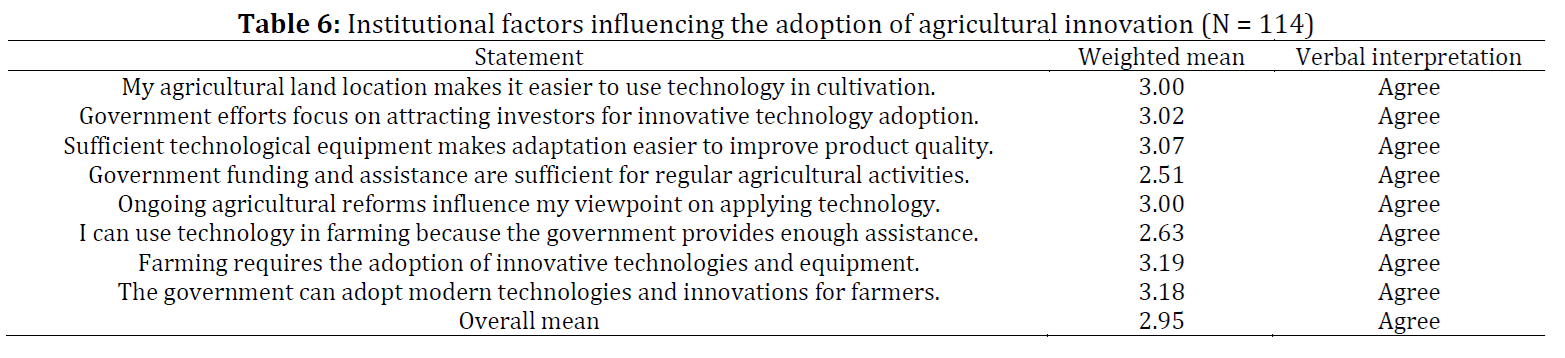
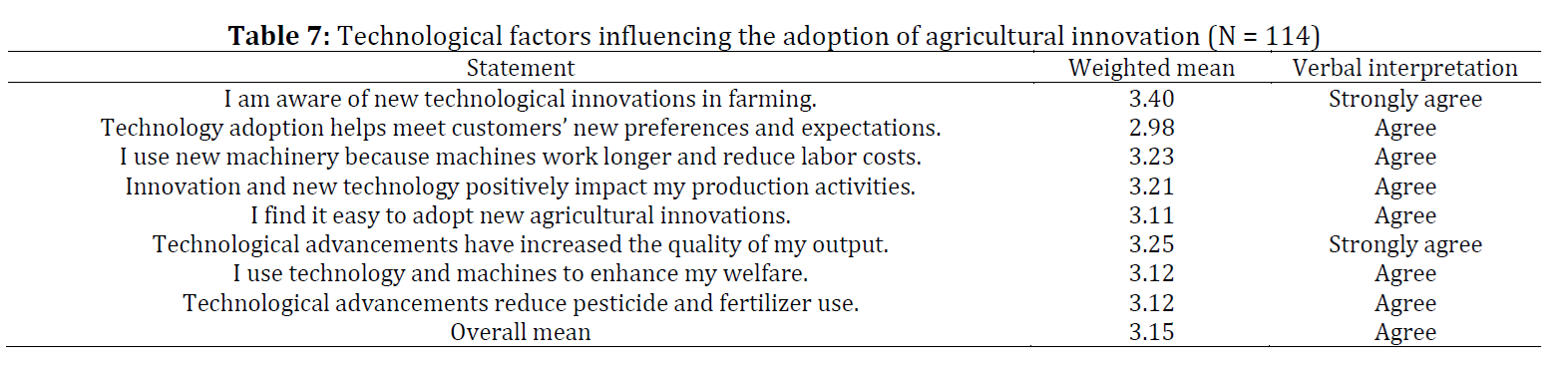
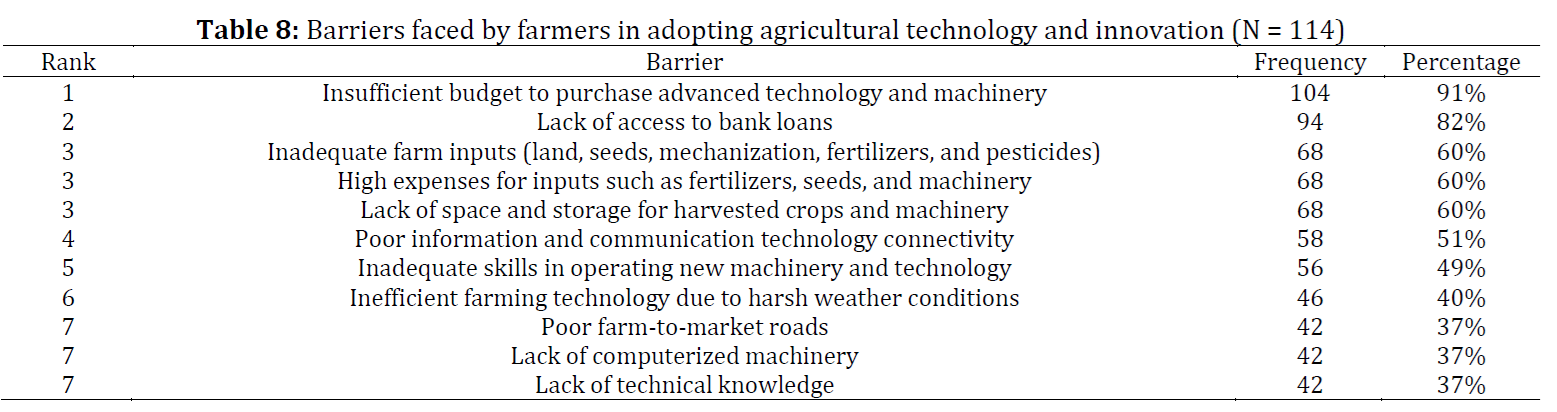
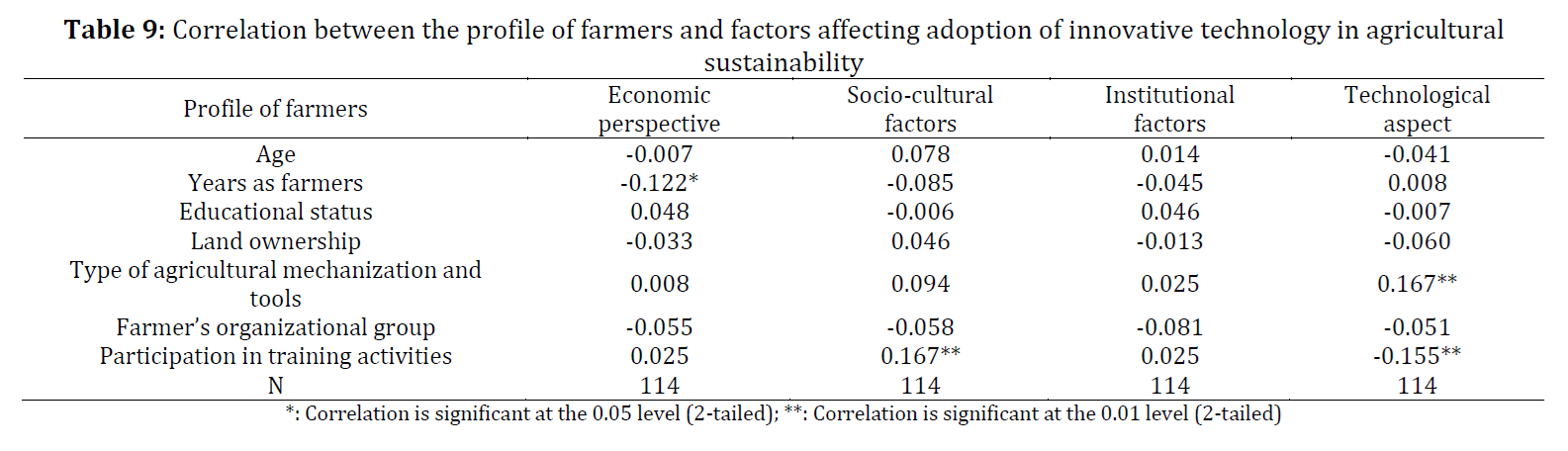
Table 1 Table 2 Table 3 Table 4 Table 5 Table 6 Table 7 Table 8 Table 9

----------------------------------------------
References (8)
Campuzano LR, Hincapié Llanos GA, Zartha Sossa JW, Orozco Mendoza GL, Palacio JC, and Herrera M (2023). Barriers to the adoption of innovations for sustainable development in the agricultural sector—systematic literature review (SLR). Sustainability, 15(5): 4374. https://doi.org/10.3390/su15054374 [Google Scholar]
Chen X and Li T (2022). Diffusion of agricultural technology innovation: Research progress of innovation diffusion in Chinese agricultural science and technology parks. Sustainability, 14(22): 15008. https://doi.org/10.3390/su142215008 [Google Scholar]
Dimitrijević MS (2023). Technological progress in the function of productivity and sustainability of agriculture: The case of innovative countries and the Republic of Serbia. Journal of Agriculture and Food Research, 14: 100856. https://doi.org/10.1016/j.jafr.2023.100856 [Google Scholar]
Kalogiannidis S, Karafolas S, and Chatzitheodoridis F (2024). The key role of cooperatives in sustainable agriculture and agrifood security: Evidence from Greece. Sustainability, 16(16): 7202. https://doi.org/10.3390/su16167202 [Google Scholar]
Kocira A and Staniak M (2025). Role of agriculture in implementing the concept of sustainable food system. Agriculture, 15(10): 1041. https://doi.org/10.3390/books978-3-7258-4190-5 [Google Scholar]
Melesse B (2018). A review on factors affecting adoption of agricultural new technologies in Ethiopia. Journal of Agricultural Science and Food Research, 9(3): 1-4. [Google Scholar]
Rosário J, Madureira L, Marques C, and Silva R (2022). Understanding farmers’ adoption of sustainable agriculture innovations: A systematic literature review. Agronomy, 12(11): 2879. https://doi.org/10.3390/agronomy12112879 [Google Scholar]
- Yokamo S (2020). Adoption of improved agricultural technologies in developing countries: Literature review. International Journal of Food Science and Agriculture, 4(2): 183-190. https://doi.org/10.26855/ijfsa.2020.06.010 [Google Scholar]