
International
ADVANCED AND APPLIED SCIENCES
EISSN: 2313-3724, Print ISSN: 2313-626X
Frequency: 12


Volume 13, Issue 2 (February 2026), Pages: 156-164

----------------------------------------------
Original Research Paper
Legal compliance of freshwater fishermen in Northeastern Thailand
Author(s):
Affiliation(s):
1Faculty of Law, Mahasarakham University, Kham Riang, Thailand
2Faculty of Veterinary Sciences, Mahasarakham University, Muang District, Thailand
3Department of Agricultural Technology (Fisheries), Faculty of Technology, Mahasarakham University, Kham Riang, Thailand
Full text

* Corresponding Author.
 Corresponding author's ORCID profile: https://orcid.org/0000-0002-4969-1338
Digital Object Identifier (DOI)
https://doi.org/10.21833/ijaas.2026.02.016
Abstract
This study examines the legal framework governing freshwater fisheries in the Lam Pao Dam area in northeastern Thailand, focusing on existing challenges and fishermen’s attitudes toward legal compliance. The participants included 20 local fishermen and 3 officers from the Kalasin Freshwater Fisheries Prevention and Suppression Center. Data were collected through surveys, semi-structured interviews, and focus group discussions. The findings indicate that Thailand’s freshwater fisheries legislation is comparable to laws in other countries aimed at protecting aquatic ecosystems. The law includes restrictions on fishing methods, equipment, as well as fishing locations and seasons. Most respondents had extensive fishing experience and a strong understanding of fisheries regulations. They did not express negative attitudes toward the law and did not consider it outdated. However, they emphasized the need for government support, particularly in providing fishing equipment and promoting alternative sources of income to offset losses resulting from legal restrictions. Such support could enhance compliance and contribute to more sustainable law enforcement. The study therefore recommends greater involvement of local fishermen in policy-making processes, including participation in monitoring and evaluation alongside relevant authorities, to support the sustainable development of fisheries in the Lam Pao Dam area.
© 2026 The Authors. Published by IASE.
This is an
Keywords
Freshwater fisheries, Fisheries law, Legal compliance, Government support, Sustainable development
Article history
Received 3 October 2025, Received in revised form 9 February 2026, Accepted 13 February 2026
Acknowledgment
This research was financially supported by the Faculty of Law, Mahasarakham University, Thailand (Grant No. 001/2566).
Compliance with ethical standards
Ethical considerations:
The study was approved by the Human Research Ethics Committee of Mahasarakham University. The license number was 579-554/2024. Oral informed consent was obtained from all fishermen before commencement of the study. Participation was 100% voluntary, and no coercion or undue influence was applied.
Conflict of interest: The author(s) declared no potential conflicts of interest with respect to the research, authorship, and/or publication of this article.Citation:
Muangsean A, Aengwanich W, Kasamesiri P, and Panchan R (2026). Legal compliance of freshwater fishermen in Northeastern Thailand. International Journal of Advanced and Applied Sciences, 13(2): 156-164
Figures
No Figure
Tables
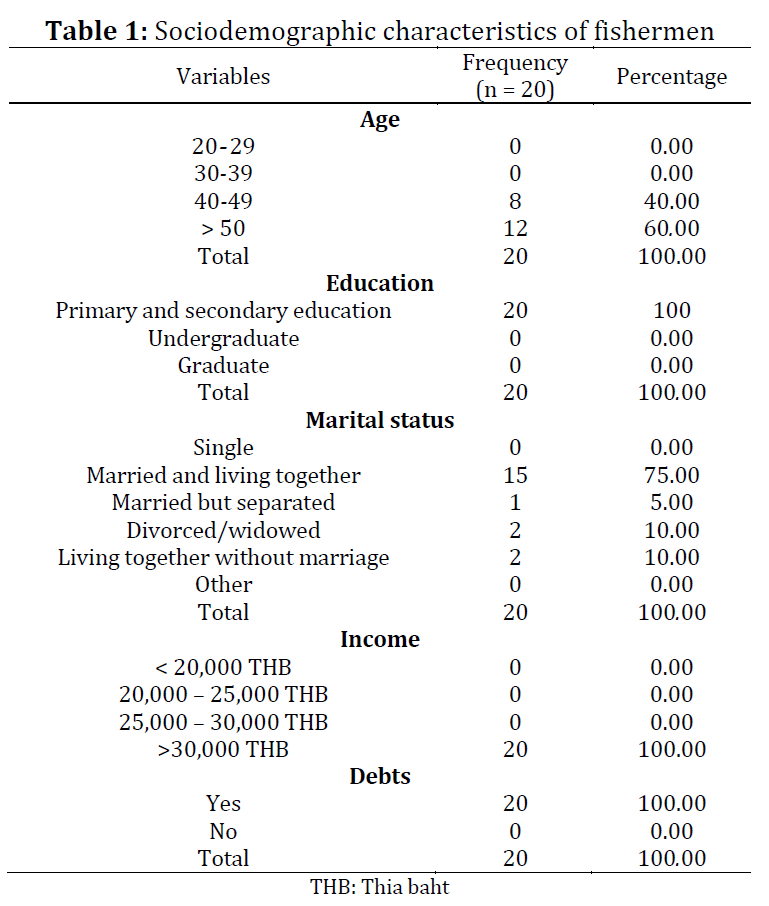
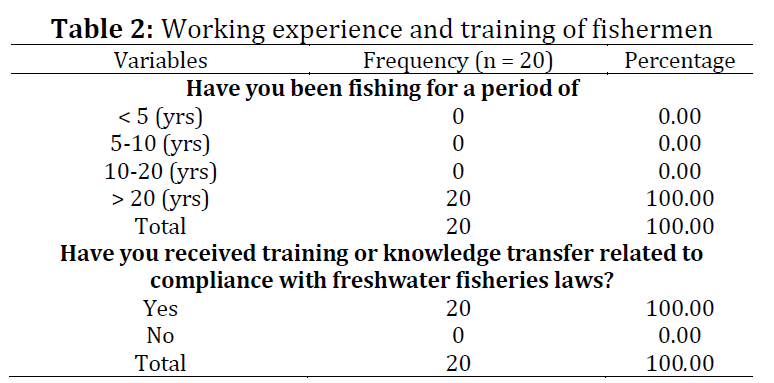
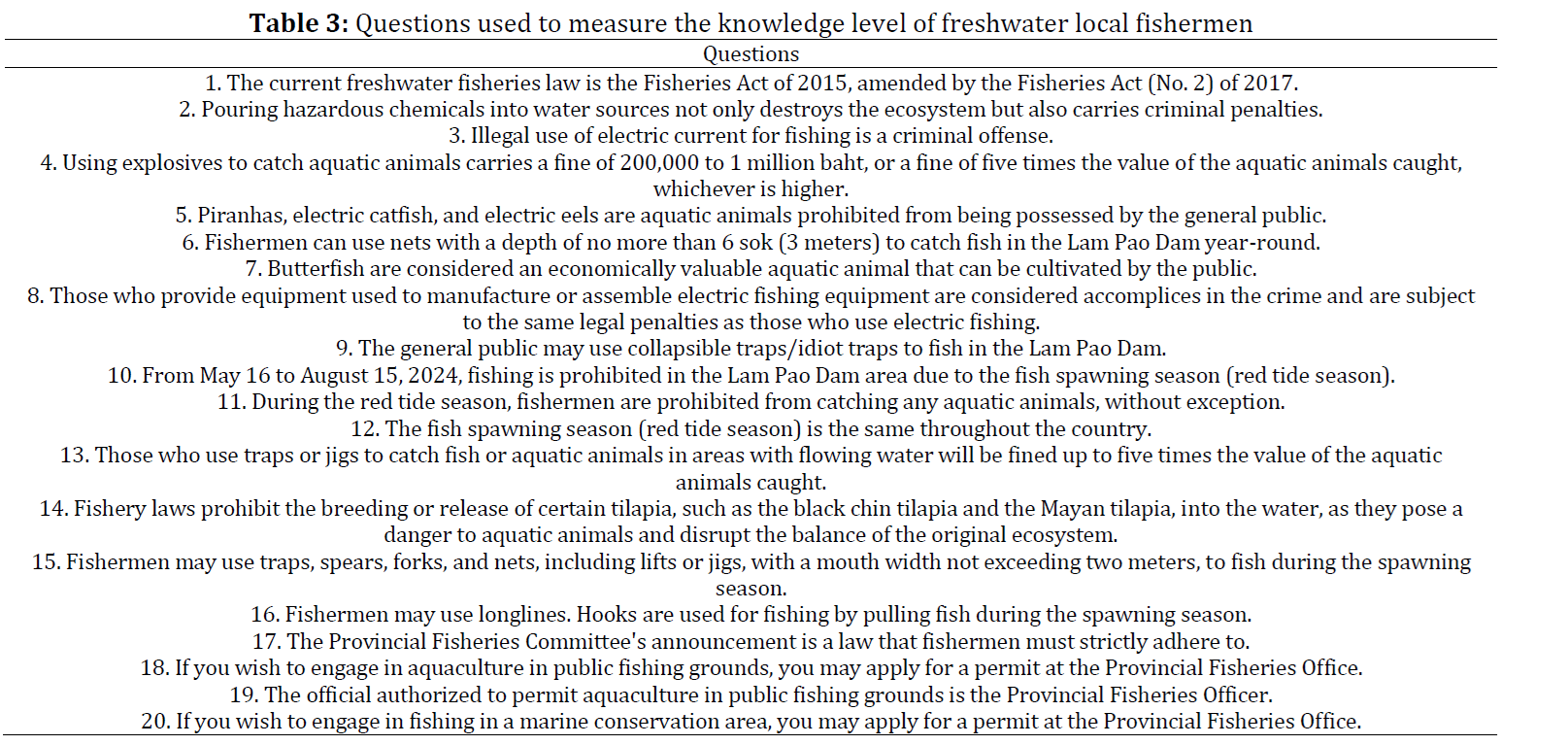
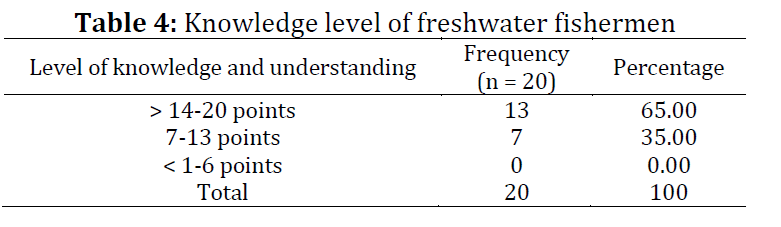
Table 1 Table 2 Table 3 Table 4 Table 5
----------------------------------------------
References (26)
Alam MS and Yousuf A (2024). Fishermen's community livelihood and socio-economic constraints in coastal areas: An exploratory analysis. Environmental Challenges, 14: 100810. https://doi.org/10.1016/j.envc.2023.100810 [Google Scholar]
Alieva D, Usmonova G, Shadmanov S, and Aktamov S (2023). Fishery culture, sustainable resources usage and transformations needed for local community development: The case of Aral Sea. Frontiers in Marine Science, 10: 1285618. https://doi.org/10.3389/fmars.2023.1285618 [Google Scholar]
Amabel DS and Parlee B (2020). Fishing livelihoods and diversifications in the Mekong River Basin in the context of the Pak Mun Dam, Thailand. Sustainability, 12(18): 7438. https://doi.org/10.3390/su12187438 [Google Scholar]
Andreu-Cazenave M, Subida MD, and Fernandez M (2018). Correction: Exploitation rates of two benthic resources across management regimes in central Chile: Evidence of illegal fishing in artisanal fisheries operating in open access areas. PLOS ONE, 13(1): e0191166. https://doi.org/10.1371/journal.pone.0191166 [Google Scholar] PMid:29315337 PMCid:PMC5760086
Bastari A, Mascarell Y, Ortega M, and Coll M (2022). Local fishers experience can contribute to a better knowledge of marine resources in the western Mediterranean Sea. Fisheries Research, 248: 106222. https://doi.org/10.1016/j.fishres.2021.106222 [Google Scholar]
Bawa DY, Garba B, and Jibril M (2024). Assessment and identification of fishing gears used by fishermen in Yauri. EPRA International Journal of Agriculture and Rural Economic Research, 12(4): 12–19. https://doi.org/10.36713/epra16378 [Google Scholar]
Cepić D and Nunan F (2017). Justifying non-compliance: The morality of illegalities in small scale fisheries of Lake Victoria, East Africa. Marine Policy, 86: 104-110. https://doi.org/10.1016/j.marpol.2017.09.018 [Google Scholar]
Garavito-Bermúdez D (2020). Biocultural learning–beyond ecological knowledge transfer. Journal of Environmental Planning and Management, 63(10): 1791-1810. https://doi.org/10.1080/09640568.2019.1688651 [Google Scholar]
Gayo L (2021). Socioeconomic facet of fisheries management in Hombolo Dam, Dodoma-Tanzania. Tanzania Journal of Forestry and Nature Conservation, 90(1): 67-81. [Google Scholar]
He J and Zhang X (2022). China revamping decades-old fisheries law to combat illegal, unreported, and unregulated fishing: Stimulating the intersection of law, technology, and markets. Frontiers in Ecology and Evolution, 10: 777497. https://doi.org/10.3389/fevo.2022.777497 [Google Scholar]
Lapointe NW, Cooke SJ, Imhof JG et al. (2014). Principles for ensuring healthy and productive freshwater ecosystems that support sustainable fisheries. Environmental Reviews, 22(2): 110-134. https://doi.org/10.1139/er-2013-0038 [Google Scholar]
Lindley J (2023). Fishing non-compliance and culture. Marine Policy, 152: 105581. https://doi.org/10.1016/j.marpol.2023.105581 [Google Scholar]
Masese FO, Wanderi EW, and Nyangweso HN (2025). Challenges and strategies for management and conservation of water resources and freshwater biodiversity in the Lake Victoria Basin. Frontiers in Conservation Science, 6: 1544429. https://doi.org/10.3389/fcosc.2025.1544429 [Google Scholar]
Mekonen S, Taddese F, and Mingist M (2025). Nature-based solutions to freshwater fisheries: Challenges and opportunities for their application in Ethiopian fisheries management. Fisheries and Aquatic Sciences, 28(3): 135-151. https://doi.org/10.47853/FAS.2025.e13 [Google Scholar]
Melo FFR, Torre J, Cuevas-Gómez GA, Amador-Castro IG, Velázquez-Castillo MA, and Espinoza-Tenorio A (2024). Inheriting wisdom: Transfer of traditional, scientific, and ecological knowledge in fishing communities in Mexico. Frontiers in Sustainability, 5: 1386259. https://doi.org/10.3389/frsus.2024.1386259 [Google Scholar]
Mulokozi DP, Mmanda FP, Onyango P, Lundh T, Tamatamah R, and Berg H (2020). Rural aquaculture: Assessment of its contribution to household income and farmers’ perception in selected districts, Tanzania. Aquaculture Economics and Management, 24(4): 387-405. https://doi.org/10.1080/13657305.2020.1725687 [Google Scholar]
Nakamura J, Chuenpagdee R, and El Halimi M (2021). Unpacking legal and policy frameworks: A step ahead for implementing the small-scale fisheries guidelines. Marine Policy, 129: 104568. https://doi.org/10.1016/j.marpol.2021.104568 [Google Scholar]
Navarro M, Mahony T, Jarvis D, Stoeckl N, Gelves-Gomez F, and Adams VM (2025). Hooking recreational fishers on sustainable fishing: Consistent psycho-social determinants raise potential for broad scale interventions. Ambio, 55: 360–370. https://doi.org/10.1007/s13280-025-02227-4 [Google Scholar] PMid:40839047 PMCid:PMC12779826
Ogutu‐Ohwayo R and Balirwa JS (2006). Management challenges of freshwater fisheries in Africa. Lakes and Reservoirs: Research and Management, 11(4): 215-226. https://doi.org/10.1111/j.1440-1770.2006.00312.x [Google Scholar]
Pramitasari SD, Gallardo WG, and Ebbers T (2015). Fishers perception and attitude toward local knowledge and local practices and its role in the fisheries management: A case study in Mae Klong River, Samut Songkhram, Thailand. Turkish Journal of Fisheries and Aquatic Sciences, 15(4): 795-804. https://doi.org/10.4194/1303-2712-v15_4_02 [Google Scholar] PMid:32935041
Reid AJ, Carlson AK, Creed IF et al. (2019). Emerging threats and persistent conservation challenges for freshwater biodiversity. Biological Reviews, 94(3): 849-873. https://doi.org/10.1111/brv.12480 [Google Scholar] PMid:30467930
Ryan KL, Syers C, Holtom K, Green T, Lyle JM, Stark KE, and Tracey SR (2025). Recreational fishers’ attitudes to fisheries management and compliance. Marine Policy, 172: 106483. https://doi.org/10.1016/j.marpol.2024.106483 [Google Scholar]
Stacey N, Gibson E, Loneragan NR, Warren C, Wiryawan B, Adhuri DS, Steenbergen DJ, and Fitriana R (2021). Developing sustainable small-scale fisheries livelihoods in Indonesia: Trends, enabling and constraining factors, and future opportunities. Marine Policy, 132: 104654. https://doi.org/10.1016/j.marpol.2021.104654 [Google Scholar]
Susilo E, Purwanti P, Fattah M, Qurrata VA, and Narmaditya BS (2021). Adaptive coping strategies towards seasonal change impacts: Indonesian small-scale fisherman household. Heliyon, 7(4): e06919. https://doi.org/10.1016/j.heliyon.2021.e06919 [Google Scholar] PMid:33997422 PMCid:PMC8105632
Suuronen P (2022). Understanding perspectives and barriers that affect fishers’ responses to bycatch reduction technologies. ICES Journal of Marine Science, 79(4): 1015-1023. https://doi.org/10.1093/icesjms/fsac045 [Google Scholar]
- Yamin L, Kuo TC, and Aziz N (2025). Interplay of traditional knowledge and adaptive capacity in climate change adaptation of small-scale fishers in central Terengganu, Malaysia. Frontiers in Marine Science, 12: 1492131. https://doi.org/10.3389/fmars.2025.1492131 [Google Scholar]