International
ADVANCED AND APPLIED SCIENCES
EISSN: 2313-3724, Print ISSN: 2313-626X
Frequency: 12


Volume 13, Issue 2 (February 2026), Pages: 144-155

----------------------------------------------
Review Paper
Strategic management of the green industry concept for entrepreneurs in Thailand: A systematic literature review
Author(s):
Affiliation(s):
Faculty of Management Science, Silpakorn University, Phetchaburi, Thailand
Full text

* Corresponding Author.
 Corresponding author's ORCID profile: https://orcid.org/0000-0002-4994-8404
Digital Object Identifier (DOI)
https://doi.org/10.21833/ijaas.2026.02.015
Abstract
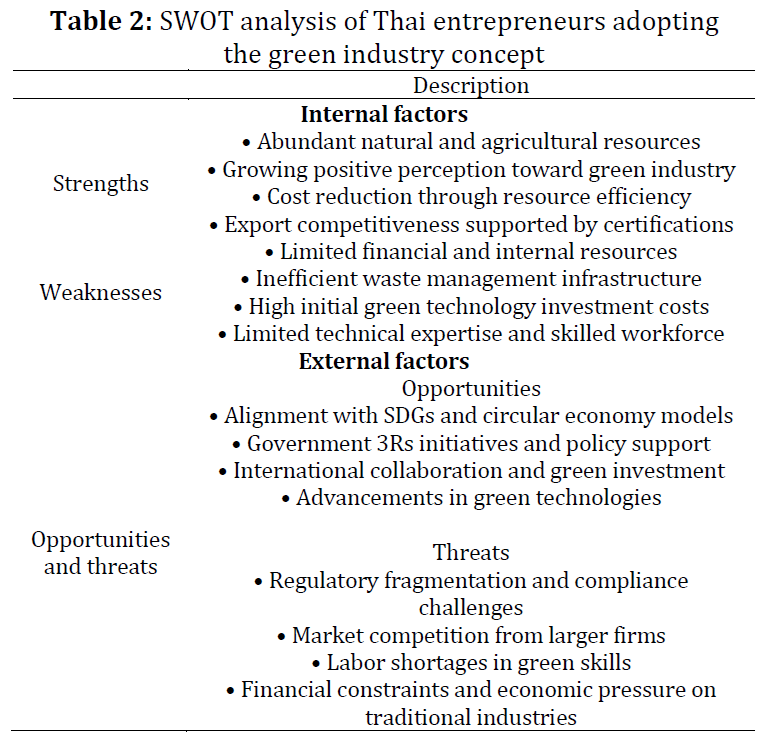
The purpose of this study is to evaluate the strengths, weaknesses, opportunities, and threats of Thai enterprises that implement the green industry concept and to examine appropriate strategic approaches for entrepreneurs who adopt these principles. This study uses documentary research and analyzes secondary data through descriptive analysis, content analysis, SWOT analysis, and the TOWS matrix. The findings indicate that Thai entrepreneurs have integrated green industry practices into their businesses, supported by government policies and incentives. However, they still face challenges, including strong market competition and high investment costs for green technologies. Therefore, strategic planning should focus on the effective use of local natural resources, responding to the increasing demand for sustainable products, building cooperation with governmental and private organizations, and applying cost-efficient green operations to reduce economic pressures on traditional industries. Furthermore, the Thai government should strengthen environmental regulations and provide tax incentives and financial support to businesses that adopt sustainable practices and green technologies.
© 2026 The Authors. Published by IASE.
This is an
Keywords
Strategy, Implementation, Management, Green industry, Sustainable
Article history
Received 24 October 2025, Received in revised form 7 February 2026, Accepted 11 February 2026
Acknowledgment
No Acknowledgment.
Compliance with ethical standards
Conflict of interest: The author(s) declared no potential conflicts of interest with respect to the research, authorship, and/or publication of this article.Citation:
Sakolnakorn TPN (2026). Strategic management of the green industry concept for entrepreneurs in Thailand: A systematic literature review. International Journal of Advanced and Applied Sciences, 13(2): 144-155
Figures
Tables
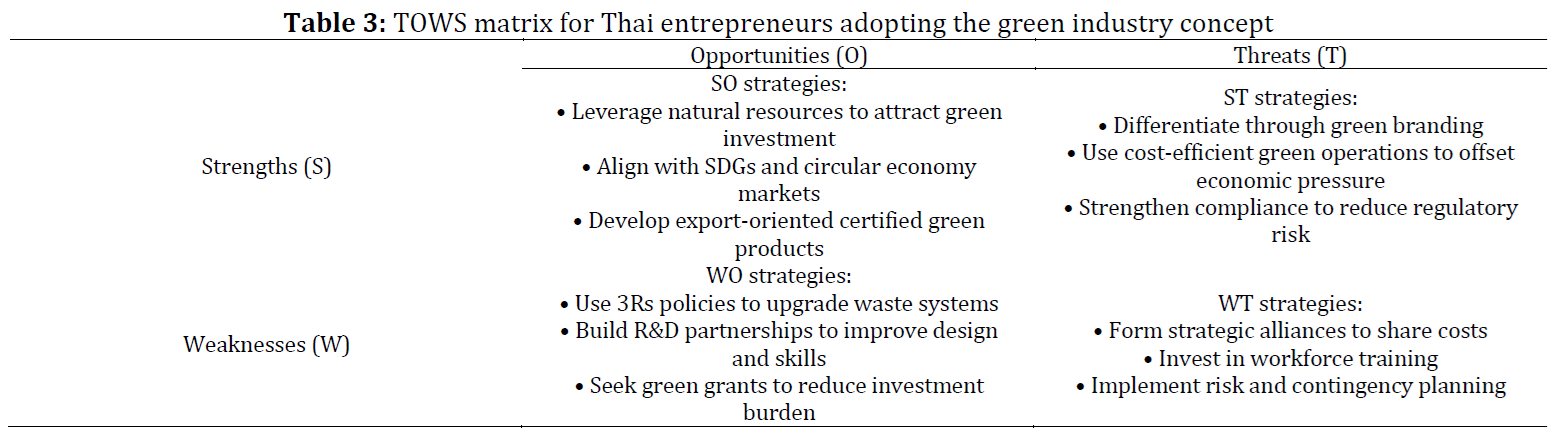
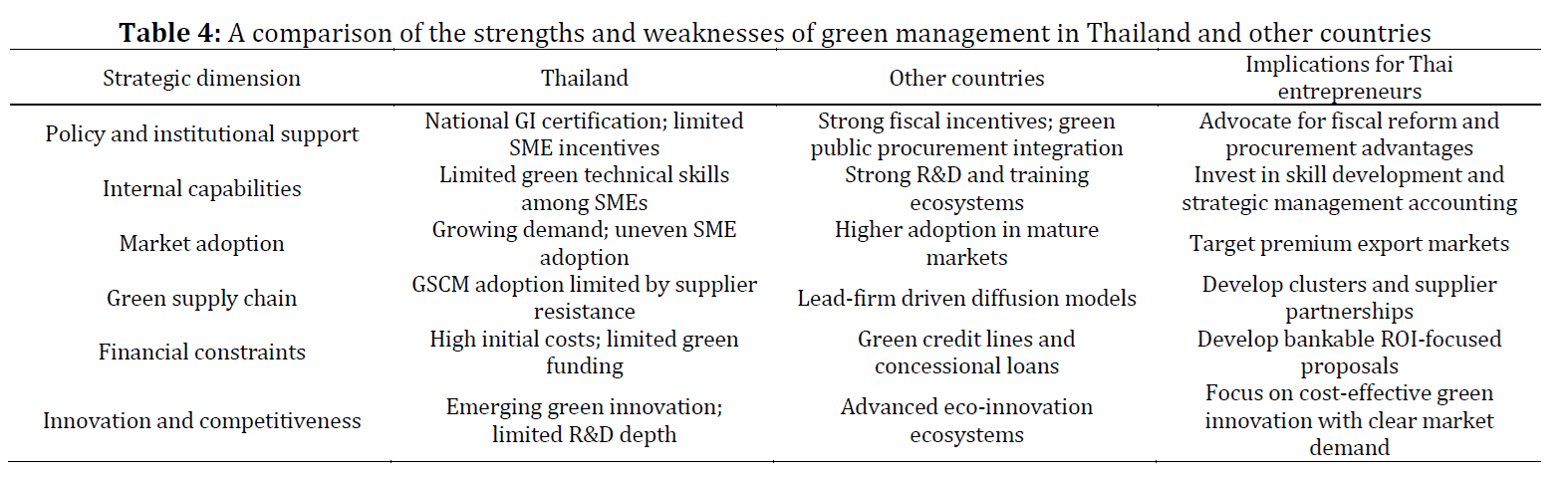
Table 1 Table 2 Table 3 Table 4
----------------------------------------------
References (42)
Abbas A, Luo X, Shahzad F, and Wattoo MU (2023). Optimizing organizational performance in manufacturing: The role of IT capability, green supply chain integration, and green innovation. Journal of Cleaner Production, 423: 138848. https://doi.org/10.1016/j.jclepro.2023.138848 [Google Scholar]
Afum E, Osei-Ahenkan VY, Agyabeng-Mensah Y, Amponsah Owusu J, Kusi LY, and Ankomah J (2020). Green manufacturing practices and sustainable performance among Ghanaian manufacturing SMEs: The explanatory link of green supply chain integration. Management of Environmental Quality: An International Journal, 31(6): 1457-1475. https://doi.org/10.1108/MEQ-01-2020-0019 [Google Scholar]
Al-Hakimi MA, Al-Swidi AK, Gelaidan HM, and Mohammed A (2022). The influence of green manufacturing practices on the corporate sustainable performance of SMEs under the effect of green organizational culture: A moderated mediation analysis. Journal of Cleaner Production, 376: 134346. https://doi.org/10.1016/j.jclepro.2022.134346 [Google Scholar]
Alkaraan F, Elmarzouky M, Hussainey K, Venkatesh VG, Shi Y, and Gulko N (2024). Reinforcing green business strategies with Industry 4.0 and governance towards sustainability: Natural‐resource‐based view and dynamic capability. Business Strategy and the Environment, 33(4): 3588-3606. https://doi.org/10.1002/bse.3665 [Google Scholar]
Amornkitvikai Y, O'Brien M, and Bhula-or R (2024). Toward green production practices: Empirical evidence from Thai manufacturers' technical efficiency. Journal of Asian Business and Economic Studies, 31(3): 216-232. https://doi.org/10.1108/JABES-05-2023-0151 [Google Scholar]
Asiaei K, O'Connor NG, Barani O, and Joshi M (2023). Green intellectual capital and ambidextrous green innovation: The impact on environmental performance. Business Strategy and the Environment, 32(1): 369-386. https://doi.org/10.1002/bse.3136 [Google Scholar]
Atkins E (2024). Levelling up as green industrial policy. Contemporary Social Science, 19(4): 495-513. https://doi.org/10.1080/21582041.2024.2418123 [Google Scholar]
Bendig D, Kleine-Stegemann L, and Gisa K (2023). The green manufacturing framework: A systematic literature review. Cleaner Engineering and Technology, 13: 100613. https://doi.org/10.1016/j.clet.2023.100613 [Google Scholar]
Dahlquist SH (2021). How green product demands influence industrial buyer/seller relationships, knowledge, and marketing dynamic capabilities. Journal of Business Research, 136: 402-413. https://doi.org/10.1016/j.jbusres.2021.07.045 [Google Scholar]
D'Amato D and Korhonen J (2021). Integrating the green economy, circular economy and bioeconomy in a strategic sustainability framework. Ecological Economics, 188: 107143. https://doi.org/10.1016/j.ecolecon.2021.107143 [Google Scholar]
Fujii H and Managi S (2019). Decomposition analysis of sustainable green technology inventions in China. Technological Forecasting and Social Change, 139: 10-16. https://doi.org/10.1016/j.techfore.2018.11.013 [Google Scholar]
Goyal A, Agrawal R, and Saha CR (2019). Quality management for sustainable manufacturing: Moving from number to impact of defects. Journal of Cleaner Production, 241: 118348. https://doi.org/10.1016/j.jclepro.2019.118348 [Google Scholar]
Grillitsch M and Hansen T (2019). Green industry development in different types of regions. European Planning Studies, 27(11): 2163-2183. https://doi.org/10.1080/09654313.2019.1648385 [Google Scholar]
Haldorai K, Kim WG, and Fernando Garcia RF (2022). Top management green commitment and green intellectual capital as enablers of hotel environmental performance: The mediating role of green human resource management. Tourism Management, 88: 104431. https://doi.org/10.1016/j.tourman.2021.104431 [Google Scholar]
Harrison A, Martin LA, and Nataraj S (2017). Green industrial policy in emerging markets. Annual Review of Resource Economics, 9: 253-274. https://doi.org/10.1146/annurev-resource-100516-053445 [Google Scholar]
Jaroensombut L, Yiengthaisong A, and Sakolnakorn TPN (2025). Corporate social responsibility management for sustainable development: A systematic literature review. International Journal of Advanced and Applied Sciences, 12(1): 172-183. https://doi.org/10.21833/ijaas.2025.01.017 [Google Scholar]
Kannan D, Shankar KM, and Gholipour P (2022). Paving the way for a green transition through mitigation of green manufacturing challenges: A systematic literature review. Journal of Cleaner Production, 368: 132578. https://doi.org/10.1016/j.jclepro.2022.132578 [Google Scholar]
Khan AN, Mehmood K, and Kwan HK (2024). Green knowledge management: A key driver of green technology innovation and sustainable performance in the construction organizations. Journal of Innovation and Knowledge, 9(1): 100455. https://doi.org/10.1016/j.jik.2023.100455 [Google Scholar]
Larsen ML and Dupuy K (2023). Greening industry: Opportunities and challenges in electricity access for Norwegian industry firms. Journal of Cleaner Production, 396: 136534. https://doi.org/10.1016/j.jclepro.2023.136534 [Google Scholar]
Lievano Pulido YP, and Ramon-Jeronimo MA (2023). Green marketing: A bibliographic perspective. Sustainability, 15(24): 16674. https://doi.org/10.3390/su152416674 [Google Scholar]
Liu Y, Zhu J, Li EY, Meng Z, and Song Y (2020). Environmental regulation, green technological innovation, and eco-efficiency: The case of Yangtze River Economic Belt in China. Technological Forecasting and Social Change, 155: 119993. https://doi.org/10.1016/j.techfore.2020.119993 [Google Scholar]
Lutfi A, Alqudah H, Alrawad M, Alshira'h AF, Alshirah MH, Almaiah MA, and Hassan MF (2023). Green environmental management system to support environmental performance: What factors influence SMEs to adopt green innovations? Sustainability, 15(13): 10645. https://doi.org/10.3390/su151310645 [Google Scholar]
Mensah K, Wieck C, and Rudloff B (2024). Sustainable food consumption and sustainable development goal 12: Conceptual challenges for monitoring and implementation. Sustainable Development, 32(1): 1109-1119. https://doi.org/10.1002/sd.2718 [Google Scholar]
Mungkung R, Sorakon K, Sitthikitpanya S, and Gheewala SH (2021). Analysis of green product procurement and ecolabels towards sustainable consumption and production in Thailand. Sustainable Production and Consumption, 28: 11-20. https://doi.org/10.1016/j.spc.2021.03.024 [Google Scholar]
Narassimhan E, Myslikova Z, and Gallagher KS (2024). Strategies for green industrial and innovation policy–an analysis of policy alignment, misalignment, and realignment around dominant designs in the EV sector. Environmental Research Letters, 19(1): 014029. https://doi.org/10.1088/1748-9326/ad101e [Google Scholar]
Nyangchak N (2022). Emerging green industry toward net-zero economy: A systematic review. Journal of Cleaner Production, 378: 134622. https://doi.org/10.1016/j.jclepro.2022.134622 [Google Scholar]
Okafor A, Adeleye BN, and Adusei M (2021). Corporate social responsibility and financial performance: Evidence from US tech firms. Journal of Cleaner Production, 292: 126078. https://doi.org/10.1016/j.jclepro.2021.126078 [Google Scholar]
Omar A, Al-Shari A, Shah SHA, Erkol Bayram G, Zameer Rahman E, and Valeri M (2024). Green manufacturing practices and SMEs’ sustainable performance: A moderated mediation mechanisms of green innovation and managerial discretion. European Business Review, 36(4): 588-609. https://doi.org/10.1108/EBR-06-2023-0186 [Google Scholar]
Papadas KK, Avlonitis GJ, and Carrigan M (2017). Green marketing orientation: Conceptualization, scale development and validation. Journal of Business Research, 80: 236-246. https://doi.org/10.1016/j.jbusres.2017.05.024 [Google Scholar]
Petroselli A, Florek J, Młyński D, Książek L, and Wałęga A (2020). New insights on flood mapping procedure: Two case studies in Poland. Sustainability, 12(20): 8454. https://doi.org/10.3390/su12208454 [Google Scholar]
Piyathanavong V, Garza-Reyes JA, Kumar V, Maldonado-Guzmán G, and Mangla SK (2019). The adoption of operational environmental sustainability approaches in the Thai manufacturing sector. Journal of Cleaner Production, 220: 507-528. https://doi.org/10.1016/j.jclepro.2019.02.093 [Google Scholar]
Ren X and Mia MA (2025). The determinants of green innovations in manufacturing industries: A systematic literature review. Future Business Journal, 11: 42. https://doi.org/10.1186/s43093-025-00461-6 [Google Scholar]
Sarasi V, Primiana I, Harsanto B, and Satyakti Y (2024). Sustainable supply chain of Indonesia’s textile and apparel industry: Opportunities and challenges. Research Journal of Textile and Apparel, 28(4): 819-838. https://doi.org/10.1108/RJTA-08-2022-0091 [Google Scholar]
Siedschlag I, Meneto S, and Tong Koecklin M (2022). Enabling green innovations for the circular economy: What factors matter? Sustainability, 14(19): 12314. https://doi.org/10.3390/su141912314 [Google Scholar]
Soleimani M, Mollaei E, Beinabaj MH, and Salamzadeh A (2023). Evaluating the enablers of green entrepreneurship in circular economy: Organizational enablers in focus. Sustainability, 15(14): 11253. https://doi.org/10.3390/su151411253 [Google Scholar]
Song C, Liu Z, Yuan M, and Zhao C (2024). From text to effectiveness: Quantifying green industrial policies in China. Journal of Cleaner Production, 446: 141445. https://doi.org/10.1016/j.jclepro.2024.141445 [Google Scholar]
Suma Y, Polprasert C, and Eaktasang N (2026). Urban waste composition associated with online food delivery in Bangkok, Thailand, with emphasis on plastic waste management. Urban Science, 10(1): 38. https://doi.org/10.3390/urbansci10010038 [Google Scholar]
Tsai SB, Liu W, and Yuan Y (2023). Guest editorial: New challenges and opportunities for green industry development. Kybernetes, 52(2): 493-494. https://doi.org/10.1108/K-02-2023-999 [Google Scholar]
Veugelers R, Tagliapietra S, and Trasi C (2024). Green industrial policy in Europe: Past, present, and prospects. Journal of Industry, Competition and Trade, 24: 4. https://doi.org/10.1007/s10842-024-00418-5 [Google Scholar]
Wichai-Utcha N and Chavalparit O (2019). 3Rs Policy and plastic waste management in Thailand. Journal of Material Cycles and Waste Management, 21: 10-22. https://doi.org/10.1007/s10163-018-0781-y [Google Scholar]
Youngswaing W, Jomnonkwao S, Cheunkamon E, and Ratanavaraha V (2024). Key factors shaping green logistics in Thailand’s auto industry: An application of structural equation modeling. Logistics, 8(1): 17. https://doi.org/10.3390/logistics8010017 [Google Scholar]
- Younnes D (2023). The impact of lean manufacturing practices on green sustainability: The case of Abdulghani company. European Journal of Business and Management Research, 8(3): 62-67. https://doi.org/10.24018/ejbmr.2023.8.3.1905 [Google Scholar]