International
ADVANCED AND APPLIED SCIENCES
EISSN: 2313-3724, Print ISSN: 2313-626X
Frequency: 12


Volume 13, Issue 2 (February 2026), Pages: 89-99

----------------------------------------------
Original Research Paper
A multidimensional framework for understanding career disinterest in software testing: A cultural, economic, and curriculum-based review
Author(s):
Affiliation(s):
1Higher Education Leadership Institute (HELI), Melbourne, Australia
2Asia Pacific International College (APIC), Sydney, Australia
3Department of Information Systems, Faculty of Computing and Information Technology in Rabigh, King Abdulaziz University, Jeddah, Saudi Arabia
4Department of Software Engineering, College of Computer Science and Engineering, University of Jeddah, Jeddah, Saudi Arabia
5Department of Computer Science, University of Tabuk, Tabuk, Saudi Arabia
6Department of Software Engineering, College of Computer Science and Engineering, University of Hafr Al Batin, Hafar Al-Batin, Saudi Arabia
Full text

* Corresponding Author.
 Corresponding author's ORCID profile: https://orcid.org/0000-0002-8512-578X
Digital Object Identifier (DOI)
https://doi.org/10.21833/ijaas.2026.02.010
Abstract
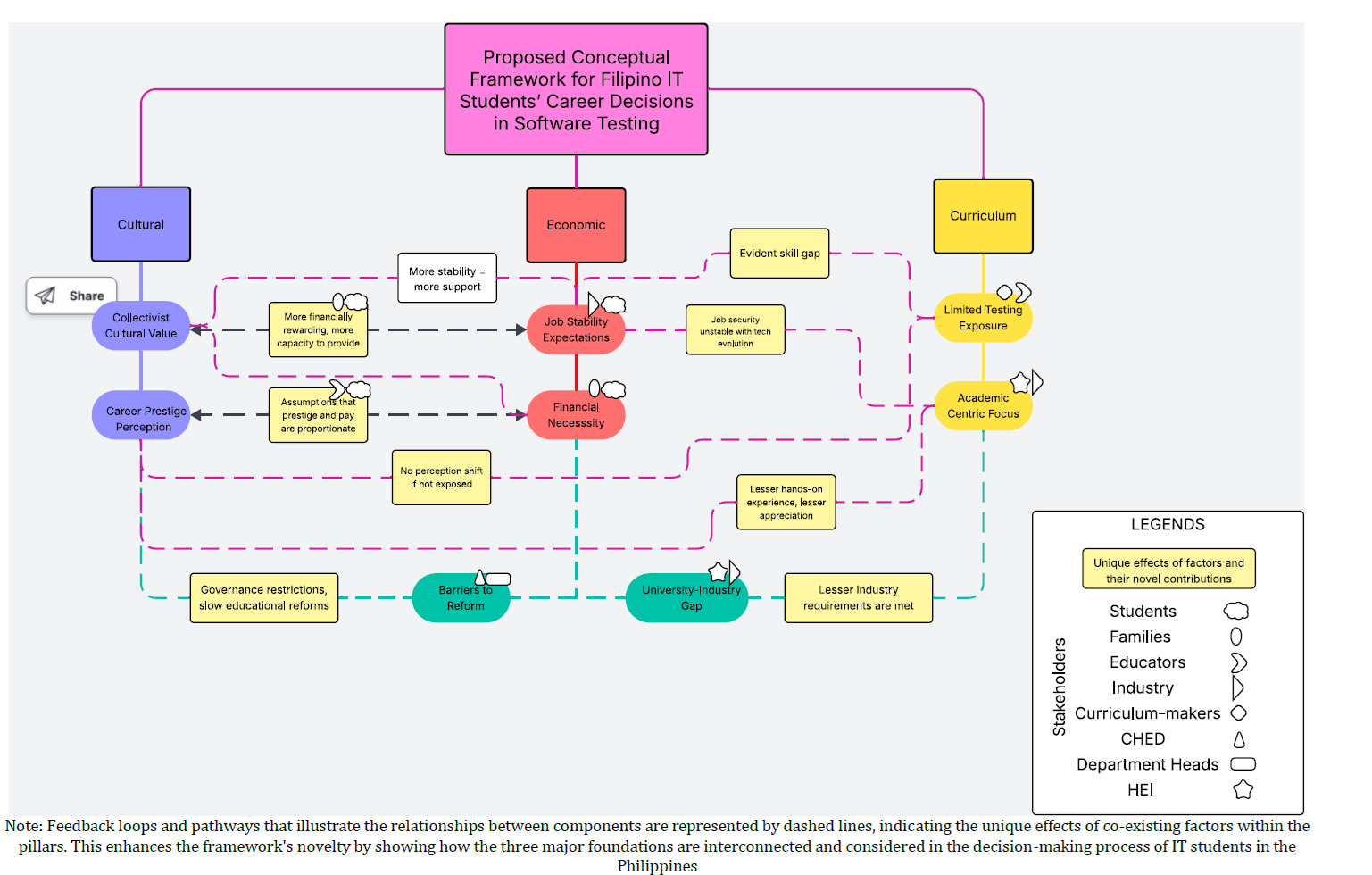
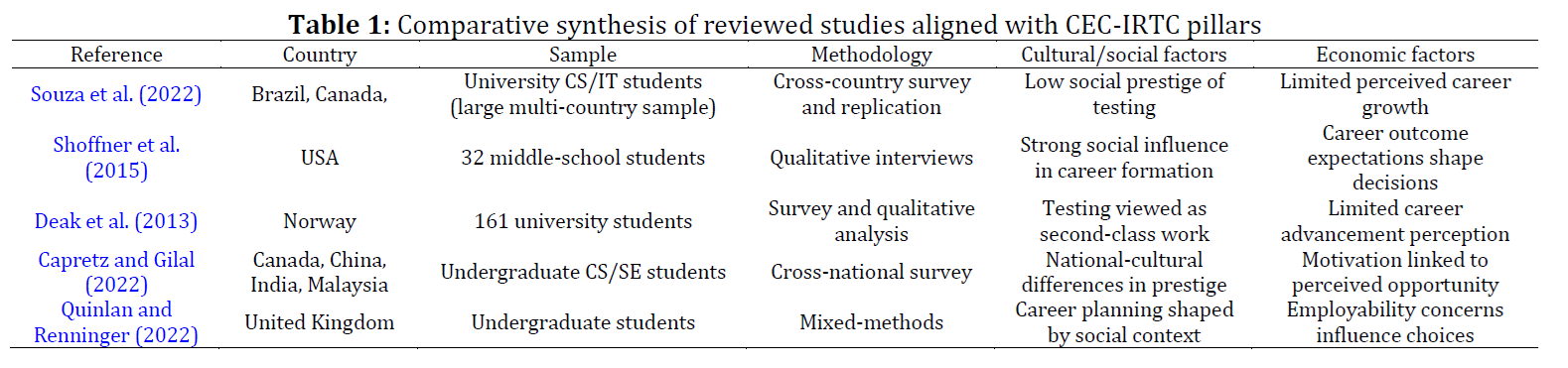
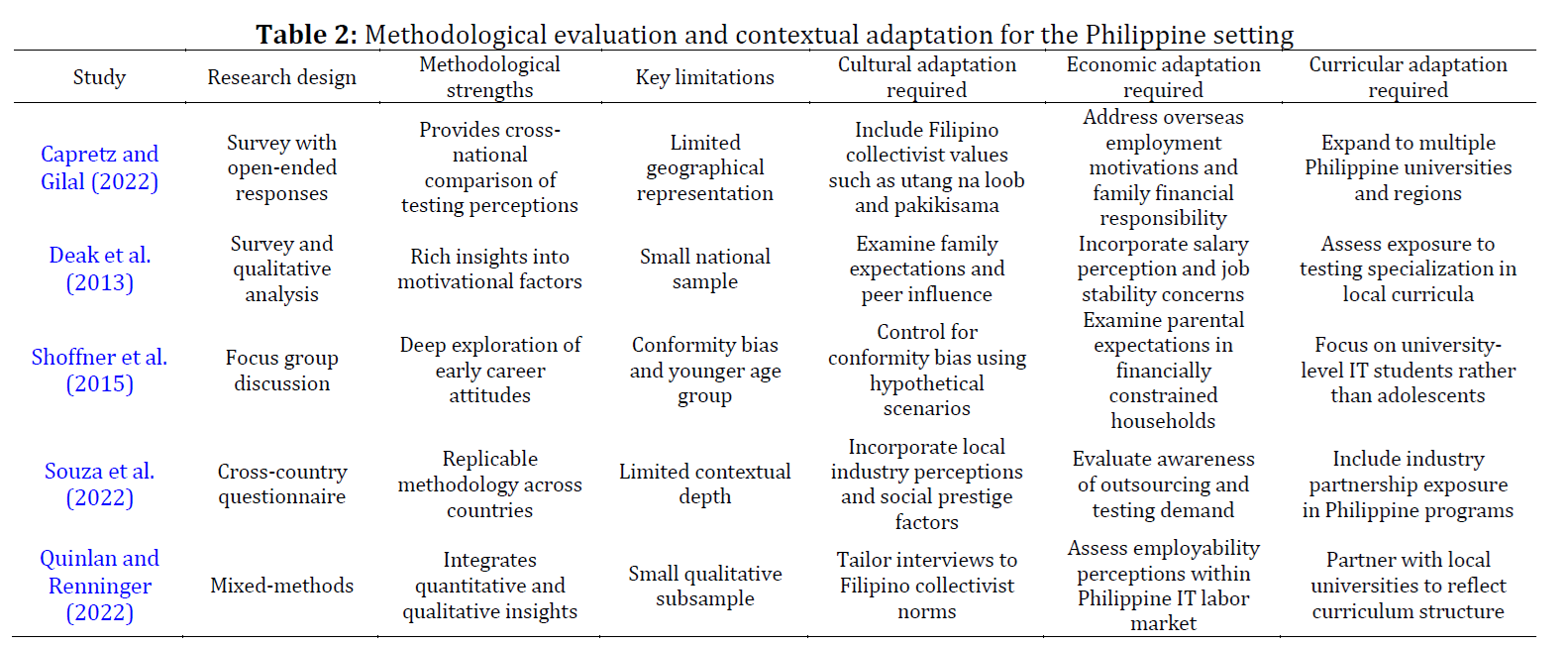
The aim of this research is to examine the global lack of interest in software testing careers among IT students and to propose culturally grounded reforms for the Philippine context. Although demand for software testing professionals continues to grow, students in many countries perceive testing as repetitive, low in prestige, and limited in career progression. This narrative review uses thematic synthesis to analyze peer-reviewed studies published between 2013 and 2024 from Pakistan, Brazil, India, China, Norway, the United Kingdom, and the United States. The findings identify three key factors influencing career reluctance: cultural influences, economic considerations, and curriculum-related gaps. In the Philippines, cultural values such as utang na loob (debt of gratitude) and pakikisama (group harmony) play an important role in shaping career choices, often discouraging interest in software testing roles. Based on these findings, the study proposes the Cultural–Economic–Curriculum Influences on Reluctance Testing Careers (CEC-IRTC) framework to support curriculum reform, industry–academe collaboration, and culturally sensitive career guidance. Further empirical research is recommended to inform policy and educational practice.
© 2026 The Authors. Published by IASE.
This is an
Keywords
Software testing careers, Student career perceptions, Cultural influences, Curriculum gaps, Philippine higher education
Article history
Received 29 September 2025, Received in revised form 1 February 2026, Accepted 4 February 2026
Acknowledgment
No Acknowledgment.
Compliance with ethical standards
Conflict of interest: The author(s) declared no potential conflicts of interest with respect to the research, authorship, and/or publication of this article.
Citation:
Carrido CJM, Alsadoon A, Al-Dala’in T, Osman AH, Elsafi A, Qismallah A, and Abuobieda A (2026). A multidimensional framework for understanding career disinterest in software testing: A cultural, economic, and curriculum-based review. International Journal of Advanced and Applied Sciences, 13(2): 89-99
Figures
Tables
----------------------------------------------
References (25)
Akosah-Twumasi P, Emeto TI, Lindsay D, Tsey K, and Malau-Aduli BS (2018). A systematic review of factors that influence youths career choices: The role of culture. Frontiers in Education, 3: 58. https://doi.org/10.3389/feduc.2018.00058 [Google Scholar]
Alampay LP (2024). Cultural values, parenting and child adjustment in the Philippines. International Journal of Psychology, 59(4): 568-577. https://doi.org/10.1002/ijop.13117 [Google Scholar] PMid:38320969 PMCid:PMC11257813
Asok Kumar D, Lau PL, Chua KH, Voon SP, and Lo YY (2024). Career adaptability across Southeast Asia: A systematic review. SAGE Open, 14(4). https://doi.org/10.1177/21582440241289737 [Google Scholar]
Capretz LF and Gilal AR (2022). What Pakistani computer science and software engineering students think about software testing? In the 2022 29th Asia-Pacific Software Engineering Conference (APSEC), IEEE, Tokyo, Japan: 574-575. https://doi.org/10.1109/APSEC57359.2022.00087 [Google Scholar]
Chen H, Liu F, Wen Y, Ling L, Chen S, Ling H, and Gu X (2021). Career exploration of high school students: Status quo, challenges, and coping model. Frontiers in Psychology, 12: 672303. https://doi.org/10.3389/fpsyg.2021.672303 [Google Scholar] PMid:34630199 PMCid:PMC8498104
Deak A, Stålhane T, and Cruzes D (2013). Factors influencing the choice of a career in software testing among Norwegian students. In the Proceedings of the Conference on Software Engineering (CSE 2013), Acta Press, Innsbruck, Austria: 1-8. https://doi.org/10.2316/P.2013.796-032 [Google Scholar]
Digamon J and De La Peña JN (2021). Attitudes of senior high school students towards career decision making. JPAIR Institutional Research, 16(1): 72-89. https://doi.org/10.7719/irj.v16i1.617 [Google Scholar]
Donato JPJ, Panotan AG, Castro FJU, and Gavino RA (2023). The concept of utang na loob among Filipino working millennials. Formosa Journal of Social Sciences, 2(3): 369-396. https://doi.org/10.55927/fjss.v2i3.4572 [Google Scholar]
Fernando Capretz L, Waychal P, Jia J, and B Basri S (2021). Comparing the popularity of testing careers among Canadian, Indian, Chinese, and Malaysian students. In the Proceedings of the 3rd International Conference on Advanced Information Science and System, Association for Computing Machinery, Sanya, China: 1-7. https://doi.org/10.1145/3503047.3503091 [Google Scholar]
Hadiyati MA and Astuti B (2023). Student careers: What factors influence career choice? Journal of Education Research and Evaluation, 7(4): 608-614. https://doi.org/10.23887/jere.v7i4.61686 [Google Scholar]
Kankanhalli A, Tan BC, Wei KK, and Holmes MC (2004). Cross-cultural differences and information systems developer values. Decision Support Systems, 38(2): 183-195. https://doi.org/10.1016/S0167-9236(03)00101-5 [Google Scholar]
Koçak O, Ergin M, and Younis MZ (2022). The associations between childhood experiences and occupational choice capability, and the mediation of societal gender roles. Healthcare, 10(6): 1004. https://doi.org/10.3390/healthcare10061004 [Google Scholar] PMid:35742055 PMCid:PMC9223097
Lalantacon XF, Bayogos LS, Bawe A, Abad AJ, and Decena III J (2024). Promoting SDG4 (quality education): The influence of family on career decisions among ABM students at Tacurong National High School. Psychology and Education: A Multidisciplinary Journal, 22(6): 744–750. [Google Scholar]
Nazareno A, Lopez-Relente MJF, Gestiada GA, Martinez MP, De Lara MLD, and Roxas-Villanueva RM (2021). Factors associated with career track choice of senior high school students. Philippine Journal of Science, 150(5): 1043-1060. https://doi.org/10.56899/150.05.15 [Google Scholar]
Pasha A and Siddiqui DA (2020). Factors influencing professional selection choices: Evidence from Pakistan. https://doi.org/10.2139/ssrn.3641642 [Google Scholar]
Quinlan KM and Renninger KA (2022). Rethinking employability: How students build on interest in a subject to plan a career. Higher Education, 84: 863-883. https://doi.org/10.1007/s10734-021-00804-6 [Google Scholar]
Ray A, Bala PK, Dasgupta SA, and Srivastava A (2020). Understanding the factors influencing career choices in India: From the students' perspectives. International Journal of Indian Culture and Business Management, 20(2): 175-193. https://doi.org/10.1504/IJICBM.2020.105641 [Google Scholar]
Rothman M and Sisman R (2016). Internship impact on career consideration among business students. Education+Training, 58(9): 1003-1013. https://doi.org/10.1108/ET-04-2015-0027 [Google Scholar]
Sharif N, Ahmad N, and Sarwar S (2019). Factors influencing career choices. IBT Journal of Business Studies, 15(1): 33-46. https://doi.org/10.46745/ilma.jbs.2019.15.01.03 [Google Scholar]
Shoffner MF, Newsome D, Barrio Minton CA, and Wachter Morris CA (2015). A qualitative exploration of the STEM career-related outcome expectations of young adolescents. Journal of Career Development, 42(2): 102-116. https://doi.org/10.1177/0894845314544033 [Google Scholar]
Souza REC, de Souza Santos RE, Capretz LF, de Sousa MA, and de Magalhães CV (2022). Roadblocks to attracting students to software testing careers: Comparisons of replicated studies. In: Vallecillo A, Visser J, and Pérez-Castillo R (Eds.), Quality of Information and Communications Technology. QUATIC 2022. Communications in Computer and Information Science, 1621: 127-139. Springer, Cham, Switzerland. https://doi.org/10.1007/978-3-031-14179-9_9 [Google Scholar]
Thomas P, John D, and Thomas L (2024). Factors influencing career decision of undergraduate and postgraduate students: An Indian context. Higher Education, Skills and Work-Based Learning, 14(1): 95-108. https://doi.org/10.1108/HESWBL-09-2022-0189 [Google Scholar]
Vautero J, Silva AD, and do Céu Taveira M (2021). Family influence on undergraduates' career choice implementation. International Journal for Educational and Vocational Guidance, 21: 551-570. https://doi.org/10.1007/s10775-020-09453-0 [Google Scholar]
Wei LZ, Zhou SS, Hu S, Zhou Z, and Chen J (2021). Influences of nursing students' career planning, internship experience, and other factors on professional identity. Nurse Education Today, 99: 104781. https://doi.org/10.1016/j.nedt.2021.104781 [Google Scholar] PMid:33530029
- Zialcita FN (2020). Universalizing local values through ‘lifting up.’ Social Transformations: Journal of the Global South, 8(1): 5-39. https://doi.org/10.13185/3271 [Google Scholar]