International
ADVANCED AND APPLIED SCIENCES
EISSN: 2313-3724, Print ISSN: 2313-626X
Frequency: 12


Volume 13, Issue 2 (February 2026), Pages: 70-80

----------------------------------------------
Original Research Paper
Bilingual education for primary students in Vietnam’s Mekong Delta: Roles of contextual, community, and family factors
Author(s):
Affiliation(s):
Faculty of Education, University of Social Sciences and Humanities, Vietnam National University, Ho Chi Minh City, Vietnam
Full text

* Corresponding Author.
 Corresponding author's ORCID profile: https://orcid.org/0000-0001-9229-8526
Digital Object Identifier (DOI)
https://doi.org/10.21833/ijaas.2026.02.008
Abstract
Bilingual education is an important approach for improving academic achievement, promoting language equity, and preserving cultural identity in multilingual settings. In Vietnam’s Mekong Delta, Khmer–Vietnamese Bilingual Education (KhVBE) supports the use of Vietnamese as the national language while maintaining the Khmer language and culture. This study investigates the factors influencing the effectiveness of KhVBE, with a focus on three key constructs: Contexts for the Application of Bilingual Education (CABE), Community Factors (CF), and Family Factors (FF). Survey data were collected from 269 school administrators and teachers and analyzed using Partial Least Squares Structural Equation Modeling (PLS-SEM). The results indicate that CABE and CF have strong and significant effects on KhVBE effectiveness, emphasizing the roles of institutional support, program structure, and community involvement. In contrast, FF does not show a significant effect, suggesting that family influence is more indirect. Overall, the findings highlight the importance of strong school and community environments in sustaining bilingual education and provide policy implications for improving teacher training, enhancing educational resources, and strengthening community partnerships. Recommendations for university administrators and other stakeholders are also discussed.
© 2026 The Authors. Published by IASE.
This is an
Keywords
Bilingual education, Khmer–Vietnamese education, Community engagement, Educational context, Program effectiveness
Article history
Received 20 September 2025, Received in revised form 22 January 2026, Accepted 2 February 2026
Acknowledgment
This research is funded by Vietnam National University Ho Chi Minh City under grant number B2024-18b-03.
Compliance with ethical standards
Ethical considerations
This study was reviewed and approved by the Ethics Review Board (ERB) of the University of Social Sciences and Humanities, Vietnam National University – Ho Chi Minh City (USSH, VNU-HCM) (ERB application number: 10-2025; approval date: 29 April 2025). All procedures were conducted in accordance with institutional ethical guidelines for research involving human participants. Participation was voluntary, informed consent was obtained from all respondents prior to data collection, and anonymity and confidentiality were strictly maintained. No personally identifiable information was collected, and all data were used solely for academic research purposes.
Conflict of interest: The author(s) declared no potential conflicts of interest with respect to the research, authorship, and/or publication of this article.
Citation:
Duong MQ, Nguyen VTT, Nguyen VT, and Bach TND (2026). Bilingual education for primary students in Vietnam’s Mekong Delta: Roles of contextual, community, and family factors. International Journal of Advanced and Applied Sciences, 13(2): 70-80
Figures
No Figure
Tables
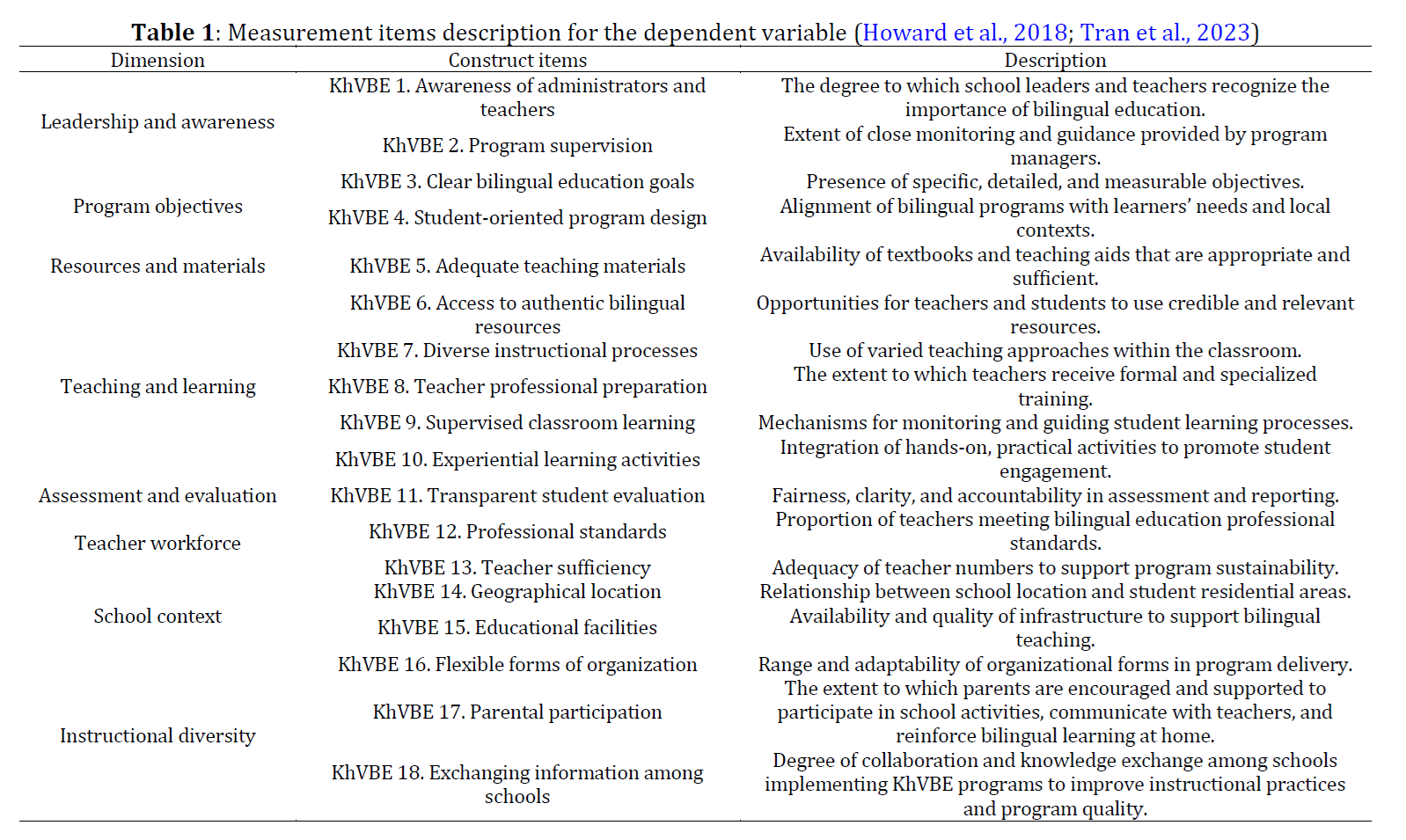
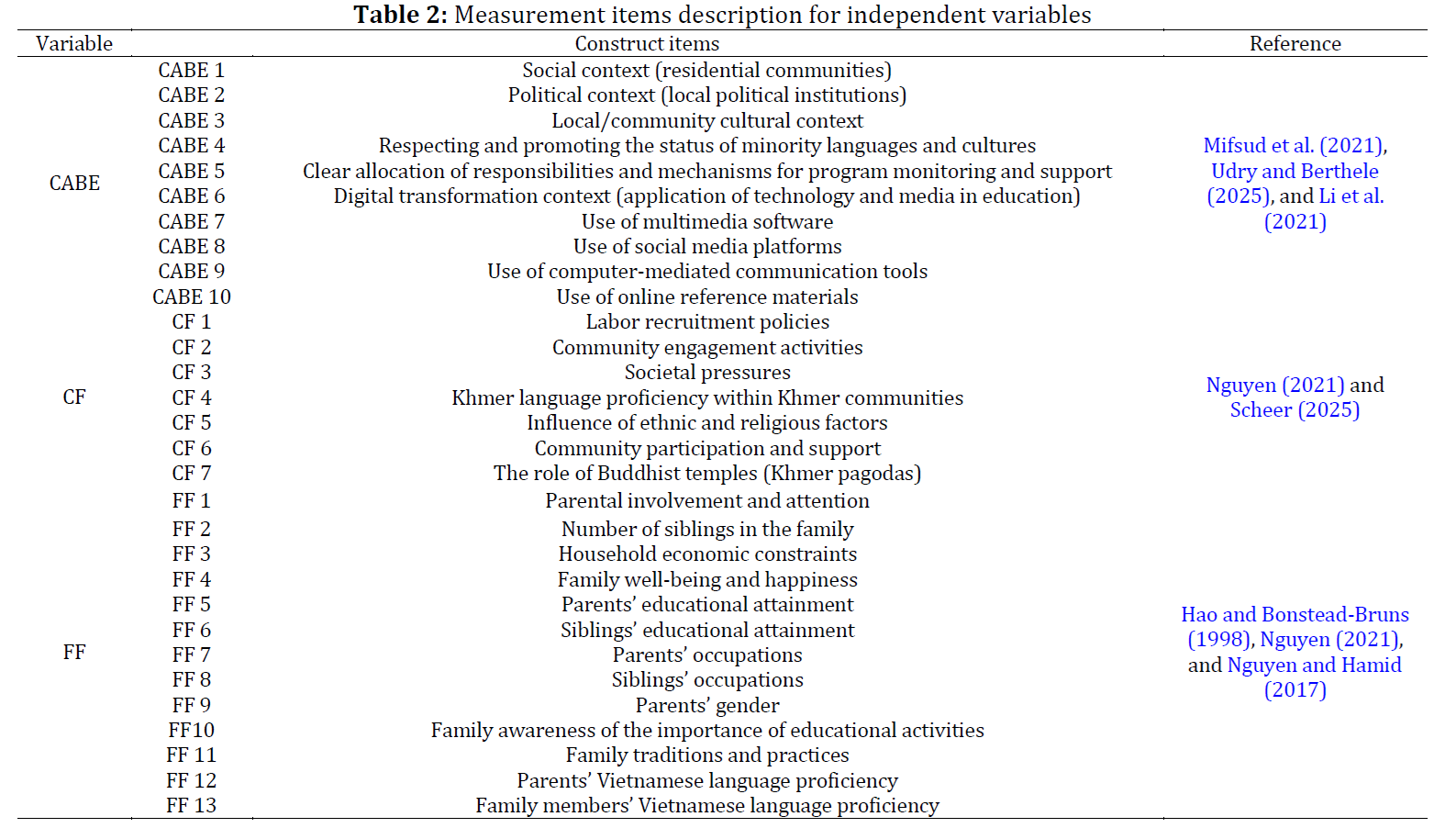
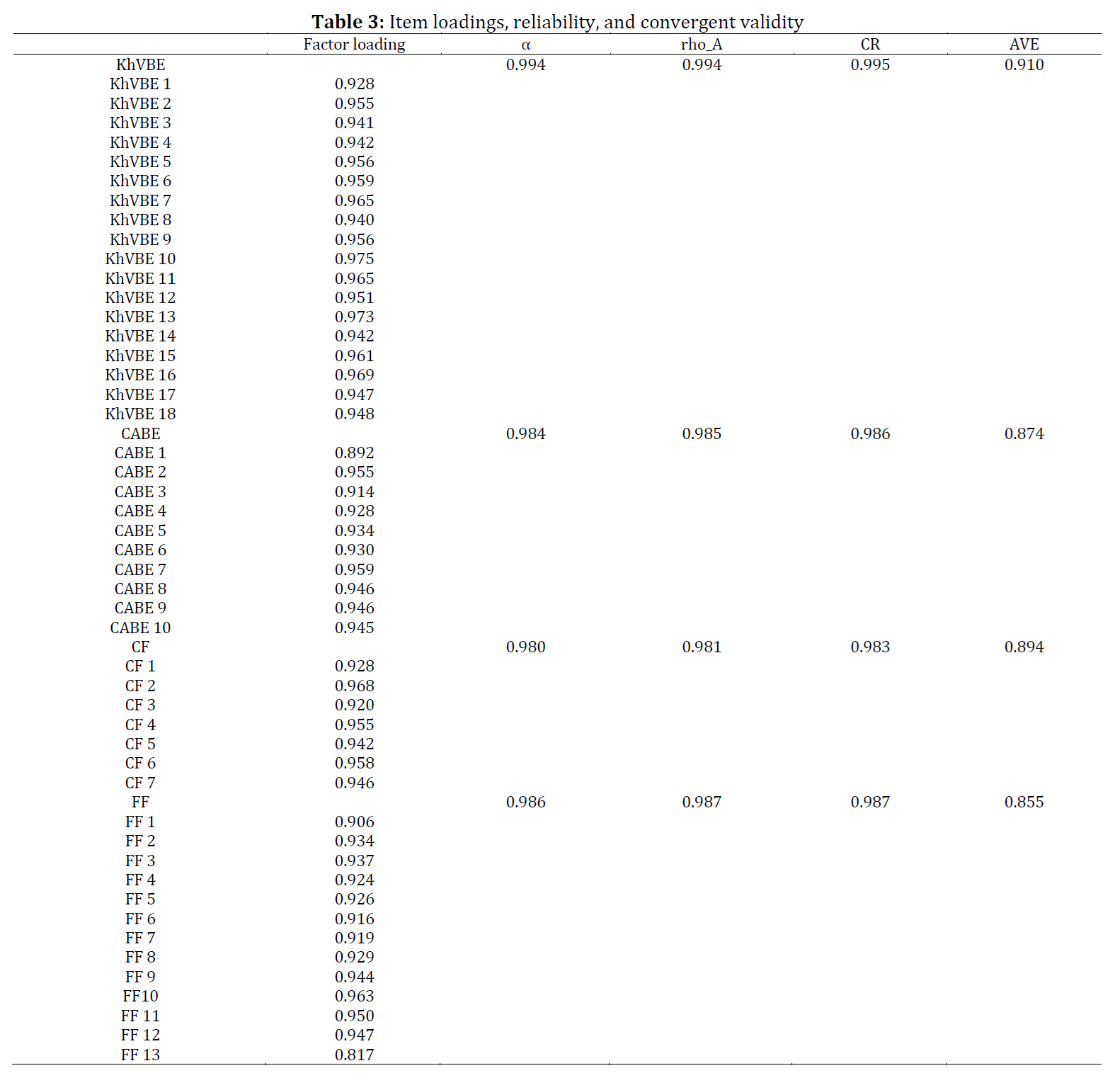
Table 1 Table 2 Table 3 Table 4 Table 5 Table 6


----------------------------------------------
References (38)
-
Almansour E and Kurt M (2022). Critical thinking for writing using Facebook under COVID-19 lockdown: A course model for English literature students. Frontiers in Psychology, 13: 903452. https://doi.org/10.3389/fpsyg.2022.903452 [ Google Scholar ] PMid:35719568 PMCid:PMC9204049
-
Babinski LM, Amendum SJ, Knotek SE, Sánchez M, and Malone P (2018). Improving young English learners' language and literacy skills through teacher professional development: A randomized controlled trial. American Educational Research Journal, 55(1): 117-143. https://doi.org/10.3102/0002831217732335 [ Google Scholar ]
-
Barrs K (2012). Fostering computer-mediated l2 interaction beyond the classroom. Language Learning & Technology, 16(1): 10-25. https://doi.org/10.64152/10125/44269 [ Google Scholar ]
-
Bhowmik MK, Kennedy KJ, and Hue MT (2018). Education for all–but not Hong Kong's ethnic minority students. Race Ethnicity and Education, 21(5): 661-679. https://doi.org/10.1080/13613324.2017.1294573 [ Google Scholar ]
-
Blake R (2000). Computer mediated communication: A window on L2 Spanish interlanguage. Language Learning & Technology, 4(1): 111-125. https://doi.org/10.64152/10125/25089 [ Google Scholar ]
-
Bourdieu P (1991). Language and symbolic power. Polity Press, Cambridge, USA. [ Google Scholar ]
-
Bui TL, Le TD, and Nguyen TT (2025). Factors affecting Khmer major students' motivation to learn the Khmer language during the COVID-19 online-teaching periods at Tra Vinh University. Practice, 7(2): 80-97. https://doi.org/10.1080/25783858.2023.2177190 [ Google Scholar ]
-
Feng A (2005). Bilingualism for the minor or the major? An evaluative analysis of parallel conceptions in China. International Journal of Bilingual Education and Bilingualism, 8(6): 529-551. https://doi.org/10.1080/13670050508669067 [ Google Scholar ]
-
Fornell C and Larcker DF (1981). Evaluating structural equation models with unobservable variables and measurement error. Journal of Marketing Research, 18(1): 39-50. https://doi.org/10.1177/002224378101800104 [ Google Scholar ]
-
García O and Wei L (2015). Translanguaging, bilingualism, and bilingual education. In: Wright WE, Boun S, and García O (Eds.), The handbook of bilingual and multilingual education: 223-240. Wiley-Blackwell, Malden, USA. https://doi.org/10.1002/9781118533406.ch13 [ Google Scholar ] PMCid:PMC4400845
-
Griva E, Chostelidou D, Ypsilanti A, and Iliadou S (2014). Students attending a bilingual primary school: A record of a language biography. Procedia - Social and Behavioral Sciences, 116: 1319-1323. https://doi.org/10.1016/j.sbspro.2014.01.390 [ Google Scholar ]
-
Hair JF, Risher JJ, Sarstedt M, and Ringle CM (2019). When to use and how to report the results of PLS-SEM. European Business Review, 31(1): 2-24. https://doi.org/10.1108/EBR-11-2018-0203 [ Google Scholar ]
-
Hamman-Ortiz L and Palmer D (2023). Identity and two-way bilingual education: Considering student perspectives: Introduction to the special issue. International Journal of Bilingual Education and Bilingualism, 26(1): 1-6. https://doi.org/10.1080/13670050.2020.1819096 [ Google Scholar ]
-
Hao L and Bonstead-Bruns M (1998). Parent-child differences in educational expectations and the academic achievement of immigrant and native students. Sociology of Education, 71(3): 175-198. https://doi.org/10.2307/2673201 [ Google Scholar ]
-
Hornberger NH (2009). Multilingual education policy and practice: Ten certainties (grounded in Indigenous experience). Language Teaching, 42(2): 197-211. https://doi.org/10.1017/S0261444808005491 [ Google Scholar ]
-
Howard ER, Lindholm-Leary KJ, Rogers D, Olague N, Medina J, Kennedy D, Sugarman J, and Christian D (2018). Guiding principles for dual language education. 3rd Edition, Center for Applied Linguistics, Washington, DC, USA. [ Google Scholar ]
-
Lee S, Watt R, and Frawley J (2015). Effectiveness of bilingual education in Cambodia: A longitudinal comparative case study of ethnic minority children in bilingual and monolingual schools. Compare: A Journal of Comparative and International Education, 45(4): 526-544. https://doi.org/10.1080/03057925.2014.909717 [ Google Scholar ]
-
Li J, Brar A, and Roihan N (2021). The use of digital technology to enhance language and literacy skills for Indigenous people: A systematic literature review. Computers and Education Open, 2: 100035. https://doi.org/10.1016/j.caeo.2021.100035 [ Google Scholar ]
-
Lindholm-Leary K (2012). Success and challenges in dual language education. Theory into Practice, 51(4): 256-262. https://doi.org/10.1080/00405841.2012.726053 [ Google Scholar ]
-
Mak E, Nichiporuk Vanni N, Yang X, Lara M, Zhou Q, and Uchikoshi Y (2023). Parental perceptions of bilingualism and home language vocabulary: Young bilingual children from low-income immigrant Mexican American and Chinese American families. Frontiers in Psychology, 14: 1059298. https://doi.org/10.3389/fpsyg.2023.1059298 [ Google Scholar ] PMid:36818097 PMCid:PMC9928566
-
Mifsud CL, Georgieva R, and Kucirkova N (2021). Parent-child joint reading of digital books in bilingual families in Malta. International Journal of Educational Research, 109: 101844. https://doi.org/10.1016/j.ijer.2021.101844 [ Google Scholar ]
-
Nguyen CD and Ha X (2023). Even studying higher, we just end up with earning a living by picking coffee cherries: Challenges to educational equity for ethnic minority students in Vietnam. Compare: A Journal of Comparative and International Education, 53(6): 967-985. https://doi.org/10.1080/03057925.2021.1976622 [ Google Scholar ]
-
Nguyen CD and Huynh TN (2023). Teacher agency in culturally responsive teaching: Learning to teach ethnic minority students in the Central Highlands of Vietnam. Educational Review, 75(4): 719-743. https://doi.org/10.1080/00131911.2021.1974346 [ Google Scholar ]
-
Nguyen CV and Vu LH (2025). Does parental absence harm children's education? Evidence from Vietnam. Journal of Asian and African Studies, 60(2): 692-716. https://doi.org/10.1177/00219096231176739 [ Google Scholar ]
-
Nguyen HTM, Nguyen HTT, Gao X, Hoang TH, and Starfield S (2024). Developing professional capacity for content language integrated learning (CLIL) teaching in Vietnam: Tensions and responses. Language and Education, 38(1): 118-138. https://doi.org/10.1080/09500782.2023.2260374 [ Google Scholar ]
-
Nguyen TTT (2021). Bilingual identity of ethnic minority students: Insights from Vietnam. International Journal of Bilingual Education and Bilingualism, 24(1): 91-106. https://doi.org/10.1080/13670050.2018.1445697 [ Google Scholar ]
-
Nguyen TTT and Hamid MO (2018). Bilingualism as a resource: Language attitudes of Vietnamese ethnic minority students. Current Issues in Language Planning, 19(4): 343-362. https://doi.org/10.1080/14664208.2017.1337922 [ Google Scholar ]
-
Perez MM (2020). Incidental vocabulary learning through viewing video: The role of vocabulary knowledge and working memory. Studies in Second Language Acquisition, 42(4): 749-773. https://doi.org/10.1017/S0272263119000706 [ Google Scholar ]
-
Phung L, Reinders H, and Pham VPH (2024). Innovation in language teaching in Vietnam and Cambodia: Key themes. In: Phung L, Reinders H, and Pham VPH (Eds.), Innovation in language learning and teaching: The case of Vietnam and Cambodia: 235-242. Springer Nature, Cham, Switzerland. https://doi.org/10.1007/978-3-031-46080-7_12 [ Google Scholar ]
-
Scheer C (2025). Cambodia, a model of multilingual education? Past and present perspectives on teaching indigenous minority languages in a Khmer nation. Moussons, 45: 27-60. https://doi.org/10.4000/147jn [ Google Scholar ]
-
Scherzinger L and Brahm T (2023). A systematic review of bilingual education teachers' competences. Educational Research Review, 39: 100531. https://doi.org/10.1016/j.edurev.2023.100531 [ Google Scholar ]
-
Streiner DL (2003). Starting at the beginning: An introduction to coefficient alpha and internal consistency. Journal of Personality Assessment, 80(1): 99-103. https://doi.org/10.1207/S15327752JPA8001_18 [ Google Scholar ] PMid:12584072
-
Tavakol M and Dennick R (2011). Making sense of Cronbach's alpha. International Journal of Medical Education, 2: 53-55. https://doi.org/10.5116/ijme.4dfb.8dfd [ Google Scholar ] PMid:28029643 PMCid:PMC4205511
-
Taylor P (2013). Losing the waterways: The displacement of Khmer communities from the freshwater rivers of the Mekong delta, 1945–2010. Modern Asian Studies, 47(2): 500-541. https://doi.org/10.1017/S0026749X12000406 [ Google Scholar ]
-
Tran TY, Vuong H, Pham TV, Dam THD, Ha TH, and Hoang TAV (2023). A model of mother tongue-based bilingual education in Vietnam: Achievements and lessons learnt. Journal for Educators, Teachers and Trainers, 14(6): 71-85. https://doi.org/10.47750/jett.2023.14.06.008 [ Google Scholar ]
-
Udry I and Berthele R (2025). A case study of online and paper bilingual dictionaries and their impact on vocabulary learning through meaning-focused reading. International Journal of Lexicography, 38(3): 219–237. https://doi.org/10.1093/ijl/ecaf004 [ Google Scholar ]
-
van Der Geest K, Nguyen KV, and Nguyen TC (2012). Internal migration in the Upper Mekong Delta, Viet Nam: What is the role of climate-related stressors? Asia-Pacific Population Journal, 29(2): 25-41. https://doi.org/10.18356/7b7d7273-en [ Google Scholar ]
- Wang G, Bahry SA, and An W (2024). Minority language revitalization and social media through the lens of COVID-19 in Yunnan and Gansu, western China. Journal of Multilingual and Multicultural Development, 45(6): 2129-2151. https://doi.org/10.1080/01434632.2022.2042541 [ Google Scholar ]