
International
ADVANCED AND APPLIED SCIENCES
EISSN: 2313-3724, Print ISSN: 2313-626X
Frequency: 12


Volume 13, Issue 2 (February 2026), Pages: 10-16

----------------------------------------------
Original Research Paper
Academic competence as a predictor of nursing students' readiness for artificial intelligence
Author(s):
Affiliation(s):
Faculty of Nursing, University of Hafr Al-Batin, Hafr Al-Batin, Saudi Arabia
Full text

* Corresponding Author.
 Corresponding author's ORCID profile: https://orcid.org/0009-0008-6657-7896
Digital Object Identifier (DOI)
https://doi.org/10.21833/ijaas.2026.02.002
Abstract
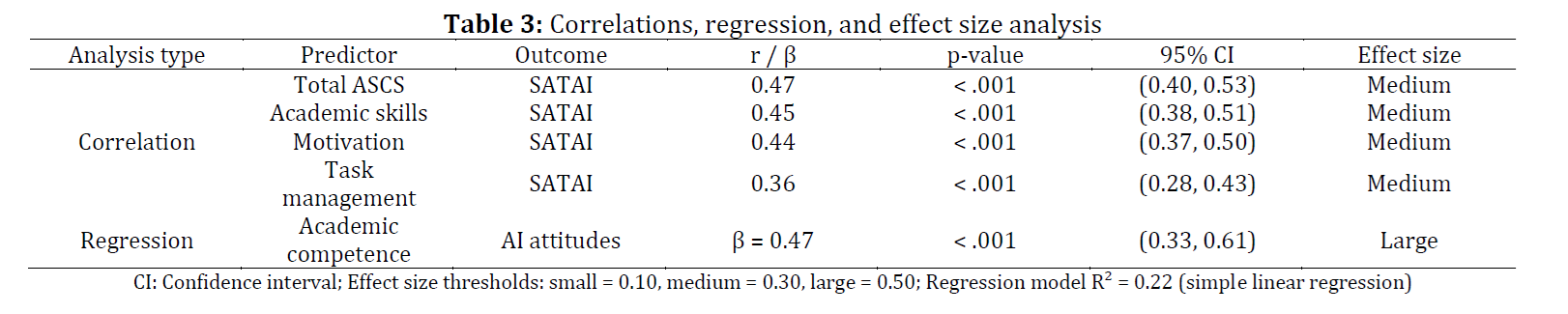
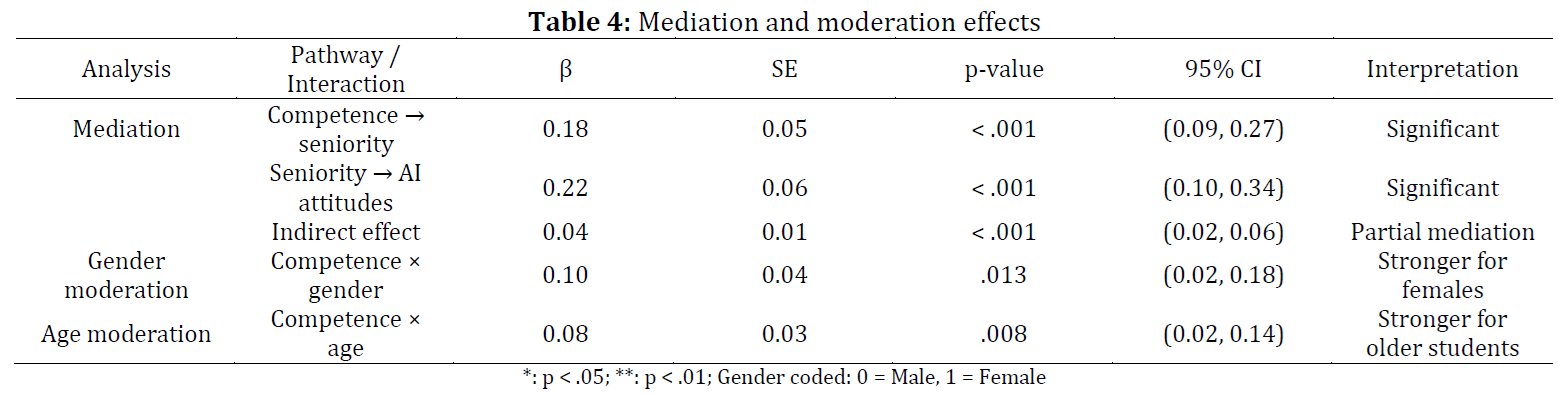
Artificial intelligence (AI) is increasingly influencing nursing education and clinical practice worldwide; however, limited evidence exists on how academic and demographic factors affect nursing students’ readiness to engage with AI in low- and middle-income countries. This study examined the relationship between academic competence and nursing students’ attitudes toward AI, with academic seniority as a mediating variable and age and gender as moderating variables. A cross-sectional, multi-institutional survey was conducted among 550 undergraduate nursing students from six Egyptian universities during the 2024–2025 academic year. Data were collected using validated measures of academic competence and attitudes toward AI. Correlation, regression, mediation, and moderation analyses were applied to test the study hypotheses. The findings showed a significant positive association between academic competence and attitudes toward AI (r = 0.47, p < .001). Academic seniority partially mediated this relationship (β = 0.04, p < .001), while age (β = 0.08, p = .008) and gender (β = 0.10, p = .013) significantly moderated it, with stronger associations observed among older and female students. These results highlight the importance of competence-based educational approaches and inclusive curriculum design in supporting AI integration in nursing education. Providing targeted support for younger and less academically advanced students, along with enhancing faculty digital skills, may improve equitable AI readiness among nursing students.
© 2026 The Authors. Published by IASE.
This is an
Keywords
Artificial intelligence, Nursing education, Academic competence, Student attitudes, Digital readiness
Article history
Received 29 August 2025, Received in revised form 13 January 2026, Accepted 25 January 2026
Acknowledgment
The author expresses sincere gratitude to the administration and faculty members of the participating Egyptian universities for their support and cooperation. Special thanks are extended to the nursing students who dedicated their time and effort to participate in this research.
Compliance with ethical standards
Ethical considerations
Ethical approval was obtained from the Research Ethics Committee, Faculty of Nursing, Helwan University (Reference No. HUNURSERC 2024/07/52/85). The study complied with the Declaration of Helsinki, and electronic informed consent was secured from all participants.
Conflict of interest: The author(s) declared no potential conflicts of interest with respect to the research, authorship, and/or publication of this article.
Citation:
Eltantawy EEE (2026). Academic competence as a predictor of nursing students' readiness for artificial intelligence. International Journal of Advanced and Applied Sciences, 13(2): 10-16
Figures
No Figure
Tables
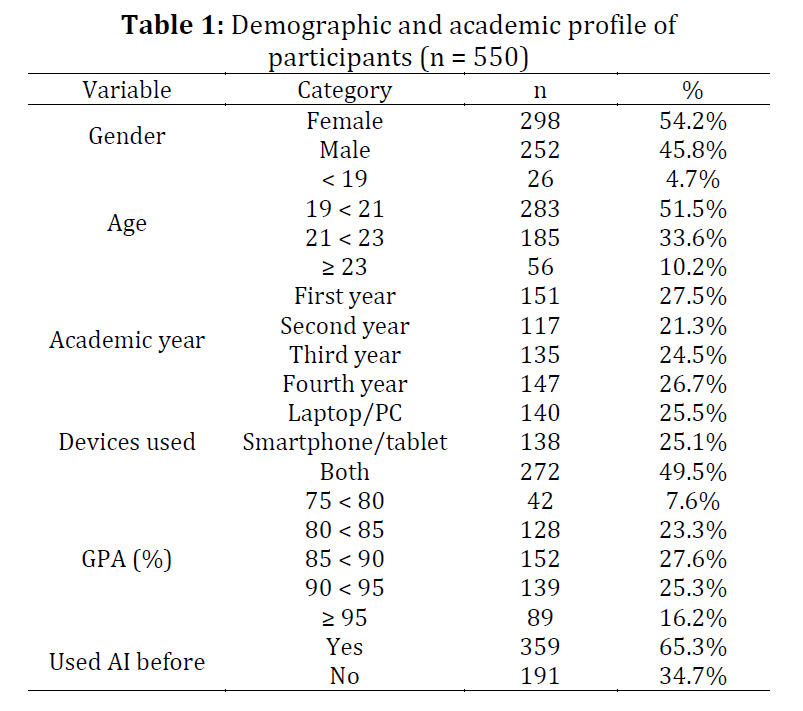
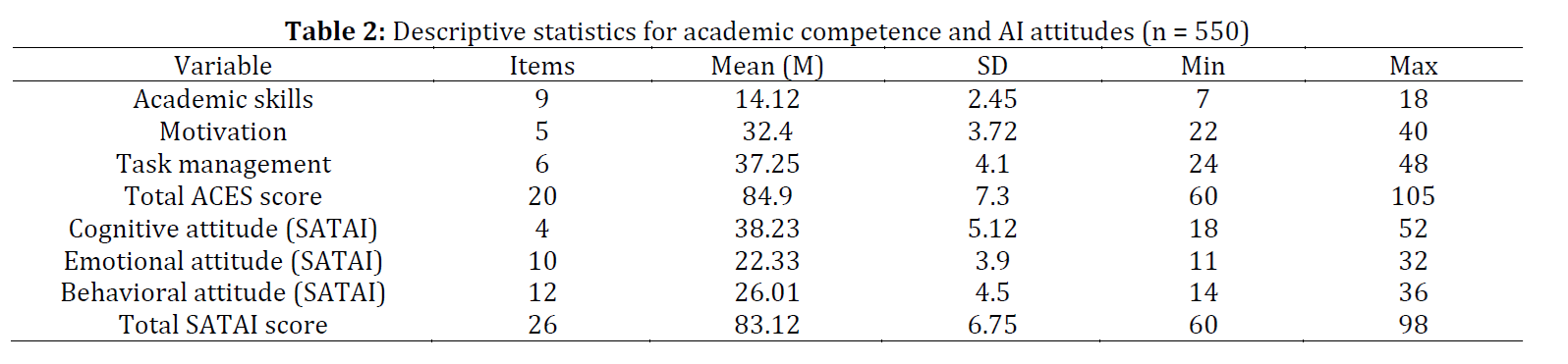
Table 1 Table 2 Table 3 Table 4
----------------------------------------------
References (28)
- Abou Hashish EA and Alnajjar H (2024). Digital proficiency: Assessing knowledge, attitudes, and skills in digital transformation, health literacy, and artificial intelligence among university nursing students. BMC Medical Education, 24: 508. https://doi.org/10.1186/s12909-024-05482-3 [Google Scholar] PMid:38715005 PMCid:PMC11077799
- Abou Hashish EA, Alsayed SA, and Abdel Razek NMF (2025). Embracing AI in academia: A mixed methods study of nursing students’ and educators’ perspectives on using ChatGPT. PLOS ONE, 20(7): e0327981. https://doi.org/10.1371/journal.pone.0327981 [Google Scholar] PMid:40674348 PMCid:PMC12270142
- Abuadas M, Albikawi Z, and Rayani A (2025). The impact of an AI-focused ethics education program on nursing students’ ethical awareness, moral sensitivity, attitudes, and generative AI adoption intention: A quasi-experimental study. BMC Nursing, 24: 720. https://doi.org/10.1186/s12912-025-03458-2 [Google Scholar] PMid:40597065 PMCid:PMC12211453
- Agaoglu FO, Bas M, Tarsuslu S, Ekinci LO, and Agaoglu NB (2025). The mediating digital literacy and the moderating role of academic support in the relationship between artificial intelligence usage and creative thinking in nursing students. BMC Nursing, 24: 484. https://doi.org/10.1186/s12912-025-03128-3 [Google Scholar] PMid:40316954 PMCid:PMC12046853
- Asal MGR, Alsenany SA, Elzohairy NW, and El-Sayed AAI (2025). The impact of digital competence on pedagogical innovation among nurse educators: The moderating role of artificial intelligence readiness. Nurse Education in Practice, 85: 104367. https://doi.org/10.1016/j.nepr.2025.104367 [Google Scholar] PMid:40209516
- Balasa KA, Hiedie Dumagay A, Alieto EO, and González Vallejo R (2025). Gender and age dynamics in future educators' attitudes toward AI integration in education: A sample from state-managed universities in Zamboanga Peninsula, Philippines. Seminars in Medical Writing and Education, AG Editor, Argentina, 4: 668. https://doi.org/10.56294/mw2025668 [Google Scholar]
- Bozkurt SA, Aydoğan S, Dursun Ergezen F, and Türkoğlu A (2025). A systematic review and sequential explanatory synthesis: Artificial intelligence in healthcare education, a case of nursing. International Nursing Review, 72(2): e70018. https://doi.org/10.1111/inr.70018 [Google Scholar] PMid:40243390 PMCid:PMC12005066
- Buchanan C, Howitt ML, Wilson R, Booth RG, Risling T, and Bamford M (2021). Predicted influences of artificial intelligence on nursing education: Scoping review. JMIR Nursing, 4(1): e23933. https://doi.org/10.2196/23933 [Google Scholar] PMid:34345794 PMCid:PMC8328269
- Davis FD (1989). Perceived usefulness, perceived ease of use, and user acceptance of information technology. MIS Quarterly, 13(3): 319-340. https://doi.org/10.2307/249008 [Google Scholar]
- Derinalp P and Ozyurt M (2025). Adaptation of the student attitudes toward artificial intelligence scale to the Turkish context: Validity and reliability study. International Journal of Human–Computer Interaction, 41(8): 4653-4667. https://doi.org/10.1080/10447318.2024.2352921 [Google Scholar]
- Dermody G, Wadsworth D, El Haddad M, Prichard R, Benson A, Benson T, and Craswell A (2025). Bridging the digital divide: A multi‐method evaluation of nursing readiness for digital health technology. Journal of Advanced Nursing. https://doi.org/10.1111/jan.70105 [Google Scholar] PMCid:PMC12721923
- Doston T, Fontenot J, Morris D, and Hebert M (2025). The use of artificial intelligence in nursing education: A scoping review. Journal of Nursing Education, 64(8): 479-488. https://doi.org/10.3928/01484834-20250313-03 [Google Scholar] PMid:40801516
- Hassan Mekawy S, Ali Mohamed Ismail S, and Zayed Mohamed M (2020). Digital health literacy (DHL) levels among nursing baccalaureate students and their perception and attitudes toward the application of artificial intelligence (AI) in nursing. Egyptian Journal of Health Care, 11(1): 1266-1277. https://doi.org/10.21608/ejhc.2020.274757 [Google Scholar]
- Hughes JL, Camden AA, Yangchen T, Smith GP, Domenech Rodríguez MM, Rouse SV, McDonald CP, Lopez S (2022). Guidance for researchers when using inclusive demographic questions for surveys: Improved and updated questions. Psi Chi Journal of Psychological Research, 27(4): 232-255. https://doi.org/10.24839/2325-7342.JN27.4.232 [Google Scholar]
- Kaya F, Aydin F, Schepman A, Rodway P, Yetişensoy O, and Demir Kaya M (2024). The roles of personality traits, AI anxiety, and demographic factors in attitudes toward artificial intelligence. International Journal of Human–Computer Interaction, 40(2): 497-514. https://doi.org/10.1080/10447318.2022.2151730 [Google Scholar]
- Liu WC and Wang CKJ (2005). Academic self-concept: A cross-sectional study of grade and gender differences in a Singapore secondary school. Asia Pacific Education Review, 6: 20-27. https://doi.org/10.1007/BF03024964 [Google Scholar]
- López DM, Rico-Olarte C, Blobel B, and Hullin C (2022). Challenges and solutions for transforming health ecosystems in low-and middle-income countries through artificial intelligence. Frontiers in Medicine, 9: 958097. https://doi.org/10.3389/fmed.2022.958097 [Google Scholar] PMid:36530888 PMCid:PMC9755337
- Ma J, Wen J, Qiu Y, Wang Y, Xiao Q, Liu T, Zhang D, Zhao Y, Lu Z, Sun Z (2025). The role of artificial intelligence in shaping nursing education: A comprehensive systematic review. Nurse Education in Practice, 84: 104345. https://doi.org/10.1016/j.nepr.2025.104345 [Google Scholar] PMid:40168750
- Ndibalema P (2025). Digital literacy gaps in promoting 21st century skills among students in higher education institutions in sub-Saharan Africa: A systematic review. Cogent Education, 12(1): 2452085. https://doi.org/10.1080/2331186X.2025.2452085 [Google Scholar]
- Prasojo LD, Yuliana L, and Prihandoko LA (2025). Research performance in higher education: A PLS-SEM analysis of research atmosphere, collaboration, funding, competence, and output, especially for science and engineering facilities in Indonesian universities. ASEAN Journal of Science and Engineering, 5(1): 123-144. https://doi.org/10.17509/ajse.v5i1.81224 [Google Scholar]
- Salameh B, Qaddumi J, Hammad B, Eqtit F, Ibraheem Ayed AJ, Fashafsheh I, ALBashtawy M, Reshia F, and Lukic I (2025). Nursing students’ attitudes toward artificial intelligence: Palestinian perspectives. SAGE Open Nursing. https://doi.org/10.1177/23779608251343297 [Google Scholar]
- Sandanasamy S, McFarlane P, Okamoto Y, and Couper AL (2025). Knowledge and attitudes of nursing students towards artificial intelligence and related factors: A systematic review. Journal of Nursing Reports in Clinical Practice, 3(6): 582-590. https://doi.org/10.32598/JNRCP.2408.1134 [Google Scholar]
- Sardi J, Candra O, Yuliana DF, Yanto DTP, and Eliza F (2025). How generative AI influences students' self-regulated learning and critical thinking skills? A systematic review. International Journal of Engineering Pedagogy, 15(1): 94-108. https://doi.org/10.3991/ijep.v15i1.53379 [Google Scholar]
- Shao Y and Kang S (2022). The association between peer relationship and learning engagement among adolescents: The chain mediating roles of self-efficacy and academic resilience. Frontiers in Psychology, 13: 938756. https://doi.org/10.3389/fpsyg.2022.938756 [Google Scholar] PMid:35992466 PMCid:PMC9384863
- Suh W and Ahn S (2022). Development and validation of a scale measuring student attitudes toward artificial intelligence. SAGE Open, 12(2). https://doi.org/10.1177/21582440221100463 [Google Scholar]
- Varol B (2025). Artificial intelligence anxiety in nursing students: The impact of self-efficacy. CIN: Computers, Informatics, Nursing, 43(6): e01250. https://doi.org/10.1097/CIN.0000000000001250 [Google Scholar] PMid:39761411
- Yan Y, Wu B, Pi J, and Zhang X (2025). Perceptions of AI in higher education: Insights from students at a top-tier Chinese university. Education Sciences, 15(6): 735. https://doi.org/10.3390/educsci15060735 [Google Scholar]
- Yaseen H, Mohammad AS, Ashal N, Abusaimeh H, Ali A, and Sharabati AAA (2025). The impact of adaptive learning technologies, personalized feedback, and interactive AI tools on student engagement: The moderating role of digital literacy. Sustainability, 17(3): 1133. https://doi.org/10.3390/su17031133 [Google Scholar]