International
ADVANCED AND APPLIED SCIENCES
EISSN: 2313-3724, Print ISSN: 2313-626X
Frequency: 12


Volume 13, Issue 1 (January 2026), Pages: 217-227

----------------------------------------------
Original Research Paper
The relationship between childhood trauma and academic burnout in vocational college students: A moderated mediation model
Author(s):
Affiliation(s):
1Faculty of Educational Sciences and Technology, Universiti Teknologi Malaysia, Johor Baharu, Johor, Malaysia
2Faculty of Human Development, Universiti Pendidikan Sultan Idris, Tanjong Malim, Perak Darul Ridzuan, Malaysia
3Faculty of Education, Huanggang Normal University, Huanggang, Hubei, China
Full text

* Corresponding Author.
 Corresponding author's ORCID profile: https://orcid.org/0000-0001-8053-0543
Digital Object Identifier (DOI)
https://doi.org/10.21833/ijaas.2026.01.023
Abstract
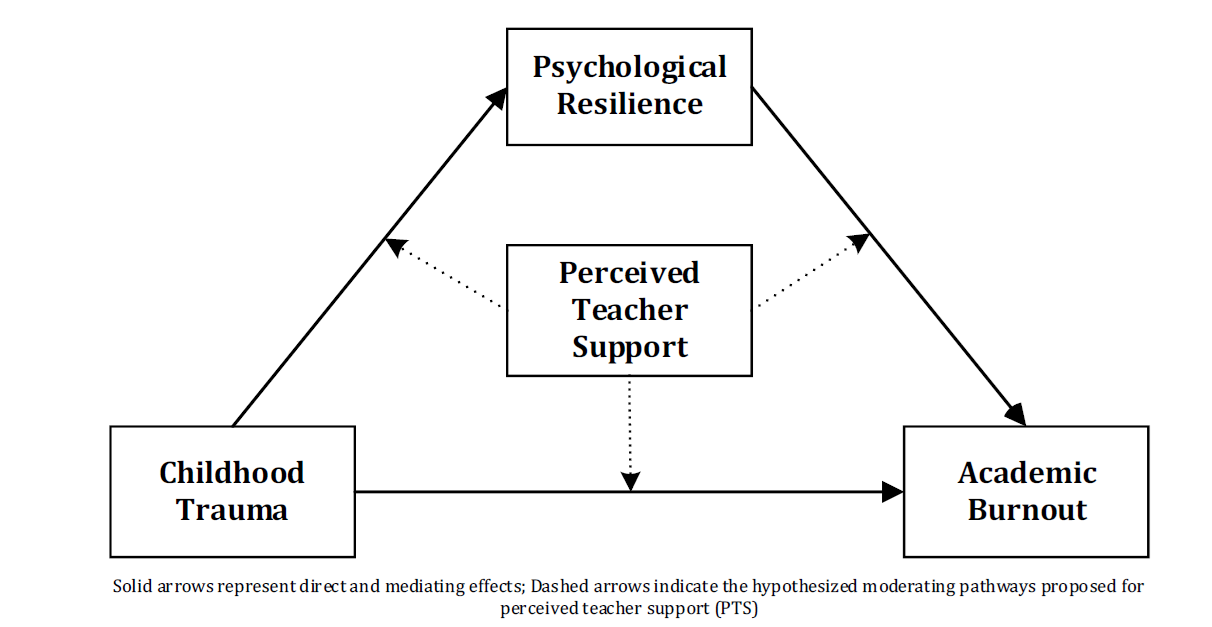
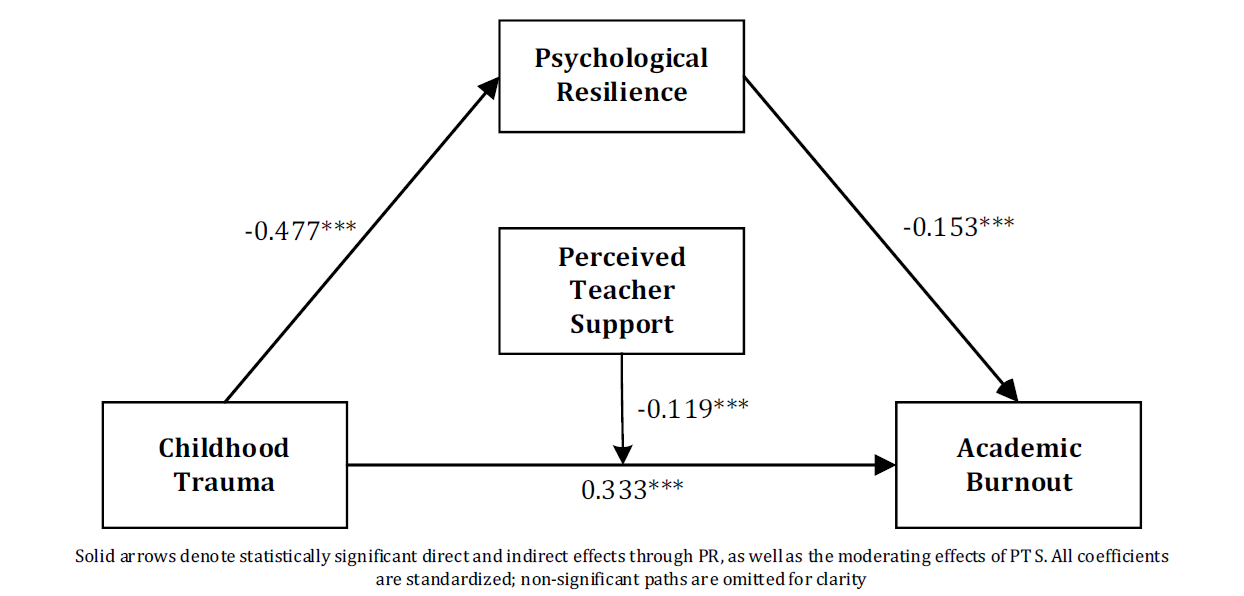
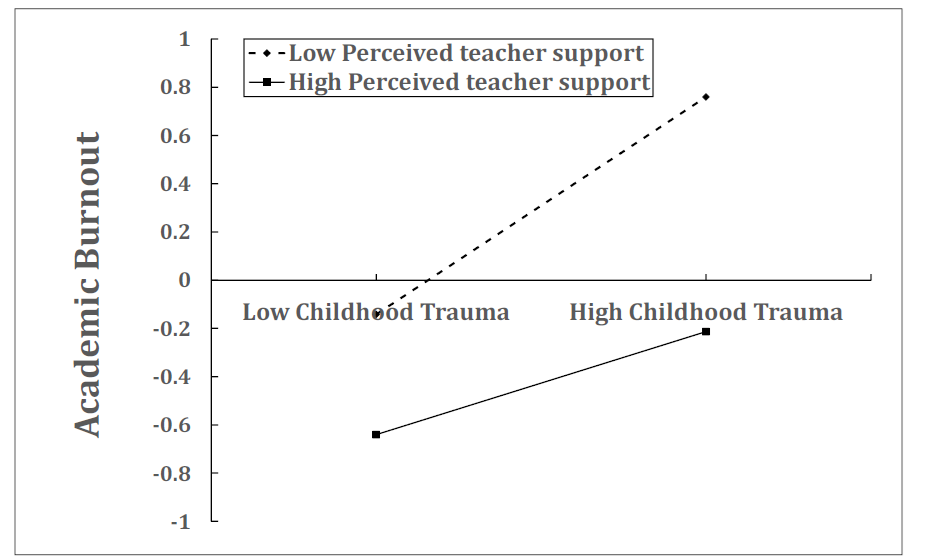
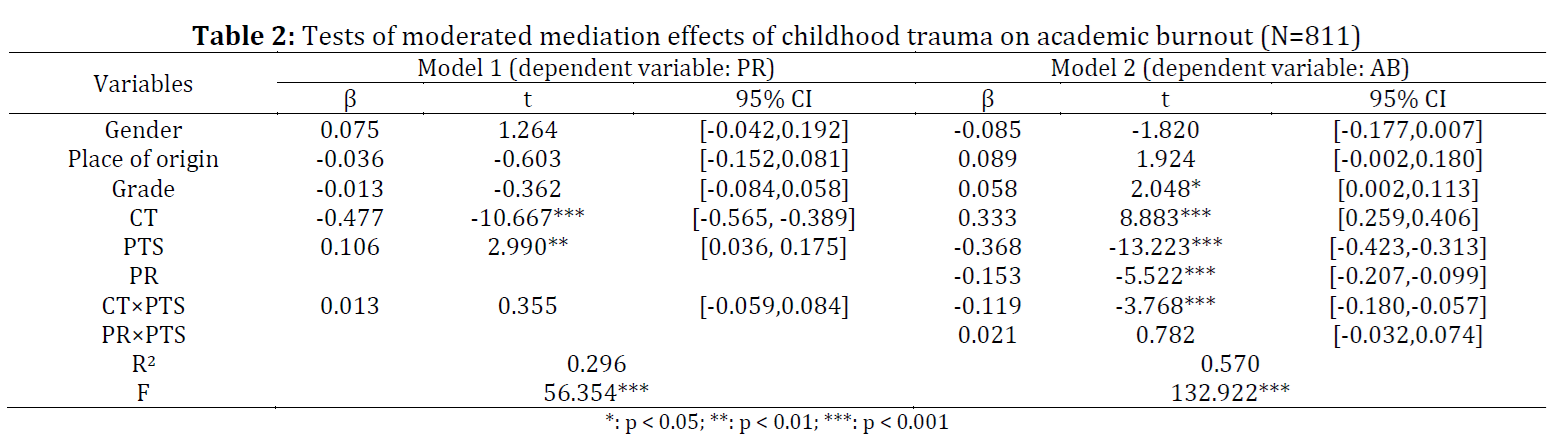
Academic burnout, marked by emotional exhaustion and disengagement caused by long-term stress, is a serious psychological concern among vocational college students. Although childhood trauma has been recognized as an important risk factor for academic burnout, the mechanisms linking early adverse experiences to academic outcomes remain unclear. This study tested a moderated mediation model among 811 Chinese vocational college students using validated measures of childhood trauma, psychological resilience, perceived teacher support, and academic burnout. The results showed that childhood trauma was significantly and positively associated with academic burnout (β = 0.564, t = 18.558, p < 0.001). Psychological resilience partially mediated this relationship, with a significant indirect effect (95% CI = [0.067, 0.137]). In addition, perceived teacher support moderated the direct association between childhood trauma and academic burnout (β = −0.119, t = −3.768, p < 0.001), such that higher levels of teacher support weakened the negative impact of childhood trauma. These findings indicate that childhood trauma influences academic burnout both directly and indirectly through reduced resilience, and they highlight the protective role of supportive teacher–student relationships. The study suggests that strengthening students’ resilience and fostering supportive educational environments may be effective strategies for reducing academic burnout in vocational higher education.
© 2026 The Authors. Published by IASE.
This is an
Keywords
Academic burnout, Childhood trauma, Psychological resilience, Teacher support, Vocational students
Article history
Received 16 August 2025, Received in revised form 5 January 2026, Accepted 17 January 2026
Acknowledgment
The authors express their sincere gratitude to all participants who participated in the study. The authors also thank the Hubei Provincial Department of Education Philosophy and Social Sciences Research Project (24Y107) for funding this research.
Compliance with ethical standards
Ethical considerations
This study was approved by the Ethics Committee of Huanggang Normal University and was conducted in accordance with the ethical principles of the Declaration of Helsinki. Before the questionnaire survey, we informed the participants of the purpose of the study, the participation process, data storage and use, and the right to withdraw, and obtained the participants’ informed consent.
Conflict of interest: The author(s) declared no potential conflicts of interest with respect to the research, authorship, and/or publication of this article.
Citation:
Lu W, Royo MA, Musta'amal AH, Wang X, Lin Y, and Tan P (2026). The relationship between childhood trauma and academic burnout in vocational college students: A moderated mediation model. International Journal of Advanced and Applied Sciences, 13(1): 217-227
Figures
Tables

----------------------------------------------
References (51)
- Allen JA (2025). Using the conservation of resources theory to understand volunteer adaptability: A personal resource for reducing burnout. European Journal of Training and Development, 49(1-2): 63-76. https://doi.org/10.1108/EJTD-05-2023-0082 [Google Scholar]
- Angelakis I and Gooding P (2022). Associations of anxiety and depression with suicide experiences in individuals with and without childhood trauma: The role of social support. Psychiatry Research, 309: 114424. https://doi.org/10.1016/j.psychres.2022.114424 [Google Scholar] PMid:35121339
- Armstrong JM, Haskett ME, and Hawkins AL (2017). The student–teacher relationship quality of abused children. Psychology in the Schools, 54(2): 142-151. https://doi.org/10.1002/pits.21989 [Google Scholar] PMid:28713179 PMCid:PMC5509067
- Banford Witting A and Busby D (2019). The long arm of trauma during childhood: Associations with resources in couple relationships. Journal of Marital and Family Therapy, 45(3): 534-549. https://doi.org/10.1111/jmft.12354 [Google Scholar] PMid:30168162
- Benner GJ, Strycker LA, Berry LA, Logan AJ, and Lee EO (2023). Associations between childhood trauma, perceived resilience, and teacher burnout. Teachers and Teaching, 29(3): 291-309. https://doi.org/10.1080/13540602.2023.2173167 [Google Scholar]
- Berger E, Bearsley A, and Lever M (2021). Qualitative evaluation of teacher trauma knowledge and response in schools. Journal of Aggression, Maltreatment & Trauma, 30(8): 1041-1057. https://doi.org/10.1080/10926771.2020.1806976 [Google Scholar]
- Bernstein DP, Fink L, Handelsman L, Foote J, Lovejoy M, Wenzel K, Sapareto E, and Ruggiero J (1994). Initial reliability and validity of a new retrospective measure of child abuse and neglect. The American Journal of Psychiatry, 151(8): 1132-1136. https://doi.org/10.1176/ajp.151.8.1132 [Google Scholar] PMid:8037246
- Campbell‐Sills L and Stein MB (2007). Psychometric analysis and refinement of the Connor–Davidson resilience scale (CD‐RISC): Validation of a 10‐item measure of resilience. Journal of Traumatic Stress, 20(6): 1019-1028. https://doi.org/10.1002/jts.20271 [Google Scholar] PMid:18157881
- Cham TH, Cheah JH, Cheng BL, and Lim XJ (2022). I am too old for this! Barriers contributing to the non-adoption of mobile payment. International Journal of Bank Marketing, 40(5): 1017-1050. https://doi.org/10.1108/IJBM-06-2021-0283 [Google Scholar]
- Chang JJ, Ji Y, Li YH, Yuan MY, and Su PY (2021). Childhood trauma and depression in college students: Mediating and moderating effects of psychological resilience. Asian Journal of Psychiatry, 65: 102824. https://doi.org/10.1016/j.ajp.2021.102824 [Google Scholar] PMid:34479025
- Cohrdes C and Mauz E (2020). Self-efficacy and emotional stability buffer negative effects of adverse childhood experiences on young adult health-related quality of life. Journal of Adolescent Health, 67(1): 93-100. https://doi.org/10.1016/j.jadohealth.2020.01.005 [Google Scholar] PMid:32192828
- Garmezy N, Masten AS, and Tellegen A (1984). The study of stress and competence in children: A building block for developmental psychopathology. Child Development, 55(1): 97-111. https://doi.org/10.2307/1129837 [Google Scholar] PMid:6705637
- Georgieva S, Tomas JM, and Navarro-Pérez JJ (2021). Systematic review and critical appraisal of childhood trauma questionnaire—short form (CTQ-SF). Child Abuse & Neglect, 120: 105223. https://doi.org/10.1016/j.chiabu.2021.105223 [Google Scholar] PMid:34352686
- Gong Z, Wang H, Zhong M, and Shao Y (2023). College students’ learning stress, psychological resilience and learning burnout: status quo and coping strategies. BMC Psychiatry, 23: 389. https://doi.org/10.1186/s12888-023-04783-z [Google Scholar] PMid:37268888 PMCid:PMC10236398
- Halbesleben JR, Neveu JP, Paustian-Underdahl SC, and Westman M (2014). Getting to the “COR” understanding the role of resources in conservation of resources theory. Journal of Management, 40(5): 1334-1364. https://doi.org/10.1177/0149206314527130 [Google Scholar]
- Hayes AF (2018). Partial, conditional, and moderated mediation: Quantification, inference, and interpretation. Communication Monographs, 85(1): 4-40. https://doi.org/10.1080/03637751.2017.1352100 [Google Scholar]
- Hayes AF (2022). Introduction to mediation, moderation, and conditional process analysis: A regression-based approach. 3rd Edition, The Guilford Press, New York, USA. [Google Scholar]
- Hu H, Chen C, Xu B, and Wang D (2024). Moderating and mediating effects of resilience between childhood trauma and psychotic-like experiences among college students. BMC Psychiatry, 24: 273. https://doi.org/10.1186/s12888-024-05719-x [Google Scholar] PMid:38609907 PMCid:PMC11010362
- Jeong YJ and Shin S (2023). The relationship between secondary traumatic stress and burnout in critical care nurses: The mediating effect of resilience. Intensive and Critical Care Nursing, 74: 103327. https://doi.org/10.1016/j.iccn.2022.103327 [Google Scholar] PMid:36208974
- Jiang WJ, Zhong BL, Liu LZ, Zhou YJ, Hu XH, and Li Y (2018). Reliability and validity of the Chinese version of the childhood trauma questionnaire-short form for inpatients with schizophrenia. PLOS ONE, 13(12): e0208779. https://doi.org/10.1371/journal.pone.0208779 [Google Scholar] PMid:30543649 PMCid:PMC6292582
- Kim B, Jee S, Lee J, An S, and Lee SM (2018). Relationships between social support and student burnout: A meta‐analytic approach. Stress and Health, 34(1): 127-134. https://doi.org/10.1002/smi.2771 [Google Scholar] PMid:28639354
- Kuzminskaite E, Penninx BW, van Harmelen AL, Elzinga BM, Hovens JG, and Vinkers CH (2021). Childhood trauma in adult depressive and anxiety disorders: An integrated review on psychological and biological mechanisms in the NESDA cohort. Journal of Affective Disorders, 283: 179-191. https://doi.org/10.1016/j.jad.2021.01.054 [Google Scholar] PMid:33561798
- Lackova Rebicova M, Dankulincova Veselska Z, Husarova D, Madarasova Geckova A, Jansen DE, van Dijk JP, and Reijneveld SA (2021). Does schoolmate and teacher support buffer against the effect of adverse childhood experiences on emotional and behavioural problems? International Journal of Environmental Research and Public Health, 18(24): 13009. https://doi.org/10.3390/ijerph182413009 [Google Scholar] PMid:34948619 PMCid:PMC8701890
- Lian R, Yang L, and Wu L (2005). Relationship between professional commitment and learning burnout of undergraduates and scales developing. Acta Psychologica Sinica, 37(5): 632-636. [Google Scholar]
- Liu H (2024). Uncovering the mediating role of resilience between EFL teacher turnover intention and wellbeing: A conservation-of-resources theory perspective. System, 124: 103394. https://doi.org/10.1016/j.system.2024.103394 [Google Scholar]
- McKee-Lopez G, Robbins L, Provencio-Vasquez E, and Olvera H (2019). The relationship of childhood adversity on burnout and depression among BSN students. Journal of Professional Nursing, 35(2): 112-119. https://doi.org/10.1016/j.profnurs.2018.09.008 [Google Scholar] PMid:30902402
- Milne L, Ratushniak A, and Nguyen H (2024). How adverse childhood experiences impact the professional quality of life of residential care workers: Resilience as a mediator for burnout, secondary traumatic stress, and compassion satisfaction. Frontiers in Child and Adolescent Psychiatry, 3: 1423451. https://doi.org/10.3389/frcha.2024.1423451 [Google Scholar] PMid:39816594 PMCid:PMC11732053
- Park JY, Lee CW, Jang Y, Lee W, Yu H, Yoon J, Oh S, Park YS, Ryoo HA, Lee J, Cho N (2023). Relationship between childhood trauma and resilience in patients with mood disorders. Journal of Affective Disorders, 323: 162-170. https://doi.org/10.1016/j.jad.2022.11.003 [Google Scholar] PMid:36395993
- Quan L, Zhang K, and Chen H (2025). The relationship between childhood trauma and romantic relationship satisfaction: The role of attachment and social support. Frontiers in Psychiatry, 15: 1519699. https://doi.org/10.3389/fpsyt.2024.1519699 [Google Scholar] PMid:39911559 PMCid:PMC11795211
- Rasmussen PD, Storebø OJ, Løkkeholt T, Voss LG, Shmueli-Goetz Y, Bojesen AB, Simonsen E, and Bilenberg N (2019). Attachment as a core feature of resilience: A systematic review and meta-analysis. Psychological Reports, 122(4): 1259-1296. https://doi.org/10.1177/0033294118785577 [Google Scholar] PMid:29958512
- Rehman AU, Bhuttah TM, and You X (2020). Linking burnout to psychological well-being: The mediating role of social support and learning motivation. Psychology Research and Behavior Management, 13: 545-554. https://doi.org/10.2147/PRBM.S250961 [Google Scholar] PMid:32753983 PMCid:PMC7354910
- Romano L, Tang X, Hietajärvi L, Salmela-Aro K, and Fiorilli C (2020). Students’ trait emotional intelligence and perceived teacher emotional support in preventing burnout: The moderating role of academic anxiety. International Journal of Environmental Research and Public Health, 17(13): 4771. https://doi.org/10.3390/ijerph17134771 [Google Scholar] PMid:32630744 PMCid:PMC7369914
- Ross N, Gilbert R, Torres S, Dugas K, Jefferies P, McDonald S, Savage S, and Ungar M (2020). Adverse childhood experiences: Assessing the impact on physical and psychosocial health in adulthood and the mitigating role of resilience. Child Abuse & Neglect, 103: 104440. https://doi.org/10.1016/j.chiabu.2020.104440 [Google Scholar] PMid:32135375
- Roy A, Carli V, and Sarchiapone M (2011). Resilience mitigates the suicide risk associated with childhood trauma. Journal of Affective Disorders, 133(3): 591-594. https://doi.org/10.1016/j.jad.2011.05.006 [Google Scholar] PMid:21621850
- Shao Y, Feng Y, Zhao X, Liu G, and Zhang L (2025). Teacher support and secondary school students’ learning engagement: A moderated mediation model. Scientific Reports, 15: 2974. https://doi.org/10.1038/s41598-025-87366-0 [Google Scholar] PMid:39849054 PMCid:PMC11757987
- Standage M, Duda JL, and Ntoumanis N (2005). A test of self‐determination theory in school physical education. British Journal of Educational Psychology, 75(3): 411-433. https://doi.org/10.1348/000709904X22359 [Google Scholar] PMid:16238874
- Su Y, Chen Z, Teng Z, Liu M, Yang Y, Chen J, Liu X, and Huang J (2024). The relationship between childhood trauma and mental health status among Chinese vocational high school adolescents: The mediating effect of poor self-control and internet addiction. BMC Public Health, 24: 2747. https://doi.org/10.1186/s12889-024-20271-9 [Google Scholar] PMid:39379860 PMCid:PMC11462986
- Tang L, Zhang F, Yin R, and Fan Z (2021). Effect of interventions on learning burnout: A systematic review and meta-analysis. Frontiers in Psychology, 12: 645662. https://doi.org/10.3389/fpsyg.2021.645662 [Google Scholar] PMid:33716914 PMCid:PMC7952745
- Tang P, Guo Y, Xiao X, Li J, Pu T, Yang T, Zuo H, Fan X, Li L, and Zhou B (2025). The impact of parenting styles on depression among high-risk adolescents of different genders in Chinese urban samples: the mediating effects of adverse childhood experiences and learning burnout. Frontiers in Psychiatry, 16: 1594584. https://doi.org/10.3389/fpsyt.2025.1594584 [Google Scholar] PMid:41179816 PMCid:PMC12571868
- Tao Y, Meng Y, Gao Z, and Yang X (2022). Perceived teacher support, student engagement, and academic achievement: A meta-analysis. Educational Psychology, 42(4): 401-420. https://doi.org/10.1080/01443410.2022.2033168 [Google Scholar]
- Thumfart KM, Jawaid A, Bright K, Flachsmann M, and Mansuy IM (2022). Epigenetics of childhood trauma: Long term sequelae and potential for treatment. Neuroscience & Biobehavioral Reviews, 132: 1049-1066. https://doi.org/10.1016/j.neubiorev.2021.10.042 [Google Scholar] PMid:34742726
- Vieira IS, Moreira FP, Mondin TC, de Azevedo Cardoso T, Branco JC, Kapczinski F, Jansen K, de Mattos Souza LD, and da Silva RA (2020). Resilience as a mediator factor in the relationship between childhood trauma and mood disorder: A community sample of young adults. Journal of Affective Disorders, 274: 48-53. https://doi.org/10.1016/j.jad.2020.04.011 [Google Scholar] PMid:32469831
- Wang B, Yang X, Fu L et al. (2022). Post-traumatic stress disorder symptoms in COVID-19 survivors 6 months after hospital discharge: An application of the conservation of resource theory. Frontiers in Psychiatry, 12: 773106. https://doi.org/10.3389/fpsyt.2021.773106 [Google Scholar] PMid:35058820 PMCid:PMC8764385
- Wang F and Ma X (2025). Perceived teacher support moderate the relationships between adverse childhood experiences and social adjustment among migrant children: A latent profile analysis. BMC Psychiatry, 25: 951. https://doi.org/10.1186/s12888-025-07179-3 [Google Scholar] PMid:41063087 PMCid:PMC12506363
- Wei J, Gong Y, Wang X, Shi J, Ding H, Zhang M, Kang C, Yu Y, Wang S, Shao N, and Chen L (2021). Gender differences in the relationships between different types of childhood trauma and resilience on depressive symptoms among Chinese adolescents. Preventive Medicine, 148: 106523. https://doi.org/10.1016/j.ypmed.2021.106523 [Google Scholar] PMid:33781775
- Wen X, Zhang Q, Wang S, Liu X, and Xu W (2023). Mindfulness and academic burnout among Chinese elementary school students: The mediating role of perceived teacher support. Teaching and Teacher Education, 123: 103991. https://doi.org/10.1016/j.tate.2022.103991 [Google Scholar]
- Wen Z and Ye B (2014). Different methods for testing moderated mediation models: Competitors or backups? Acta Psychologica Sinica,46(5): 714-726. https://doi.org/10.3724/SP.J.1041.2014.00714 [Google Scholar]
- Yang HJ and Farn CK (2005). An investigation the factors affecting MIS student burnout in technical-vocational college. Computers in Human Behavior, 21(6): 917-932. https://doi.org/10.1016/j.chb.2004.03.001 [Google Scholar]
- Zhang JY, Shu T, Xiang M, and Feng ZC (2021). Learning burnout: Evaluating the role of social support in medical students. Frontiers in Psychology, 12: 625506. https://doi.org/10.3389/fpsyg.2021.625506 [Google Scholar] PMid:33692725 PMCid:PMC7937700
- Zhao H, Han M, Wang Z, and Liu B (2024). School connectedness and academic burnout in middle school students: A multiple serial mediation model. Behavioral Sciences, 14(11): 1077. https://doi.org/10.3390/bs14111077 [Google Scholar] PMid:39594377 PMCid:PMC11591098
- Zheng K, Chu J, Zhang X, Ding Z, Song Q, Liu Z, Peng W, Cao W, Zou T, and Yi J (2022). Psychological resilience and daily stress mediate the effect of childhood trauma on depression. Child Abuse & Neglect, 125: 105485. https://doi.org/10.1016/j.chiabu.2022.105485 [Google Scholar] PMid:35026440