
International
ADVANCED AND APPLIED SCIENCES
EISSN: 2313-3724, Print ISSN: 2313-626X
Frequency: 12


Volume 13, Issue 1 (January 2026), Pages: 65-73

----------------------------------------------
Original Research Paper
Parental empathy and behavior: A study on discipline, punishment, and psychological control
Author(s):
Affiliation(s):
1Faculty of Social Work, University of Labour & Social Affairs, Hanoi, Vietnam
2Department of General Education and Teacher Training, Academy of Journalism and Communication, Hanoi, Vietnam
3Department of Training Management and Advanced Training, People’s Security Academy, Hanoi, Vietnam
Full text

* Corresponding Author.
 Corresponding author's ORCID profile: https://orcid.org/0009-0004-3625-3912
Digital Object Identifier (DOI)
https://doi.org/10.21833/ijaas.2026.01.007
Abstract
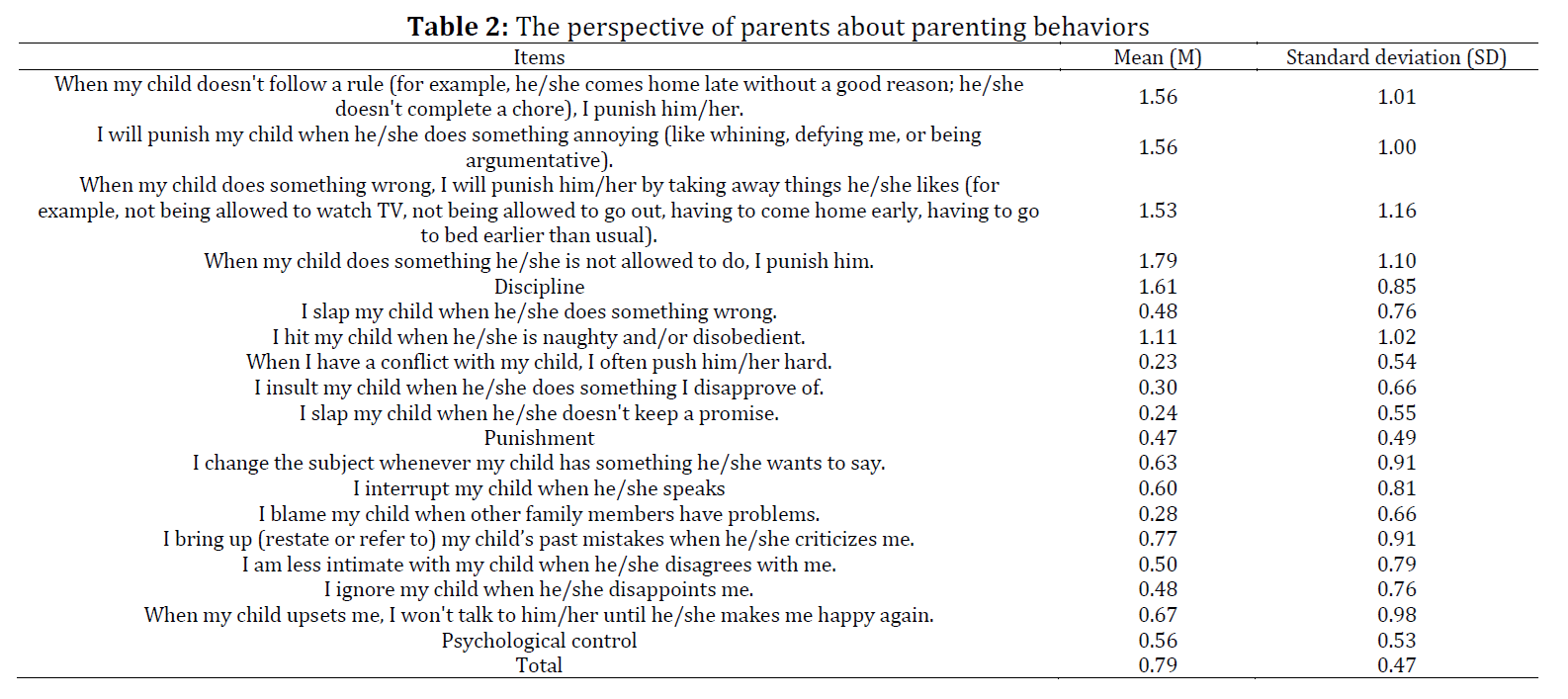
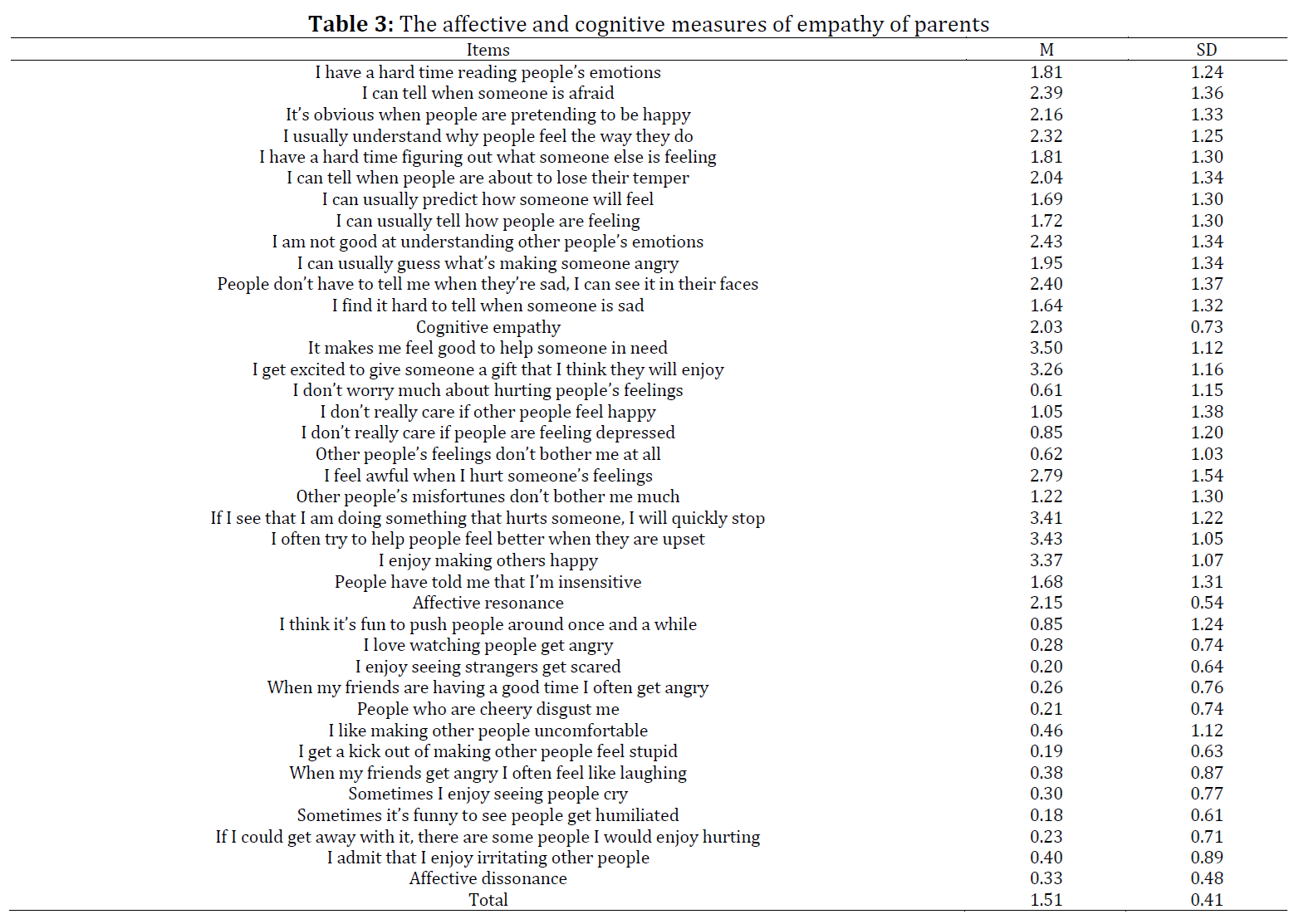
Parenting behaviors strongly influence children’s emotional, cognitive, and social development. Parental empathy, including cognitive empathy, emotional resonance, and emotional dissonance, shapes disciplinary practices and parent–child relationships. This study examines levels of parental empathy and parenting behaviors in the areas of discipline, punishment, and psychological control, and explores how emotional and cognitive involvement in parenting affects disciplinary approaches and family interactions. Data were collected from 349 parents using validated instruments, including the Emotional and Cognitive Empathy Scale and the Parenting Behavior Scale–Short Form with the Psychological Control Scale. Descriptive statistical analyses showed that parents mainly used non-aggressive discipline methods (M = 1.61, SD = 0.85) and reported high emotional resonance (M = 2.15, SD = 0.54). Punitive behaviors were rare (M = 0.47, SD = 0.49), while psychological control was used at a moderate level (M = 0.56, SD = 0.53). Emotional resonance was positively associated with positive parenting behaviors, and cognitive empathy showed a moderate relationship with constructive disciplinary practices. Overall, the findings highlight the important role of parental empathy in promoting effective parenting and healthy family dynamics, while also indicating that the use of psychological control and lower levels of cognitive empathy remain areas for improvement.
© 2025 The Authors. Published by IASE.
This is an
Keywords
Parental empathy, Parenting behaviors, Discipline practices, Psychological control, Parent–child relationship
Article history
Received 25 July 2025, Received in revised form 25 November 2025, Accepted 14 December 2025
Acknowledgment
No Acknowledgment.
Compliance with ethical standards
Ethical considerations
This study was conducted in accordance with internationally accepted ethical standards for research involving human participants. All participants were fully informed about the purpose of the study, the voluntary nature of their participation, and their right to withdraw at any time without penalty. Informed consent was obtained electronically prior to data collection. Participants were assured of anonymity and confidentiality, and no identifying information was collected.
Conflict of interest: The author(s) declared no potential conflicts of interest with respect to the research, authorship, and/or publication of this article.
Citation:
Nguyen HT, Ly HTM, Tran TL, Nguyen HT, and Nguyen HD (2026). Parental empathy and behavior: A study on discipline, punishment, and psychological control. International Journal of Advanced and Applied Sciences, 13(1): 65-73
Figures
No Figure
Tables
----------------------------------------------
References (27)
- Aneesh A, Sia SK, and Kumar P (2024). Parent-child relationship and psychological well-being of adolescents: Role of emotion regulation and social competence. Journal of Human Behavior in the Social Environment, 34(2): 153-171. https://doi.org/10.1080/10911359.2023.2221321 [Google Scholar]
- Avasthi A (2010). Preserve and strengthen family to promote mental health. Indian Journal of Psychiatry, 52(2): 113-126. https://doi.org/10.4103/0019-5545.64582 [Google Scholar] PMid:20838498 PMCid:PMC2927880
- Baker AJ, Fine PR, and LaCheen-Baker A (2020). Restoring family connections: Helping targeted parents and adult alienated children work through conflict, improve communication, and enhance relationships. Bloomsbury Publishing PLC., London, UK. [Google Scholar]
- Baumrind D (1971). Current patterns of parental authority. Developmental Psychology, 4(1): 1-103. https://doi.org/10.1037/h0030372 [Google Scholar]
- Brooks RB (2023). The power of parenting. In: Goldstein S and Brooks RB (Eds.), Handbook of resilience in children: 377-395: Springer, Cham, Switzerland. https://doi.org/10.1007/978-3-031-14728-9_21 [Google Scholar] PMCid:PMC10897103
- Bu H, Liu IKF, and Yu NX (2024). A randomized controlled trial of two parenting interventions on enhancing parental resilience resources and reducing children’s problem behaviors in Chinese cross-boundary families: Positive benefits and moderation effects. Behavior Therapy, 55(3): 485-498. https://doi.org/10.1016/j.beth.2023.08.007 [Google Scholar] PMid:38670663
- Çakmak Tolan Ö and Bolluk Uğur G (2024). The relation between psychological resilience and parental attitudes in adolescents: A systematic review. Current Psychology, 43: 8048-8074. https://doi.org/10.1007/s12144-023-04966-7 [Google Scholar]
- Choe SY, Laursen B, Cheah CS, Lengua LJ, Schoppe-Sullivan SJ, and Bagner DM (2023). Intrusiveness and emotional manipulation as facets of parental psychological control: A culturally and developmentally sensitive reconceptualization. Human Development, 67(2): 69-87. https://doi.org/10.1159/000530493 [Google Scholar]
- Covey SR (2014). The 7 habits of highly effective families: Creating a nurturing family in a turbulent world. St. Martin's Press, New York, USA. [Google Scholar]
- De Paul J and Guibert M (2008). Empathy and child neglect: A theoretical model. Child Abuse & Neglect, 32(11): 1063-1071. https://doi.org/10.1016/j.chiabu.2008.03.003 [Google Scholar] PMid:19013642
- Decety J and Holvoet C (2021). The emergence of empathy: A developmental neuroscience perspective. Developmental Review, 62: 100999. https://doi.org/10.1016/j.dr.2021.100999 [Google Scholar]
- Dupper DR (2010). A new model of school discipline: Engaging students and preventing behavior problems. Oxford University Press, Oxford, UK. [Google Scholar]
- Hajal NJ and Paley B (2020). Parental emotion and emotion regulation: A critical target of study for research and intervention to promote child emotion socialization. Developmental Psychology, 56(3): 403. https://doi.org/10.1037/dev0000864 [Google Scholar] PMid:32077713
- Krauthamer Ewing ES, Herres J, Dilks KE, Rahim F, and Trentacosta CJ (2019). Understanding of emotions and empathy: Predictors of positive parenting with preschoolers in economically stressed families. Journal of Child and Family Studies, 28: 1346-1358. https://doi.org/10.1007/s10826-018-01303-6 [Google Scholar]
- Landry SH, Smith KE, and Swank PR (2006). Responsive parenting: Establishing early foundations for social, communication, and independent problem-solving skills. Developmental Psychology, 42(4): 627-642. https://doi.org/10.1037/0012-1649.42.4.627 [Google Scholar] PMid:16802896 PMCid:PMC4010236
- Le DT, Huynh SV, Vu TV et al. (2023). Personality traits and aggressive behavior in Vietnamese adolescents. Psychology Research and Behavior Management, 16: 1987-2003. https://doi.org/10.2147/PRBM.S405379 [Google Scholar] PMid:37284555 PMCid:PMC10239631
- Nguyen-Thi DM, Huynh VS, and Tran-Chi VL (2020). Loneliness, stress, self-esteem, and deception among adolescents. Journal of Human Ecology, 70(1-3): 118-123. https://doi.org/10.31901/24566608.2020/70.1-3.3217 [Google Scholar]
- Rogers AA, Padilla-Walker LM, McLean RD, and Hurst JL (2020). Trajectories of perceived parental psychological control across adolescence and implications for the development of depressive and anxiety symptoms. Journal of Youth and Adolescence, 49: 136-149. https://doi.org/10.1007/s10964-019-01070-7 [Google Scholar] PMid:31273602
- Rothman NB, Pratt MG, Rees L, and Vogus TJ (2017). Understanding the dual nature of ambivalence: Why and when ambivalence leads to good and bad outcomes. Academy of Management Annals, 11(1): 33-72. https://doi.org/10.5465/annals.2014.0066 [Google Scholar]
- Shapiro S and White C (2014). Mindful discipline: A loving approach to setting limits and raising an emotionally intelligent child. New Harbinger Publications, Oakland, USA. [Google Scholar]
- Vachon DD and Lynam DR (2016). Fixing the problem with empathy: Development and validation of the affective and cognitive measure of empathy. Assessment, 23(2): 135-149. https://doi.org/10.1177/1073191114567941 [Google Scholar] PMid:25612628
- Van Heel M, Bijttebier P, Colpin H, Goossens L, Van Den Noortgate W, Verschueren K, and Van Leeuwen K (2019). Investigating the interplay between adolescent personality, parental control, and externalizing problem behavior across adolescence. Journal of Research in Personality, 81: 176-186. https://doi.org/10.1016/j.jrp.2019.06.005 [Google Scholar]
- Van Pham S (2024). The influence of social and emotional learning on academic performance, emotional well-being, and implementation strategies: A literature review. Saudi Journal of Humanities and Social Sciences, 9(12): 381-391. https://doi.org/10.36348/sjhss.2024.v09i12.001 [Google Scholar]
- Van-Huynh S and Tran-Chi VL (2019). Vietnamese high school students’ perceptions of academic advising. International Journal of Learning, Teaching and Educational Research, 18(8): 98-107. https://doi.org/10.26803/ijlter.18.8.6 [Google Scholar]
- Vu TV, Nguyen XTK, Vu TTT, and Chi VLT (2022). Parent-adolescent conflict during the COVID-19 pandemic. Studies on Ethno-Medicine, 16(3-4): 106-113. https://doi.org/10.31901/24566772.2022/16.3-4.653 [Google Scholar]
- Winkler JL, Walsh ME, de Blois M, Mare J, and Carvajal SC (2017). Kind discipline: Developing a conceptual model of a promising school discipline approach. Evaluation and Program Planning, 62: 15-24. https://doi.org/10.1016/j.evalprogplan.2017.02.002 [Google Scholar] PMid:28242511
- Zolkoski SM and Bullock LM (2012). Resilience in children and youth: A review. Children and Youth Services Review, 34(12): 2295-2303. https://doi.org/10.1016/j.childyouth.2012.08.009 [Google Scholar]