International
ADVANCED AND APPLIED SCIENCES
EISSN: 2313-3724, Print ISSN: 2313-626X
Frequency: 12


Volume 13, Issue 1 (January 2026), Pages: 35-44

----------------------------------------------
Original Research Paper
Assessment of science laboratory resources and teachers’ laboratory skills: Basis for a training program
Author(s):
Affiliation(s):
1College of Education, Nueva Ecija University of Science and Technology, Cabanatuan City, Philippines
2Department of Education, SDO Cabanatuan City, Philippines
Full text

* Corresponding Author.
 Corresponding author's ORCID profile: https://orcid.org/0000-0002-6143-6129
Digital Object Identifier (DOI)
https://doi.org/10.21833/ijaas.2026.01.004
Abstract
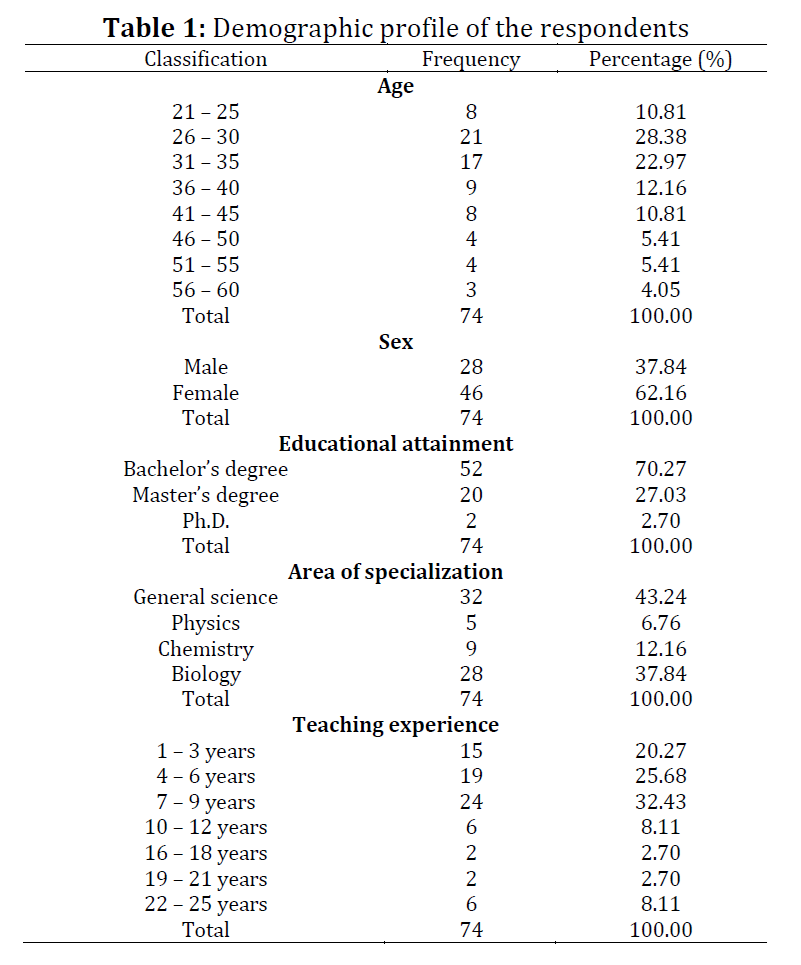
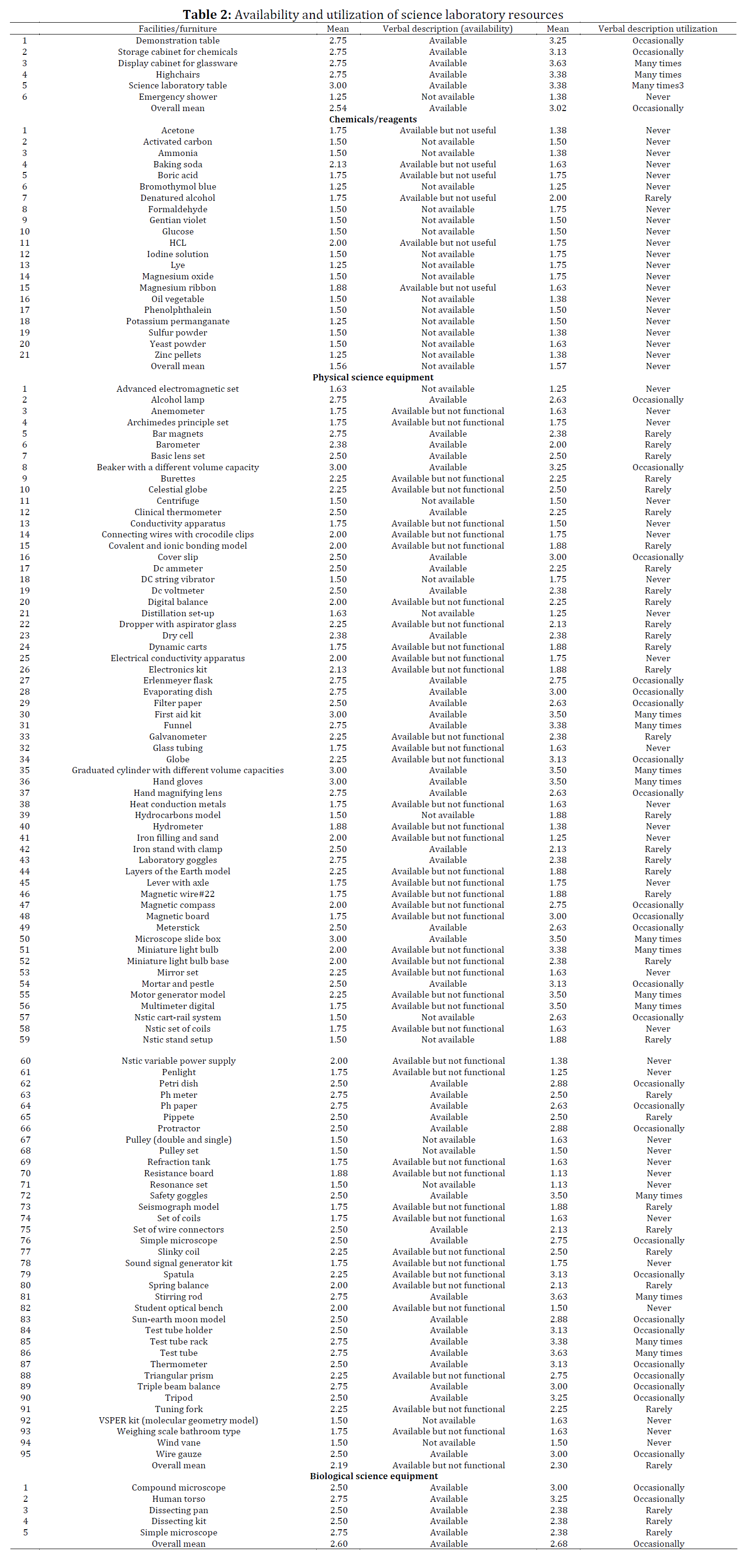
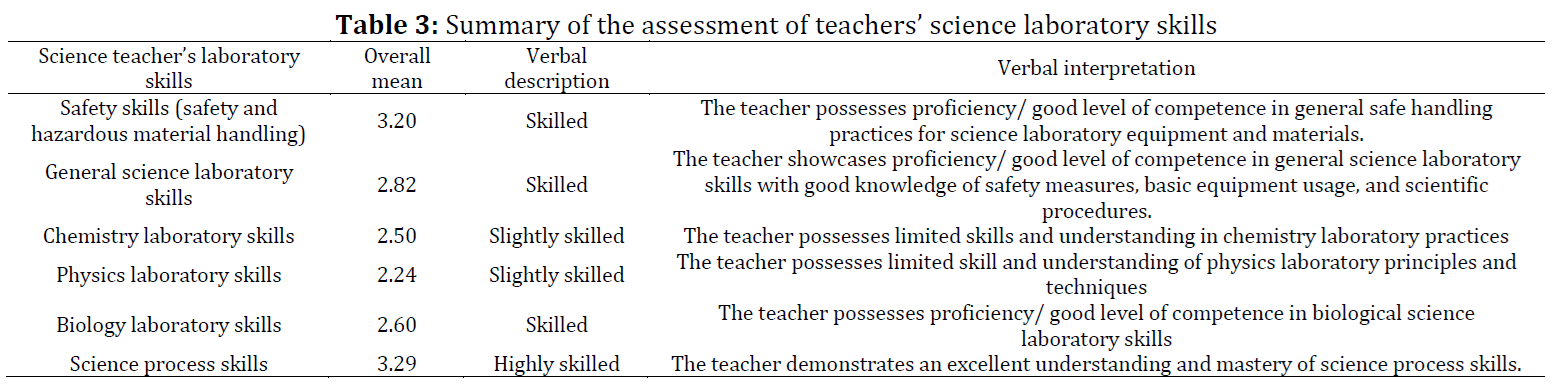
This study developed a training program for science teachers using a developmental research design guided by the ADDIE model (Analysis, Design, Development, Implementation, and Evaluation). A quantitative approach was applied to assess laboratory resources, evaluate teachers’ laboratory competencies, and inform program design. Findings showed that most participants were female, aged 26–35, and held at least a bachelor’s degree in General or Biological Science. Laboratory resources and their use were generally rated as average, with notable shortages in chemicals, reagents, and physical science equipment. Teachers demonstrated moderate to high proficiency in laboratory skills and safety practices, though some areas required improvement. Based on these needs, a training program was designed, validated by experts, and implemented, showing effectiveness in addressing identified gaps. The study highlights the importance of continuous professional development through targeted training and workshops to enhance laboratory competence and ensure safe and effective science teaching.
© 2025 The Authors. Published by IASE.
This is an
Keywords
Developmental research, Science laboratory resources, Science laboratory skills, Training program, ADDIE model
Article history
Received 5 June 2025, Received in revised form 9 October 2025, Accepted 11 December 2025
Acknowledgment
The researchers acknowledge the Science teachers for their valuable participation, the NEUST community for their financial support, and the College of Education for their encouragement in completing this research.
Compliance with ethical standards
Ethical considerations
This study was conducted in compliance with ethical standards. All participants provided informed consent prior to participation, and their privacy and confidentiality were protected throughout the study.
Conflict of interest: The author(s) declared no potential conflicts of interest with respect to the research, authorship, and/or publication of this article.
Citation:
Rivera AT and Deleon SP (2026). Assessment of science laboratory resources and teachers’ laboratory skills: Basis for a training program. International Journal of Advanced and Applied Sciences, 13(1): 35-44
Figures
No Figure
Tables
Table 1 Table 2 Table 3 Table 4 Table 5 Table 6 Table 7

----------------------------------------------
References (21)
- Álvarez-Siordia FM, Merino-Soto C, Rosas-Meléndez SA, Pérez-Díaz M, and Chans GM (2025). Simulators as an innovative strategy in the teaching of physics in higher education. Education Sciences, 15(2): 131. https://doi.org/10.3390/educsci15020131 [Google Scholar]
- Anto IJC, Buagas IRA, Ong PMVJ, Naparan GB, and Villaver AV (2023). Challenges and coping strategies of science teachers. Canadian Journal of Educational and Social Studies, 3(4): 148–166. https://doi.org/10.53103/cjess.v3i4.168 [Google Scholar]
- Bancual R and Ricafort JD (2019). Laboratory practices of junior high school science teachers. International Journal of Engineering Science and Computing, 9(6): 22845-22854. [Google Scholar]
- Courduff J, Lee H, and Cannaday J (2021). The impact and interrelationship of teaching, cognitive, and social presence in face-to-face, blended, and online masters courses. Distance Learning, 18(1): 1-12. https://doi.org/10.1108/DL-07-2021-0002 [Google Scholar]
- de Borja JMA and Espinosa AA (2025). Understanding the culture of science research teachers with winning science investigatory projects. Journal of Science Teacher Education, 36(4): 511-534. https://doi.org/10.1080/1046560X.2024.2429204 [Google Scholar]
- Dizon R, Calbi J, Cuyos J, and Miranda M (2019). Perspectives on the implementation of the K to 12 program in the Philippines: A research review. International Journal of Innovation and Research in Educational Sciences, 6(6): 757-765. [Google Scholar]
- Grgić M and Jutzi M (2024). Linking school culture to successful curriculum reform. Education Sciences, 14(6): 558. https://doi.org/10.3390/educsci14060558 [Google Scholar]
- Hipolito ER and De Leon SP (2021). Training program for mobile teachers in teaching science. European Journal of Humanities and Educational Advancements, 2(8): 37-44. [Google Scholar]
- Jimenez J and Errabo DD (2024). Cross-cultural biology teaching using next-generation science standards. Education Sciences, 14(11): 1243. https://doi.org/10.3390/educsci14111243 [Google Scholar]
- Lacerenza CN, Reyes DL, Marlow SL, Joseph DL, and Salas E (2017). Leadership training design, delivery, and implementation: A meta-analysis. Journal of Applied Psychology, 102(12): 1686–1718. https://doi.org/10.1037/apl0000241 [Google Scholar] PMid:28749153
- Luneta K (2012). Designing continuous professional development programmes for teachers: A literature review. Africa Education Review, 9(2): 360-379. https://doi.org/10.1080/18146627.2012.722395 [Google Scholar]
- Mormina M (2019). Science, technology and innovation as social goods for development: Rethinking research capacity building from Sen’s capabilities approach. Science and Engineering Ethics, 25(3): 671–692. https://doi.org/10.1007/s11948-018-0037-1 [Google Scholar] PMid:29497970 PMCid:PMC6591180
- Noroña RV (2021). Status of laboratory resources and science process skills of Grade 11 learners in the Division of Eastern Samar, Philippines. TARAN-AWAN Journal of Educational Research and Technology Management, 2(1): 46-59. [Google Scholar]
- OECD (2021). TALIS: The OECD teaching and learning international survey. Organisation for Economic Co-operation and Development, Paris, France. [Google Scholar]
- Orbe JR, Espinosa AA, and Datukan JT (2018). Teaching chemistry in a spiral progression approach: Lessons from science teachers in the Philippines. Australian Journal of Teacher Education, 43(4): 17–30. https://doi.org/10.14221/ajte.2018v43n4.2 [Google Scholar]
- Pareek RB (2019). An assessment of availability and utilization of laboratory facilities for teaching science at secondary level. Science Education International, 30(1): 75-81. https://doi.org/10.33828/sei.v30.i1.9 [Google Scholar]
- Pinar FI, Panergayo AA, Sagcal RR, Acut DP, Roleda LS, and Prudente MS (2025). Fostering scientific creativity in science education through scientific problem-solving approaches and STEM contexts: A meta-analysis. Disciplinary and Interdisciplinary Science Education Research, 7: 18. https://doi.org/10.1186/s43031-025-00137-9 [Google Scholar]
- Rivera AB and Tanghal ADS (2021). Student-based assessment on the utilization of innovative teaching methods in the new normal. Puissant, 2: 236-255. [Google Scholar]
- Trust T and Whalen J (2020). Should teachers be trained in remote instruction? An investigation of teacher and administrator perceptions. Journal of Technology and Teacher Education, 28(2): 243–256. https://doi.org/10.70725/307718pkpjuu [Google Scholar]
- UNESCO (2021). Reimagining our futures together: A new social contract for education. United Nations Educational, Scientific and Cultural Organization, Paris, France. [Google Scholar]
- Vural ÖF and Başaran M (2021). The reasons for teachers’ preference for Master’s degree: Teachers’ preference for Master’s degree. International Journal of Curriculum and Instruction, 13(1): 589-613. [Google Scholar]