
International
ADVANCED AND APPLIED SCIENCES
EISSN: 2313-3724, Print ISSN: 2313-626X
Frequency: 12


Volume 12, Issue 12 (December 2025), Pages: 184-191

----------------------------------------------
Original Research Paper
Digital transformation status of savings cooperatives: Evidence from Thailand
Author(s):
Affiliation(s):
1School of Accountancy and Finance, Walailak University, Nakhon Si Thammarat, Thailand
2Faculty of Management Science, Silpakorn University, Phetchaburi, Thailand
Full text

* Corresponding Author.
 Corresponding author's ORCID profile: https://orcid.org/0000-0001-6275-9053
Digital Object Identifier (DOI)
https://doi.org/10.21833/ijaas.2025.12.016
Abstract
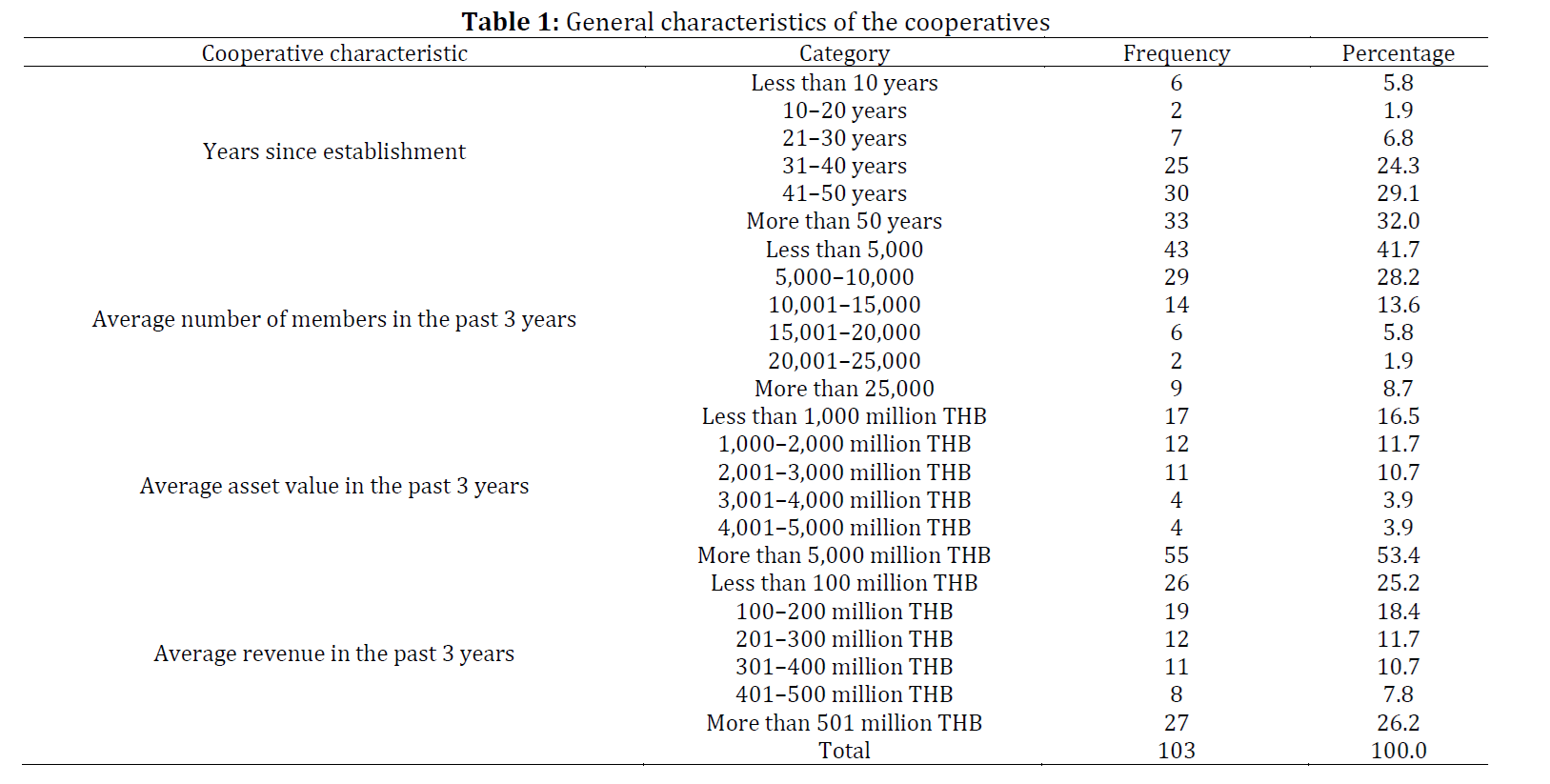
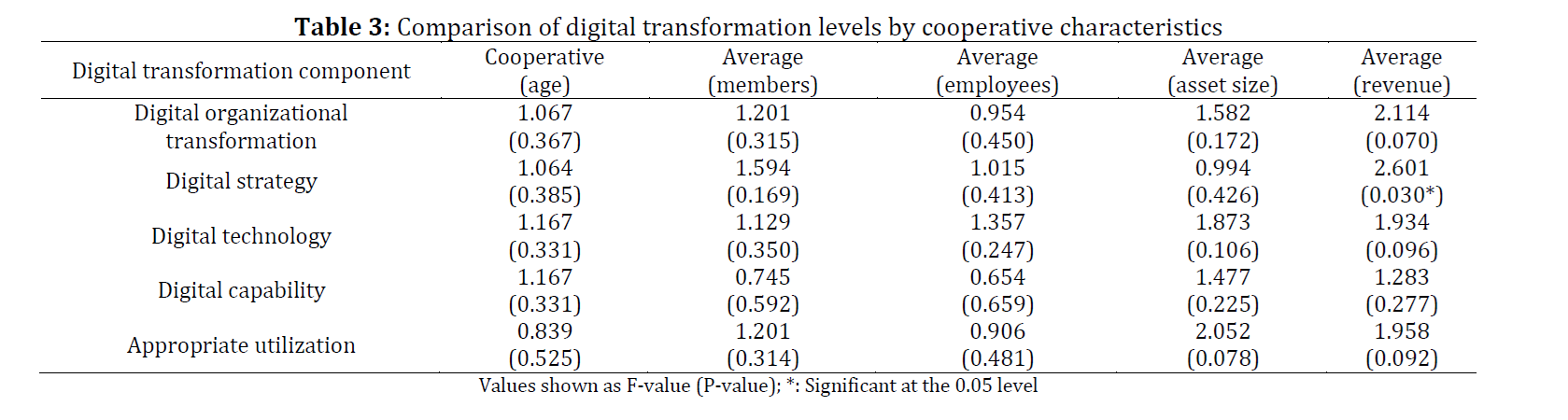
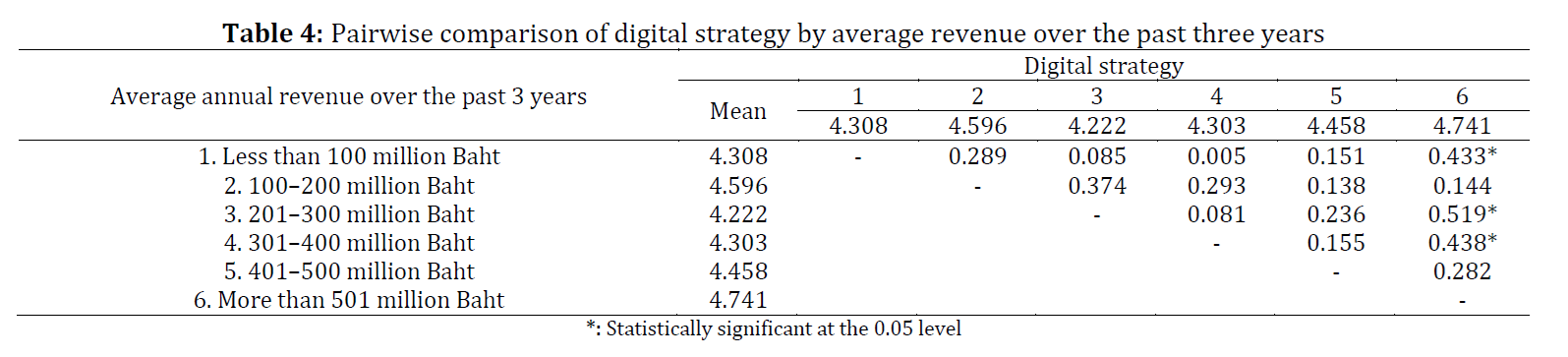
This study examined the level of digital transformation among savings cooperatives in Thailand. Data were collected from 103 cooperative managers or acting managers using a structured questionnaire, and analyzed with descriptive statistics and one-way ANOVA. The results showed that the overall digital transformation level was high, and all subdimensions—digital strategy, digital technology, digital capability, and effective utilization—were also rated as high. The analysis further indicated that digital transformation did not differ significantly by years of establishment, number of members, number of employees, or average assets over the past three years. However, a significant difference was found in the digital strategy dimension when categorized by average revenue. Cooperatives with average revenue of 501 million baht or more had significantly higher digital strategy scores than those with revenue below 100 million baht, 201–300 million baht, and 301–400 million baht.
© 2025 The Authors. Published by IASE.
This is an
Keywords
Digital transformation, Savings cooperatives, Digital strategy, Thailand, ANOVA
Article history
Received 7 August 2025, Received in revised form 24 November 2025, Accepted 26 November 2025
Acknowledgment
The authors are deeply grateful to all cooperative participants who generously dedicated their time to this research. Their valuable contributions were instrumental to the success of this study.
Compliance with ethical standards
Ethical considerations
The authors declared that the participants were assured that their participation was voluntary and that they could withdraw from the study at any time. The data collected from the participants was kept confidential and anonymous, and the data was only used for research purposes. The authors further declared that the study complied with ethical guidelines set forth by the Institutional Review Board of the human research ethics committee (WUEC-25-026-01).
Conflict of interest: The author(s) declared no potential conflicts of interest with respect to the research, authorship, and/or publication of this article.
Citation:
Esamah A, Rakangthong NK, and Aujirapongpan S (2025). Digital transformation status of savings cooperatives: Evidence from Thailand. International Journal of Advanced and Applied Sciences, 12(12): 184-191
Figures
No Figures
Tables
Table 1 Table 2 Table 3 Table 4

----------------------------------------------
References (34)
- Ciruela-Lorenzo AM, Del-Aguila-Obra AR, Padilla-Meléndez A, and Plaza-Angulo JJ (2020). Digitalization of Agri-cooperatives in the smart agriculture context: Proposal of a digital diagnosis tool. Sustainability, 12(4): 1325. https://doi.org/10.3390/su12041325 [Google Scholar]
- Creswell JW (2009). Research designs: Qualitative, quantitative, and mixed methods approaches. 3rd Edition, SAGE Publications, Thousand Oaks, USA. [Google Scholar]
- Duarte AF, Moreira VR, Ferraresi AA, and Gerhard A (2016). Evaluating credit union members’ perception of service quality through service innovation. RAI Revista de Administração e Inovação, 13(4): 242-250. https://doi.org/10.1016/j.rai.2016.06.007 [Google Scholar]
- Ermaya K, Ermaya HNL, Azhar S, and Mulyana I (2023). The unique strategy in digital cooperatives to increase benefit for members. International Journal of Business, Economics, and Social Development, 4(4): 246-252. https://doi.org/10.46336/ijbesd.v4i4.430 [Google Scholar]
- Esamah A, Aujirapongpan S, Rakangthong NK, and Imjai N (2023). Agile leadership and digital transformation in savings cooperative limited: Impact on sustainable performance amidst COVID-19. Journal of Human, Earth, and Future, 4(1): 36-53. https://doi.org/10.28991/HEF-2023-04-01-04 [Google Scholar]
- Etikan I, Musa SA, and Alkassim RS (2016). Comparison of convenience sampling and purposive sampling. American Journal of Theoretical and Applied Statistics, 5(1): 1-4. https://doi.org/10.11648/j.ajtas.20160501.11 [Google Scholar]
- Fernandez-Vidal J, Perotti FA, Gonzalez R, and Gasco J (2022). Managing digital transformation: The view from the top. Journal of Business Research, 152: 29-41. https://doi.org/10.1016/j.jbusres.2022.07.020 [Google Scholar]
- Haq IU and Huo C (2023). Digital strategy and environmental performance: the mediating role of digitalization in SMEs. Digital Economy and Sustainable Development, 1: 9. https://doi.org/10.1007/s44265-023-00010-5 [Google Scholar] PMCid:PMC10232346
- Kamau JN, Mathuva DM, and Ndiritu SW (2024). Digital transformation: a study of how SACCO members in Kenya experience financial inclusion through digital financial services. Forum Scientiae Oeconomia, 12(1): 139-150. [Google Scholar]
- Kebede AS, Ozolins LL, Holst H, and Galvin K (2022). Digital engagement of older adults: Scoping review. Journal of Medical Internet Research, 24(12): e40192. https://doi.org/10.2196/40192 [Google Scholar] PMid:36477006 PMCid:PMC9773036
- Khin S and Ho TC (2019). Digital technology, digital capability and organizational performance: A mediating role of digital innovation. International Journal of Innovation Science, 11(2): 177-195. https://doi.org/10.1108/IJIS-08-2018-0083 [Google Scholar]
- Kraus S, Durst S, Ferreira JJ, Veiga P, Kailer N, and Weinmann A (2022). Digital transformation in business and management research: An overview of the current status quo. International Journal of Information Management, 63: 102466. https://doi.org/10.1016/j.ijinfomgt.2021.102466 [Google Scholar]
- Kreuzer T, Lindenthal AK, Oberländer AM, and Röglinger M (2022). The effects of digital technology on opportunity recognition. Business & Information Systems Engineering, 64: 47-67. https://doi.org/10.1007/s12599-021-00733-9 [Google Scholar] PMCid:PMC8811742
- Krumpal I (2013). Determinants of social desirability bias in sensitive surveys: A literature review. Quality & Quantity, 47: 2025-2047. https://doi.org/10.1007/s11135-011-9640-9 [Google Scholar]
- Lewin K (1947). Frontiers in group dynamics: Concept, method and reality in social science; social equilibria and social change. Human Relations, 1(1): 5-41. https://doi.org/10.1177/001872674700100103 [Google Scholar]
- Minzar M and Mishra MK (2024). Digital transformation in cooperatives: Opportunities and challenges. IOSR Journal of Business and Management, 26(10): 23-31. https://doi.org/10.9790/487X-2610132331 [Google Scholar]
- Ogindo EA and Njoka C (2023). Digital transformation and financial performance of deposit-taking savings and credit co-operatives in Nairobi City County, Kenya. Journal of Finance and Accounting, 3(2): 45-56. https://doi.org/10.70619/vol3iss2pp45-56 [Google Scholar]
- Pojanavatee S and Kingshott R (2025). Liquidity and leverage on the financial performance of savings and credit cooperatives in the emerging Thailand market. Journal of Indian Business Research, 17(1): 66-82. https://doi.org/10.1108/JIBR-10-2024-0221 [Google Scholar]
- Ribeiro-Navarrete B, López-Cabarcos MÁ, Piñeiro-Chousa J, and Simón-Moya V (2025). The moment is now! From digital transformation to environmental performance. Venture Capital, 27(1): 43-78. https://doi.org/10.1080/13691066.2023.2249231 [Google Scholar]
- Ribeiro-Navarrete B, Martín JMM, Guaita-Martínez JM, and Simón-Moya V (2023). Analysing cooperatives’ digital maturity using a synthetic indicator. International Journal of Information Management, 72: 102678. https://doi.org/10.1016/j.ijinfomgt.2023.102678 [Google Scholar]
- Rogers EM (2003). Diffusion of innovations. 5th Edition, Free Press, New York, USA. [Google Scholar]
- Santos FJ, Guzman C, and Ahumada P (2024). Assessing the digital transformation in agri-food cooperatives and its determinants. Journal of Rural Studies, 105: 103168. https://doi.org/10.1016/j.jrurstud.2023.103168 [Google Scholar]
- Stefanelli V and Manta F (2023). Digital financial services and open banking innovation: Are banks becoming ‘invisible’? Global Business Review. https://doi.org/10.1177/09721509231151491 [Google Scholar]
- Sturn R (2024). Digital transformation and solidarity in cooperatives. In: Ambühl M, Brusoni S, Niedworok A, and Gutmann M (Eds.) Cooperatives in an uncertain world: 93-110. Springer, Cham, Switzerland. https://doi.org/10.1007/978-3-031-56200-6_6 [Google Scholar]
- Trist EL and Bamforth KW (1951). Some social and psychological consequences of the longwall method of coal-getting: An examination of the psychological situation and defences of a work group in relation to the social structure and technological content of the work system. Human Relations, 4(1): 3-38. https://doi.org/10.1177/001872675100400101 [Google Scholar]
- van Zeeland I and Pierson J (2024). Changing the whole game: effects of the COVID-19 pandemic's accelerated digitalization on European bank staff's data protection capabilities. Financial Innovation, 10: 29. https://doi.org/10.1186/s40854-023-00533-y [Google Scholar]
- Velyako V and Musa S (2024). The relationship between digital organizational culture, digital capability, digital innovation, organizational resilience, and competitive advantage. Journal of the Knowledge Economy, 15: 11956-11975. https://doi.org/10.1007/s13132-023-01575-4 [Google Scholar]
- Verstegen L, Houkes W, and Reymen I (2019). Configuring collective digital-technology usage in dynamic and complex design practices. Research Policy, 48(8): 103696. https://doi.org/10.1016/j.respol.2018.10.020 [Google Scholar]
- Vial G (2021). Understanding digital transformation: A review and a research agenda. In: Hinterhuber A, Vescovi T, and Checchinato F (Eds.) Managing digital transformation: 13-66. 1st Edition, Routledge, London, UK. [Google Scholar]
- Wanyonyi KS and Ngaba D (2021). Digital financial services and financial performance of savings and credit cooperative societies in Kakamega County, Kenya. International Journal of Current Aspects in Finance, Banking and Accounting, 3(1): 9-20. https://doi.org/10.35942/ijcfa.v3i1.177 [Google Scholar]
- Wu CH, Chou CW, Chien CF, and Lin YS (2024). Digital transformation in manufacturing industries: Effects of firm size, product innovation, and production type. Technological Forecasting and Social Change, 207: 123624. https://doi.org/10.1016/j.techfore.2024.123624 [Google Scholar]
- Xia Y, Qiao Z, and Xie G (2022). Corporate resilience to the COVID-19 pandemic: The role of digital finance. Pacific-Basin Finance Journal, 74: 101791. https://doi.org/10.1016/j.pacfin.2022.101791 [Google Scholar] PMCid:PMC9159783
- Yamane T (1973). Statistics: An introductory analysis. Harper & Row, New York, USA. [Google Scholar]
- Zhu Y and Jin S (2023). COVID-19, digital transformation of banks, and operational capabilities of commercial banks. Sustainability, 15(11): 8783. https://doi.org/10.3390/su15118783 [Google Scholar]