International
ADVANCED AND APPLIED SCIENCES
EISSN: 2313-3724, Print ISSN: 2313-626X
Frequency: 12


Volume 12, Issue 12 (December 2025), Pages: 51-61

----------------------------------------------
Original Research Paper
Cultivating innovative behavior through AI awareness: A human resource perspective on early childhood education in Guangdong Province, China
Author(s):
Affiliation(s):
1School of Management, Guangzhou Huashang College, Guangzhou, China
2Academic Support Department, Colorado Social Science Research Academy, Denver, USA
3School of Business Administration, Guangzhou Institute of Science and Technology, Guangzhou, China
Full text

* Corresponding Author.
 Corresponding author's ORCID profile: https://orcid.org/0009-0000-5991-7444
Digital Object Identifier (DOI)
https://doi.org/10.21833/ijaas.2025.12.006
Abstract
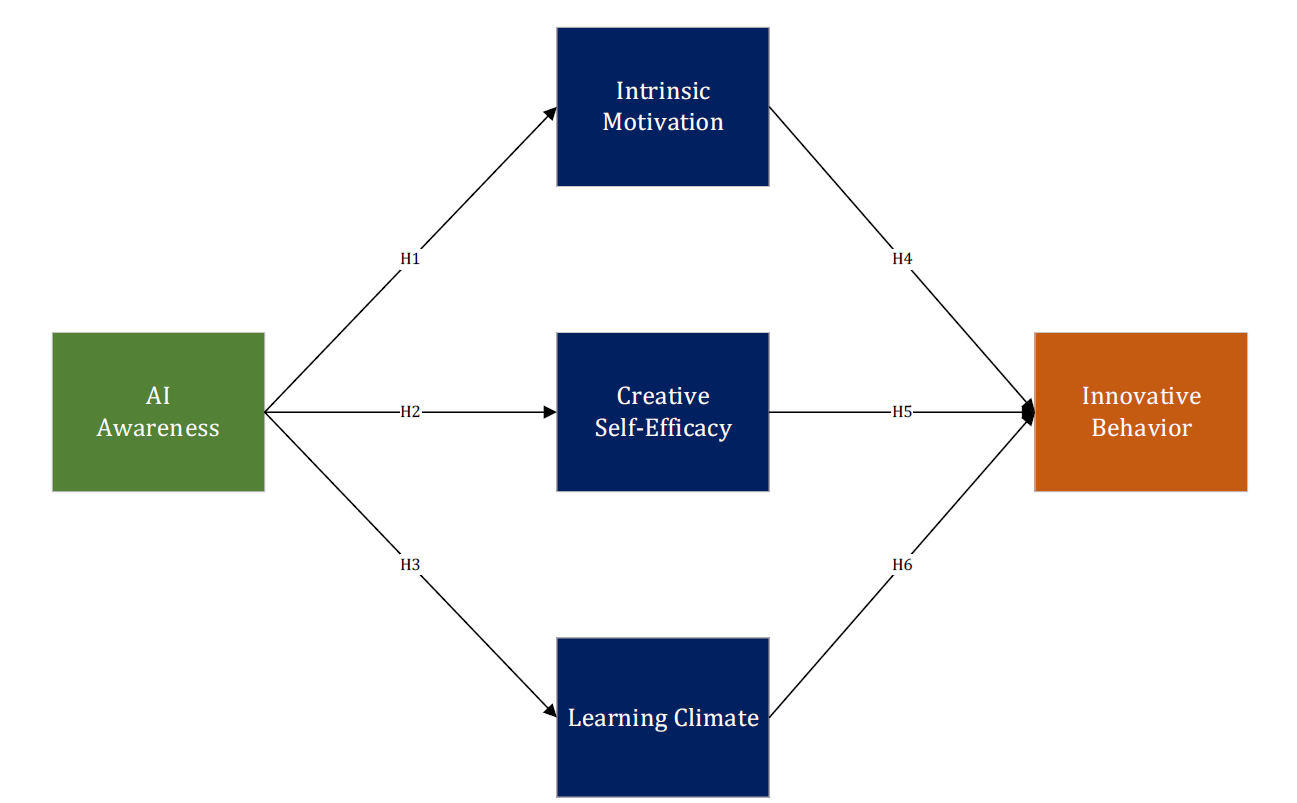
The aim of this study is to examine the effect of artificial intelligence (AI) awareness on innovative practices among early childhood educators in Guangdong, China. Data were collected through online questionnaires from 466 educators across 225 institutions. The study investigates how AI awareness influences intrinsic motivation, creative self-efficacy, learning climate, and innovative behavior. Using SmartPLS-4 and SPSSPRO for analysis, the results indicate that AI awareness significantly affects innovative behavior, with intrinsic motivation (β = 0.505), creative self-efficacy (β = 0.446), and learning climate (β = 0.310) acting as mediating variables. These findings highlight the critical role of AI awareness in promoting innovation among educators and offer practical implications for human resource management in educational institutions. From this perspective, professional development programs that enhance AI literacy can improve teacher motivation, creative self-efficacy, performance, and retention. Future research should also address ethical challenges associated with AI integration in educational contexts.
© 2025 The Authors. Published by IASE.
This is an
Keywords
AI awareness, Innovative behavior, Intrinsic motivation, Creative self-efficacy, Learning climate
Article history
Received 8 July 2025, Received in revised form 2 November 2025, Accepted 13 November 2025
Acknowledgment
This study was supported by the Specialized Talent Training Program of the Department of Education of Guangdong Province [Grant Number: Yuejiao Gaohan (2024) No. 30-415], administered through the School of Business Administration at Guangzhou Institute of Science and Technology.
Compliance with ethical standards
Ethical considerations
All participants provided informed consent, and data were collected anonymously with appropriate ethical safeguards in place.
Conflict of interest: The author(s) declared no potential conflicts of interest with respect to the research, authorship, and/or publication of this article.
Citation:
Tang X and Liu Y (2025). Cultivating innovative behavior through AI awareness: A human resource perspective on early childhood education in Guangdong Province, China. International Journal of Advanced and Applied Sciences, 12(12): 51-61
Figures

Tables
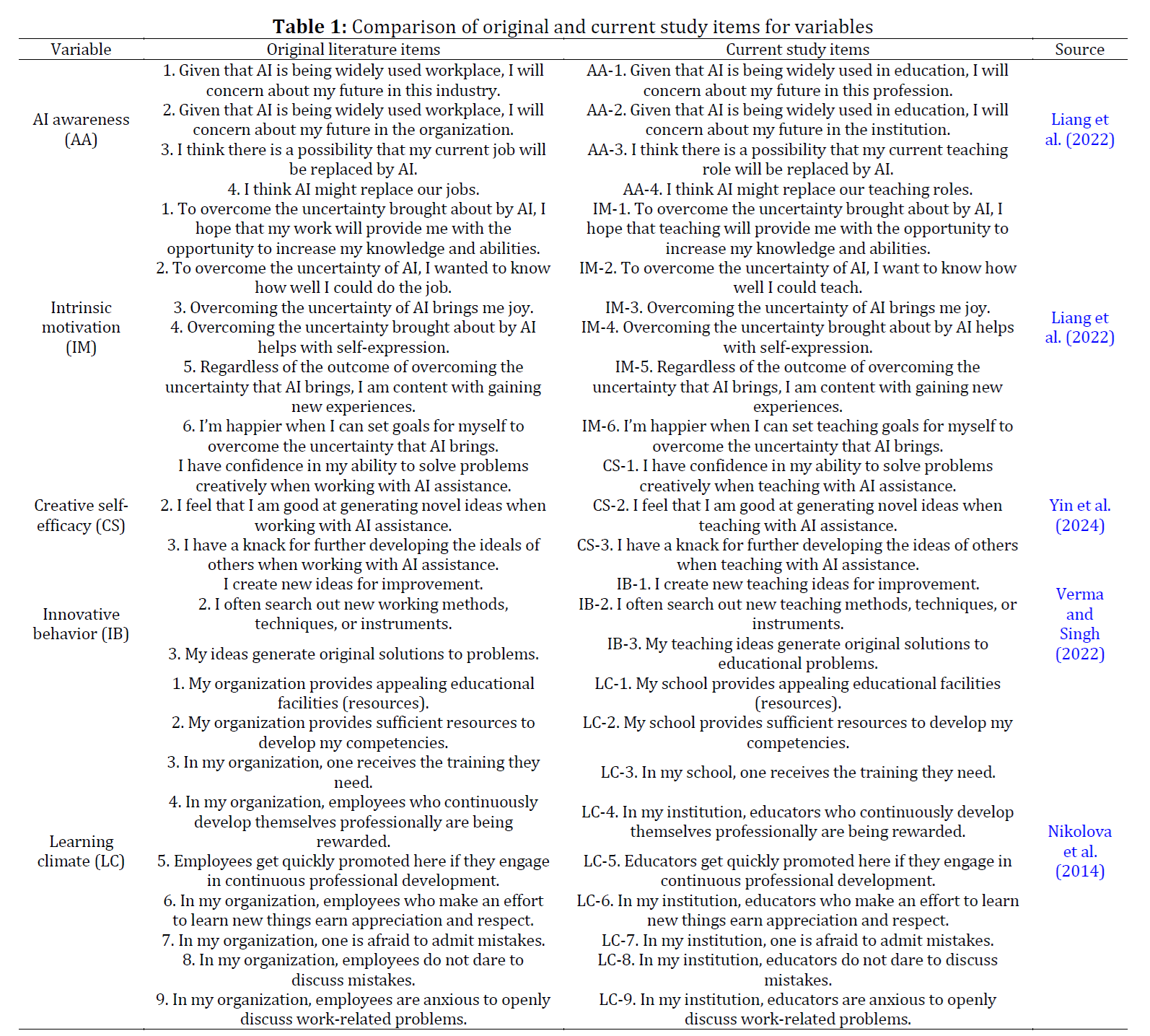
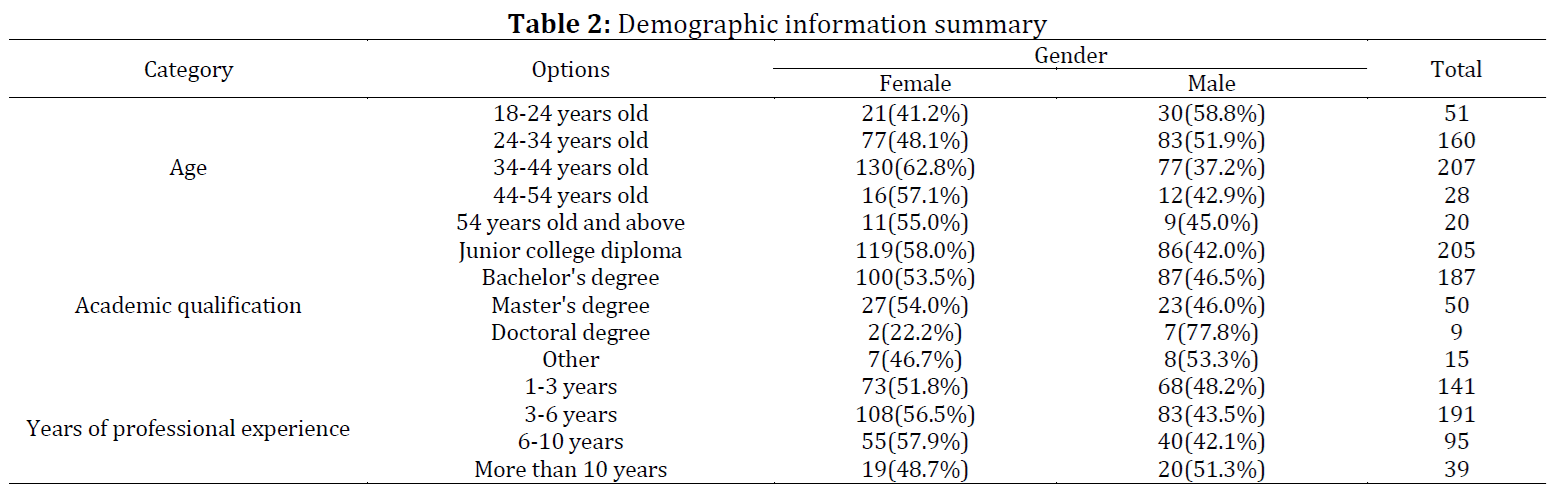
Table 1 Table 2 Table 3 Table 4 Table 5 Table 6 Table 7 Table 8





----------------------------------------------
References (40)
- Abdulraheem M and Imouokhome EO (2021). The influence of social media sites on consumer buying behavior in Shoprite Nigeria Limited. Binus Business Review, 12(2): 113-120. https://doi.org/10.21512/bbr.v12i2.6513 [Google Scholar]
- Ayeni OO, Al Hamad NM, Chisom ON, Osawaru B, and Adewusi OE (2024). AI in education: A review of personalized learning and educational technology. GSC Advanced Research and Reviews, 18(2): 261-271. https://doi.org/10.30574/gscarr.2024.18.2.0062 [Google Scholar]
- Berson IR, Berson MJ, Luo W, and He H (2023). Intelligence augmentation in early childhood education: A multimodal creative inquiry approach. In the 24th International Conference on Artificial Intelligence in Education. Springer Nature, Tokyo, Japan: 756-763. https://doi.org/10.1007/978-3-031-36336-8_116 [Google Scholar]
- Boulamatsi A, Liu S, Lambert LS, Yao X, Guo R, and Yin J (2021). How and when are learning‐adaptable newcomers innovative? Examining mechanisms and constraints. Personnel Psychology, 74(4): 751-772. https://doi.org/10.1111/peps.12435 [Google Scholar]
- Bucea-Manea-Țoniş R, Kuleto V, Gudei SCD, Lianu C, Lianu C, Ilić MP, and Păun D (2022). Artificial intelligence potential in higher education institutions enhanced learning environment in Romania and Serbia. Sustainability, 14(10): 5842. https://doi.org/10.3390/su14105842 [Google Scholar]
- Buçinca Z (2024). Optimizing decision-maker's intrinsic motivation for effective human-AI decision-making. In the Extended Abstracts of the CHI Conference on Human Factors in Computing Systems, Association for Computing Machinery, Honolulu, USA: 1-5. https://doi.org/10.1145/3613905.3638179 [Google Scholar]
- Carnabuci G, Nedkovski V, and Guerci M (2023). Unpacking the link between intrinsic motivational orientation and innovative performance: A social network perspective. In: Gerbasi A, Emery C, and Parker A (Eds.), Understanding workplace relationships: An examination of the antecedents and outcomes: 25-65. Palgrave Macmillan, Cham, Switzerland. https://doi.org/10.1007/978-3-031-16640-2_2 [Google Scholar]
- Chen JJ and Lin JC (2024). Artificial intelligence as a double-edged sword: Wielding the POWER principles to maximize its positive effects and minimize its negative effects. Contemporary Issues in Early Childhood, 25(1): 146-153. https://doi.org/10.1177/14639491231169813 [Google Scholar]
- Cochran WG (1977). Sampling techniques. 3rd Edition, John Wiley and Sons, New York, USA. [Google Scholar]
- Crescenzi-Lanna L (2023). Literature review of the reciprocal value of artificial and human intelligence in early childhood education. Journal of Research on Technology in Education, 55(1): 21-33. https://doi.org/10.1080/15391523.2022.2128480 [Google Scholar]
- di Domenico SI and Ryan RM (2017). The emerging neuroscience of intrinsic motivation: A new frontier in self-determination research. Frontiers in Human Neuroscience, 11: 145. https://doi.org/10.3389/fnhum.2017.00145 [Google Scholar] PMid:28392765 PMCid:PMC5364176
- Garg A, Babu BV, and Balas VE (2024). Advances in technological innovations in higher education: Theory and practices. 1st Edition, CRC Press, Boca Raton, USA. https://doi.org/10.1201/9781003376699 [Google Scholar]
- Gong X, Tang Y, Liu X, Jing S, Cui W, Liang J, and Wang FY (2020). K-9 artificial intelligence education in Qingdao: Issues, challenges and suggestions. In the IEEE International Conference on Networking, Sensing and Control, IEEE, Nanjing, China: 1-6. https://doi.org/10.1109/ICNSC48988.2020.9238087 [Google Scholar]
- Henriksen D, Mishra P, and Stern R (2024). Creative learning for sustainability in a world of AI: Action, mindset, values. Sustainability, 16(11): 4451. https://doi.org/10.3390/su16114451 [Google Scholar]
- Hu B and Zhao Y (2016). Creative self-efficacy mediates the relationship between knowledge sharing and employee innovation. Social Behavior and Personality: An International Journal, 44(5): 815-826. https://doi.org/10.2224/sbp.2016.44.5.815 [Google Scholar]
- Hu YH (2022). Effects and acceptance of precision education in an AI-supported smart learning environment. Education and Information Technologies, 27: 2013-2037. https://doi.org/10.1007/s10639-021-10664-3 [Google Scholar]
- Jaber TA (2022). Artificial intelligence in computer networks. Periodicals of Engineering and Natural Sciences, 10(1): 309-322. https://doi.org/10.21533/pen.v10.i1.539 [Google Scholar]
- Kanders K, Stupple‐Harris L, Smith L, and Gibson JL (2024). Perspectives on the impact of generative AI on early‐childhood development and education. Infant and Child Development, 33(4): e2514. https://doi.org/10.1002/icd.2514 [Google Scholar]
- Kaswan KS, Dhatterwal JS, and Ojha RP (2024). AI in personalized learning. In: Garg A, Babu BV, and Balas VE (Eds.), Advances in technological innovations in higher education: 103-117. 1st Edition, CRC Press, Boca Raton, USA. https://doi.org/10.1201/9781003376699-9 [Google Scholar]
- Kitcharoen P, Howimanporn S, and Chookaew S (2024). Enhancing teachers' AI competencies through artificial intelligence of things professional development training. International Journal of Interactive Mobile Technologies, 18(2): 4-15. https://doi.org/10.3991/ijim.v18i02.46613 [Google Scholar]
- Lapsomboonkamol S, Songkram N, Thamsuwan P, and Songkram N (2022). The mediating effect of knowledge integration on the relationship between capability and innovative behaviour. Emerging Science Journal, 6: 92-107. https://doi.org/10.28991/ESJ-2022-SIED-07 [Google Scholar]
- Leung K, Chen T, and Chen G (2014). Learning goal orientation and creative performance: The differential mediating roles of challenge and enjoyment intrinsic motivations. Asia Pacific Journal of Management, 31: 811-834. https://doi.org/10.1007/s10490-013-9367-3 [Google Scholar]
- Liang X, Guo G, Shu L, Gong Q, and Luo P (2022). Investigating the double-edged sword effect of AI awareness on employee's service innovative behavior. Tourism Management, 92: 104564. https://doi.org/10.1016/j.tourman.2022.104564 [Google Scholar]
- Lim EM (2023). The effects of pre-service early childhood teachers' digital literacy and self-efficacy on their perception of AI education for young children. Education and Information Technologies, 28: 12969-12995. https://doi.org/10.1007/s10639-023-11724-6 [Google Scholar]
- Makinde WA and Abati MO (2024). Effects of community radio on political education in Ibadan Metropolis, Oyo State, Nigeria. Journal of Social, Humanity, and Education, 4(4): 219-229. https://doi.org/10.35912/jshe.v4i4.1843 [Google Scholar]
- Nikolova I, Van Ruysseveldt J, De Witte H, and Van Dam K (2014). Learning climate scale: Construction, reliability and initial validity evidence. Journal of Vocational Behavior, 85(3): 258-265. https://doi.org/10.1016/j.jvb.2014.07.007 [Google Scholar]
- Orth M and Volmer J (2017). Daily within-person effects of job autonomy and work engagement on innovative behaviour: The cross-level moderating role of creative self-efficacy. European Journal of Work and Organizational Psychology, 26(4): 601-612. https://doi.org/10.1080/1359432X.2017.1332042 [Google Scholar]
- Puente-Díaz R and Cavazos-Arroyo J (2017). Creative self-efficacy: The influence of affective states and social persuasion as antecedents and imagination and divergent thinking as consequences. Creativity Research Journal, 29(3): 304-312. https://doi.org/10.1080/10400419.2017.1360067 [Google Scholar]
- Raju B, Jumah F, Ashraf O et al. (2020). Big data, machine learning, and artificial intelligence: A field guide for neurosurgeons. Journal of Neurosurgery, 135(2): 373-383. https://doi.org/10.3171/2020.5.JNS201288 [Google Scholar] PMid:33007750
- Steinkamp J and Cook TS (2021). Basic artificial intelligence techniques: Natural language processing of radiology reports. Radiologic Clinics, 59(6): 919-931. https://doi.org/10.1016/j.rcl.2021.06.003 [Google Scholar] PMid:34689877
- Su J and Yang W (2022). Artificial intelligence in early childhood education: A scoping review. Computers and Education: Artificial Intelligence, 3: 100049. https://doi.org/10.1016/j.caeai.2022.100049 [Google Scholar]
- Su J and Zhong Y (2022). Artificial intelligence (AI) in early childhood education: Curriculum design and future directions. Computers and Education: Artificial Intelligence, 3: 100072. https://doi.org/10.1016/j.caeai.2022.100072 [Google Scholar]
- Su J, Ng DTK, and Chu SKW (2023). Artificial intelligence (AI) literacy in early childhood education: The challenges and opportunities. Computers and Education: Artificial Intelligence, 4: 100124. https://doi.org/10.1016/j.caeai.2023.100124 [Google Scholar]
- Thurlings M, Evers AT, and Vermeulen M (2015). Toward a model of explaining teachers' innovative behavior: A literature review. Review of Educational Research, 85(3): 430-471. https://doi.org/10.3102/0034654314557949 [Google Scholar]
- Venketsamy A and Lew C (2024). Intrinsic and extrinsic reward synergies for innovative work behavior among South African knowledge workers. Personnel Review, 53(1): 1-17. https://doi.org/10.1108/PR-02-2021-0108 [Google Scholar]
- Verma S and Singh V (2022). Impact of artificial intelligence-enabled job characteristics and perceived substitution crisis on innovative work behavior of employees from high-tech firms. Computers in Human Behavior, 131: 107215. https://doi.org/10.1016/j.chb.2022.107215 [Google Scholar]
- Wang YM, Wei CL, Lin HH, Wang SC, and Wang YS (2024). What drives students' AI learning behavior: A perspective of AI anxiety. Interactive Learning Environments, 32(6): 2584-2600. https://doi.org/10.1080/10494820.2022.2153147 [Google Scholar]
- Xia L and Zheng G (2020). To meet the trend of AI: The ecology of developing AI talents for pre-service teachers in China. International Journal of Learning, 6(3): 186-190. https://doi.org/10.18178/ijlt.6.3.186-190 [Google Scholar]
- Xie S, Chen X, Peng S, and Zhang S (2023). Pre-service teachers' behavioral intention for AI-integrated instruction: A path analysis of the theory of motivation-opportunity-ability (MOA). In the 5th International Conference on Computer Science and Technologies in Education, IEEE, Xi'an, China: 1-5. https://doi.org/10.1109/CSTE59648.2023.00057 [Google Scholar]
- Yin M, Jiang S, and Niu X (2024). Can AI really help? The double-edged sword effect of AI assistant on employees' innovation behavior. Computers in Human Behavior, 150: 107987. https://doi.org/10.1016/j.chb.2023.107987 [Google Scholar]